
A Craftsman and Weapons Historian Brings History to Life With a Variety of Miniature Weapons
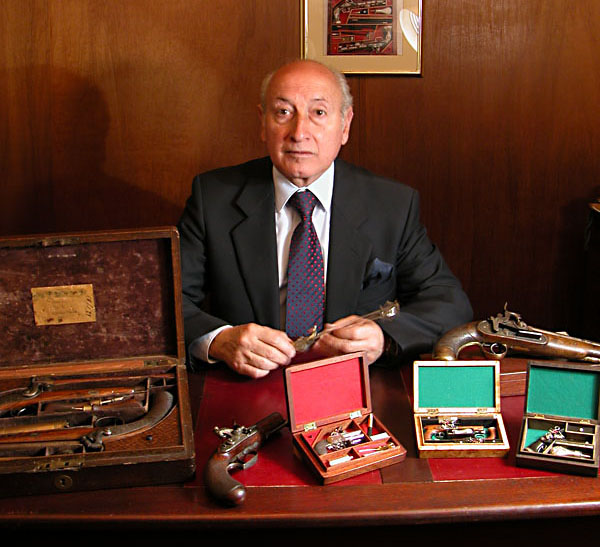
Antonio Rincón, of Columbia, poses with several of his exceptional miniature and full-size antique firearms.
Biography
Ever since he was a child, Antonio Rincón Granados was fascinated with the world of arms. The history, complex mechanisms, and exquisite ornamentation fully captured his attention. After extensive study and practice in the field, Antonio began producing unique miniature copies of famous weapons. His miniatures faithfully reproduce both the detail and spirit of the originals. Antonio’s pieces are the equivalent of a gunsmith’s representation of a firearm. He dispels myths surrounding certain weapons and converts them into works of art worthy of the most prized collections.
This interest, to which Antonio has dedicated over 40 years of his life, was reaffirmed one day when he bought a 19th century Miquelet lock pistol. Antonio found it at an antique shop in Bogotá. The pistol was made by the Spaniard Agustín Bustindui, a master in the production of Damascus cannons.
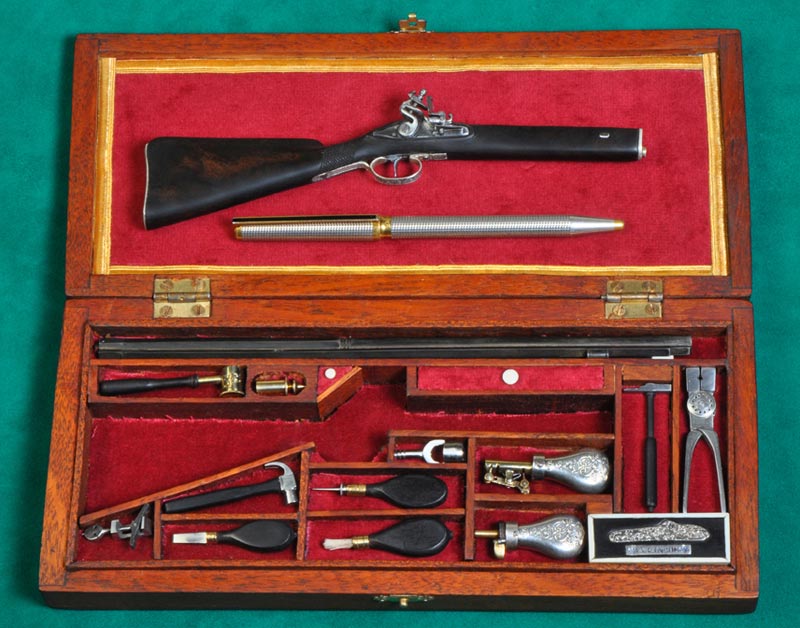
One of Mr. Rincón’s more recent projects was this 1/4 scale single-barreled flintlock hunting shotgun designed by Joseph Manton. It has a gooseneck hammer and a total length of 11-3/4”, including the barrel which measures 8”. Antonio also made an assortment of miniature accessories for the shotgun. A fountain pen provides scale reference.
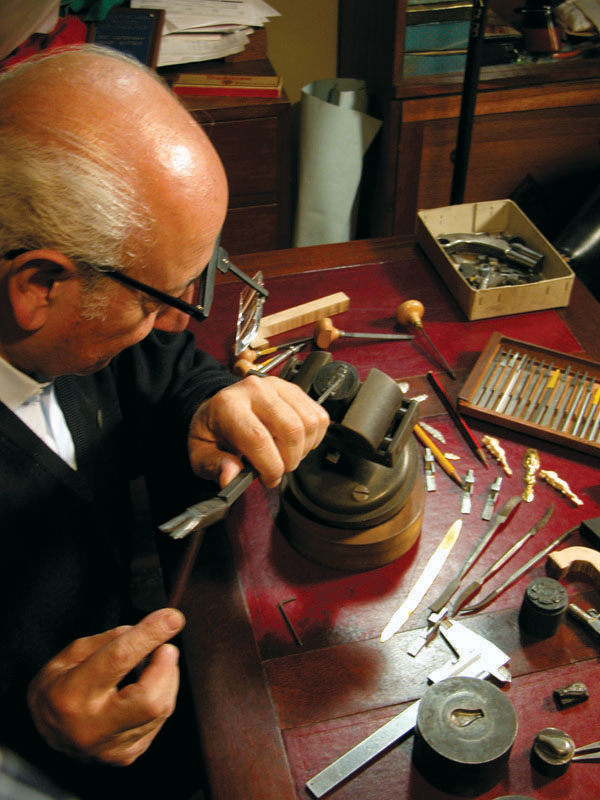
Master miniature gunsmith Antonio Rincón at work on a project.
Now, Antonio Rincón was barely twenty years old when the magic of antique firearms attracted his attention. For several months, he made daily visits to an antique dealer in order to obtain the firearm he desired. It had been reserved for a collector, but Antonio was finally able to persuade the shop owners to let him purchase the antique weapon—which he considered a genuine treasure.
Around 1962, in what was a strange twist of fate, the person for whom that antique gun was originally reserved for would become Antonio’s mentor. The collector was Luís Izquierdo, a member of a small select group of professionals known as the Columbian Association of Arms Collectors. This group also included the pediatrician Alfonso Gutiérrez, who owned a considerable collection and library.
Coincidentally, the weapon that Luís Izquierdo had reserved, and which Antonio had ultimately managed to purchase, was intended for Dr. Gutiérrez. At Dr. Gutiérrez’s side, Antonio discovered the secrets of the hobby and learned about the history and different mechanisms. Above all, he learned how to distinguish the markings that confirm the authenticity of an antique weapon. That skill enabled Antonio to start a collection of his own.
Many years later, Antonio’s collection now includes two pairs of dueling pistols in cases (among other pieces). One of the pairs was from the English maker John Manton, brother of Joseph Manton, who first developed the checkering or cross milling of handles to improve grip. John Manton was equally skilled at this technique.
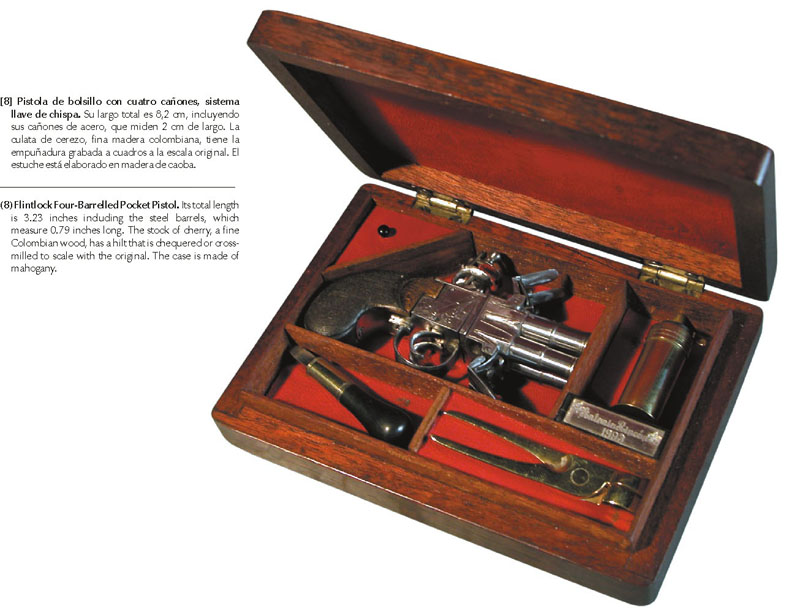
A miniature flintlock four-barreled pocket pistol in its presentation case, all made by Mr. Rincón.
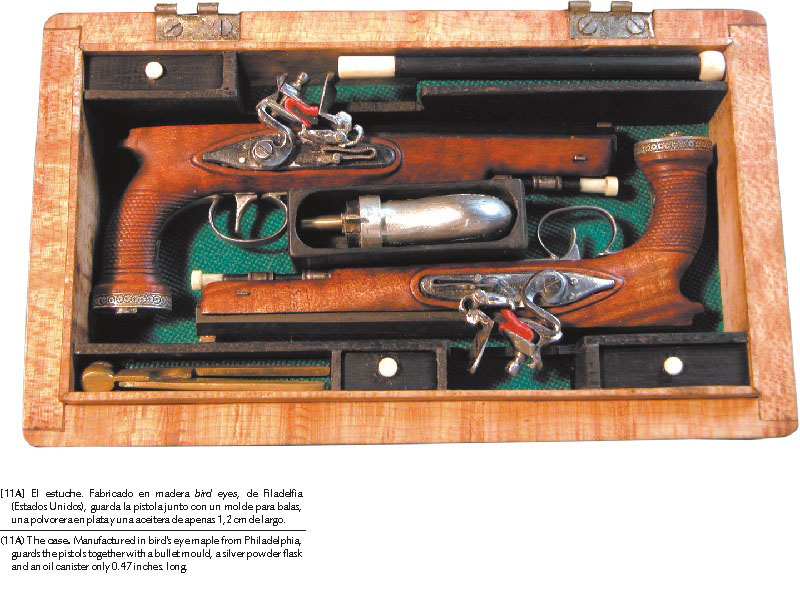
A pair of Manton patent flintlock dueling pistols in a Birdseye maple case.
The other cased pair was made by Nicolás Noël Boutet, who was Napoleon Bonaparte’s gunsmith. Mr. Boutet became a leading figure in the history of this field because of his impressive and highly detailed work. With unequaled mastery, Boutet made luxury arms for the emperor, generals, and marshals—as well as the standard arms issued to the troops. It is said that his work has never been surpassed.
Now, Antonio Rincón also owns, among other beautiful antiques: a flintlock pistol from 1790 made by Henry Nock, a notable 17th century English maker; another English flintlock from 1780 made by the gunsmith Dagless; a French military percussion pistol made by Chatelerot in 1850; and a tower system pistol from 1855 made by John and William Rigby of Ireland.
Books, files, private collections, and auctions have occupied much of Antonio’s time. The Columbian enjoys international fame, and his rigorous research and work as a gunsmith has brought him into contact with many well-known experts.
One of the teachers who influenced Antonio’s career the most was Harold McMmillan. Mr. McMillan was highly skilled in rifle making and repairs. With this distinguished master, Antonio learned how to assemble a variety of complex mechanisms for different firearms.
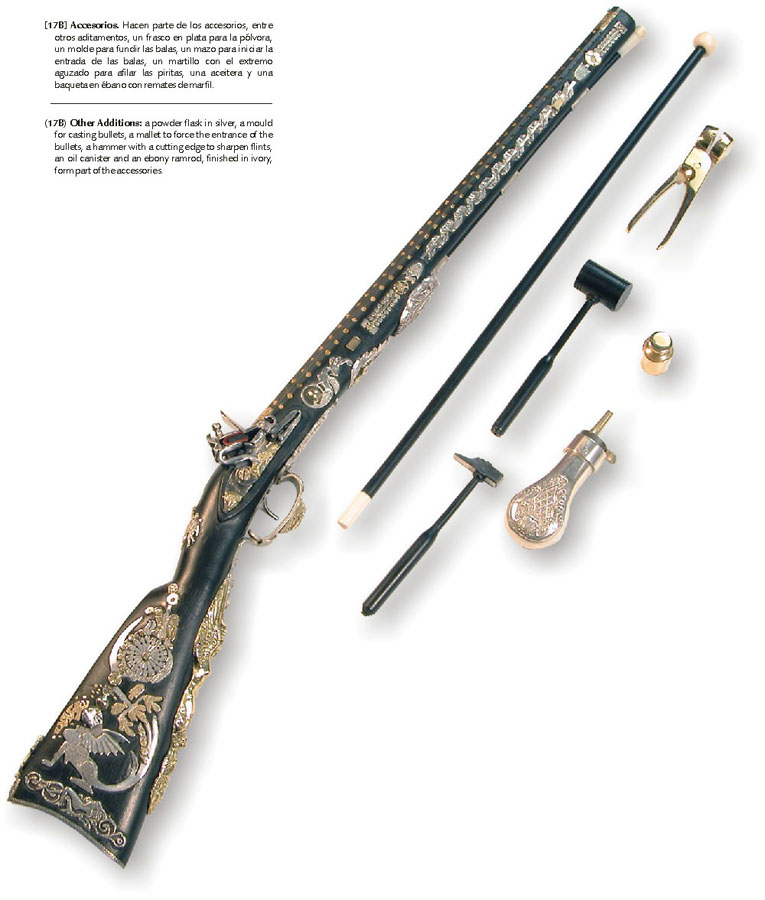
A miniature flintlock carbine of Griffen design, along with some of the accompanying shooting accessories.
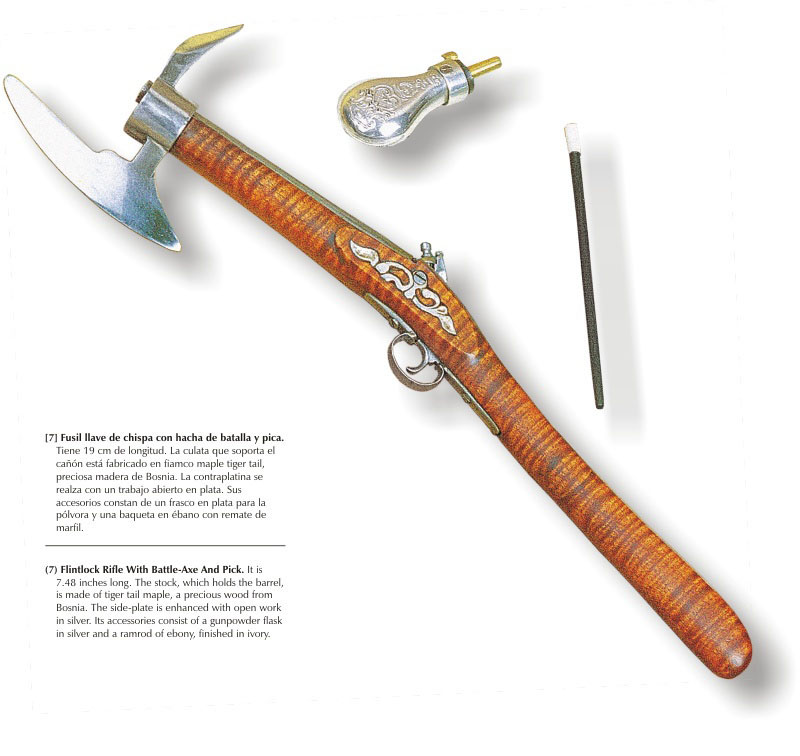
A miniature flintlock rifle with battle-axe and pick.
Expanding his Expertise Through Travel
Additionally, Antonio bolstered his knowledge by visiting exhibitions in countries with some of the best collections in the world. In England, Antonio was able to make detailed observations, one by one, of the pieces in the Wallace Collection, the National Collection of the Tower of London, and the Royal Collection at Windsor Castle. Antonio visited the Royal Armoury in Madrid and the Army Museum in Paris, which is internationally recognized for its comprehensive displays of Napoleonic weapons.
Antonio also visited the Dresden Armoury, where Saxon arms are notably abundant, and the Bavarian National Museum in Munich. In the US, Mr. Rincón was in direct contact with the former curator of antique arms for the Metropolitan Museum of Art in New York City, Stephen V. Grancsay. Mr. Grancsay wrote various commentaries about Antonio’s work, often admiring the high quality.
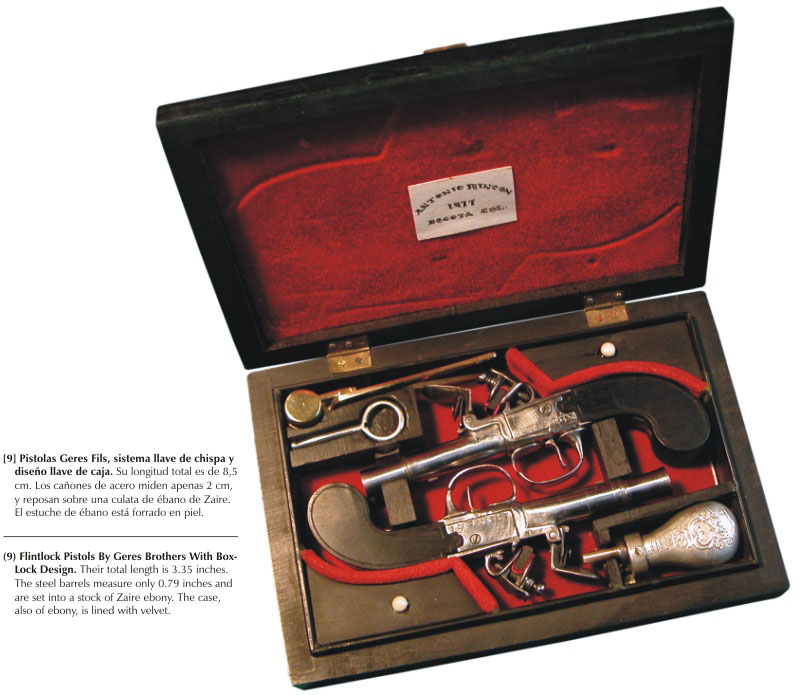
A boxed set of miniature flintlock pistols with boxlock design, originally produced by Geres Brothers. Each pistol is 3.35” long with a steel barrel measuring 0.79”. The handles and velvet lined case are made from Zaire ebony.
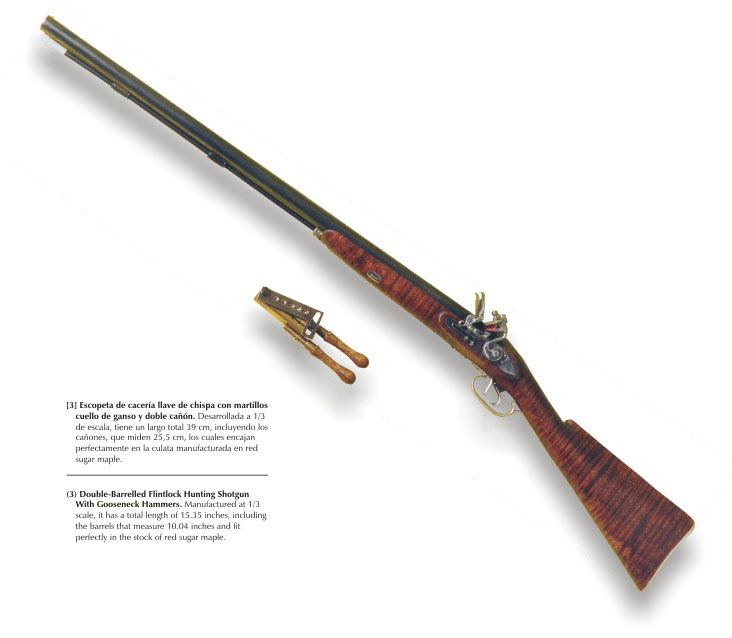
Antonio’s 1/3 scale double-barreled flintlock hunting shotgun with gooseneck hammers. When fully assembled, the total length is 15.35”. The barrels measure 10.04” long.
It was also in the US that Antonio met Stuart W. Pyhrr, who suceeded Mr. Grancsay as the museum curator at the Metropolitan Museum of Art. After inspecting Antonio’s pieces, Mr. Pyhrr exclaimed, “W. Keith Neal would have loved your work!” This compliment was well received, as Mr. Pyhrr was referring to the famous English collector and arms specialist, who owned some of the most fantastic pieces to ever exist.
Later, Mr. Pyhrr invited Antonio to exhibit his work at the Arms and Armor Club of New York. He also spoke highly of Mr. Rincón at a conference, pointing out the many achievements of the South American armourer. These experiences gave Antonio the knowledge necessary to emulate the work of many great craftsmen.
Mr. Rincón replicated the fine craftsmanship of people like Segallas, who was famous for his repeating arms and combinations with knuckle dusters. He also followed the likes of John and William Rigby who stood out for their percussion systems and knuckle duster combinations.
Additionally, Antonio learned about the work of J. Purdey, whose flintlock and percussion systems achieved world renown. Furthermore, Mr. Rincón has reproduced the work of such celebrities as Bustindui, Boutet, Manton, and Enfield, among other great gunsmiths.
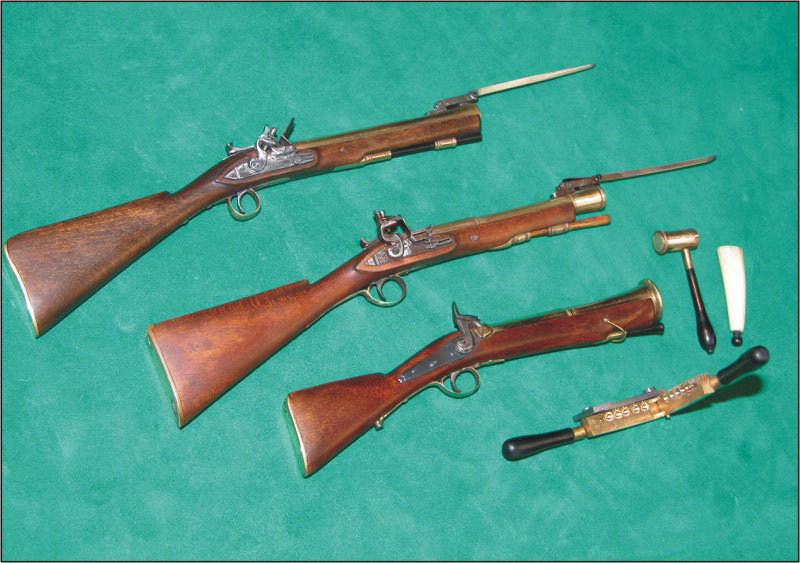
A set of miniature blunderbusses made by Antonio. Two are flintlock style with bayonets, and the other is a percussion blunderbuss, along with accessories.
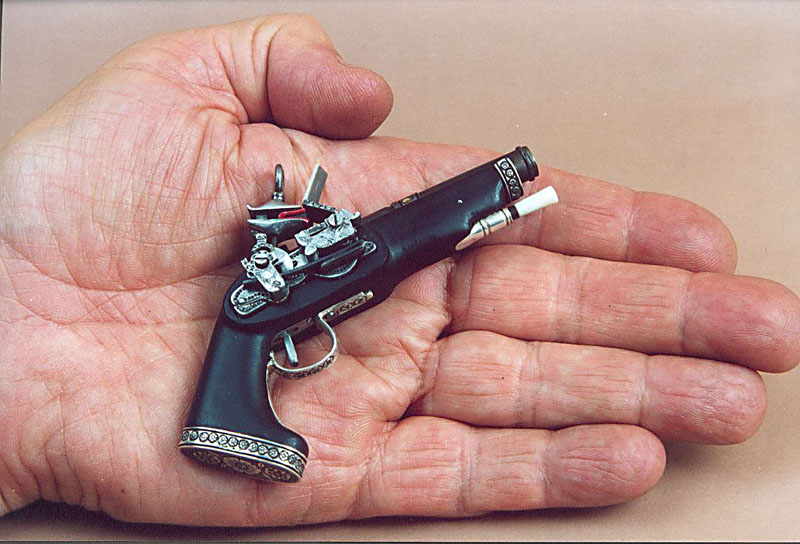
Antonio holds his miniature Spanish Miquelet pistol.
Earning Critical Acclaim
Now, there are no doubts about Antonio Rincón’s versatility. His artistic sense and dexterity are truly impressive. Antonio has a watchmaker’s skill for handling screws with the diameter of a hair, and the precision of a jeweler, making minute engraved inlays in precious metals. He also has the unique ability to reduce the intricate mechanisms of different firearms to 1/3 or 1/4 scale. Doing so requires scaling down virtually every task involved in the manufacture of his miniatures.
While production of the originals involved many experts, such as specialists for barrels, mechanisms, butts, and engraving, Antonio carries out each one of these activities himself. The result is a precious piece of work, in which functionality and aesthetics blend harmoniously.
The refinement and artistic perfection in each one of Mr. Rincón’s pieces has given him a prominent international position in the field. His work has been featured in exhibitions in Nuremburg, Tokyo, Houston, Philadelphia, and several other parts of the US. Antonio is also the proud recipient of several notable prizes. Among them is the “Outstanding Related Arms Exhibit,” which was given to Antonio in 1999 by the National Rifle Association (NRA) of America.
Mr. Rincón also won the “Best Contemporary Made Antique,” which was conferred by the Miniature Arms Society in Houston, Texas. In 2003, Antonio received the award for “Best Miniature Arms Exhibited,” at the annual meetings for the NRA.
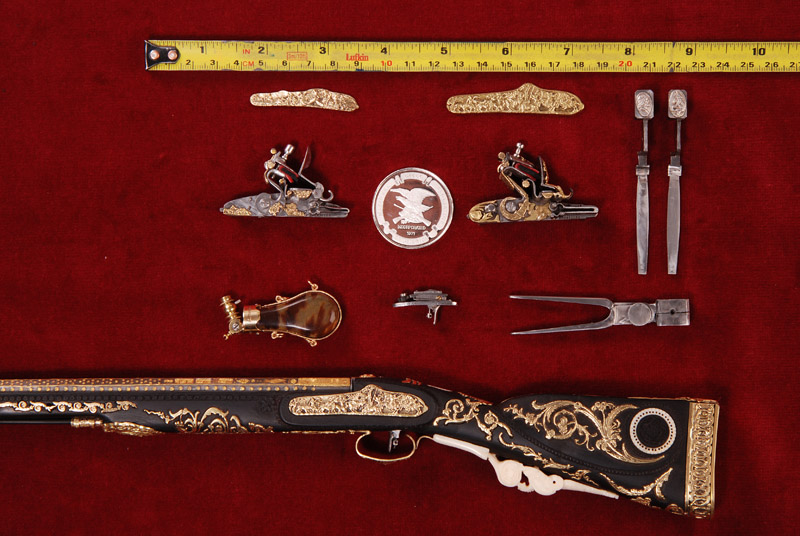
Antonio crafted this octagonal hooked-breech barrel, poly-groove rifled carbine. The miniature carbine is decorated with an elaborate damascened panel of engraved gold work, depicting panoplies-of-arms, crossed cannons, flags, classical motifs of Grecian-style urns, and masonic symbols of flaming orbs.
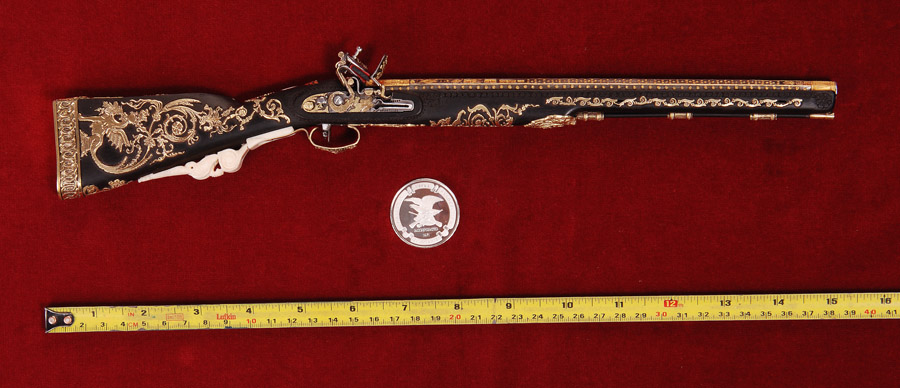
The carbine is approximately .18 caliber at the muzzle. It also features 398 five-pointed stars, each only 1/32″ tall. The decorated trigger guard is solid gold. Ebony from Zaire was used on the stock, and carved ivory was also used in the designs. The decoration includes six cartouches of Nicolás Boutet, Jean Le Clerc, and BC (unknown).
Additionally, Antonio’s work has garnered praise in several specialist magazines. One such article was written by Ralph Koebbeman, a collector, curator, and correspondent for the Miniature Arms Journal. Mr. Koebbeman wrote, “In the book, Miniature Arms by Merrill Lindsay, published in 1970, I have seen a photograph of the original weapon which Napoleon Bonaparte had made by Boutet for his brother Joseph, King of Spain, by the side of which appears the miniature reproduction made by the North American jeweler Billy Johnson. Now, I don’t want to take any honors away from Billy, but we do have a relative newcomer maker, nearby, who is taking aim at Billy’s crown.”
Mr. Koebbeman continued, “That person is Antonio Rincón, a South American who lives in Bogotá, Colombia. I have no way of knowing whether Antonio’s workmanship is as good, better or inferior to Billy’s, but I do know that Antonio beats him on quantity. As far as I know, Billy only made one Boutet pistol, while Antonio has made at least four pistols and a carbine. Two of his pistols have 35 gold stars on the barrel, and the carbine has 176. Billy’s has 150 stars.”
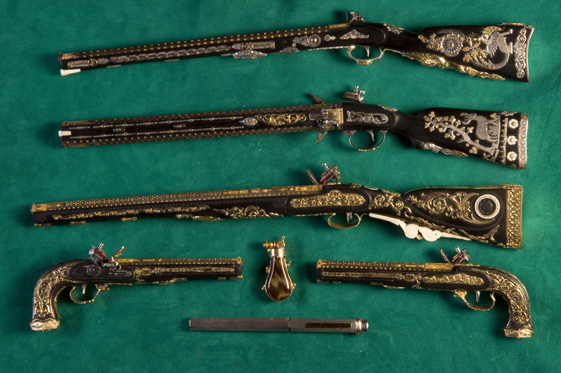
A collection of Antonio’s miniature Boutet carbines and dueling pistols, all extravagantly decorated.
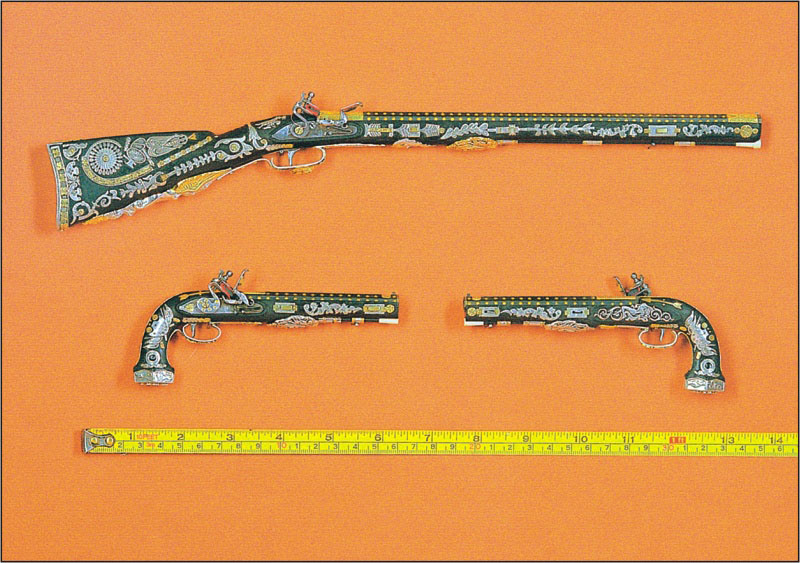
A miniature rifle and pair of matching pistols.
In 1994, Antonio’s miniature of a flintlock pistol made by Boutet for Napolean appeared in the magazine, Guns Review of London. Victor Francis, who was the English correspondent for the American magazine, Shooting the Breeze, wrote, “We have not seen anything like this in England.”
These comments have pushed Antonio to continue demanding more of himself. His perfectionism knows no limits. No detail escapes him. He makes his own tools and uses only the finest quality materials. Gold and silver adorn barrels and plates.
Exotic woods like ebony, walnut, cherry, bird’s eye, red sugar, and different varieties of maple have all been used for Antonio’s miniatures. Barrels and plates for the miniature arms are manufactured from the best quality Swedish steel. When Antonio makes a miniature, every single line in the reproduction stays true to the original. Antonio has been able to assemble different mechanisms with the greatest precision. He even studied Leonardo da Vinci’s Codex Atlanticus in order to understand how the famed inventor’s creations worked.
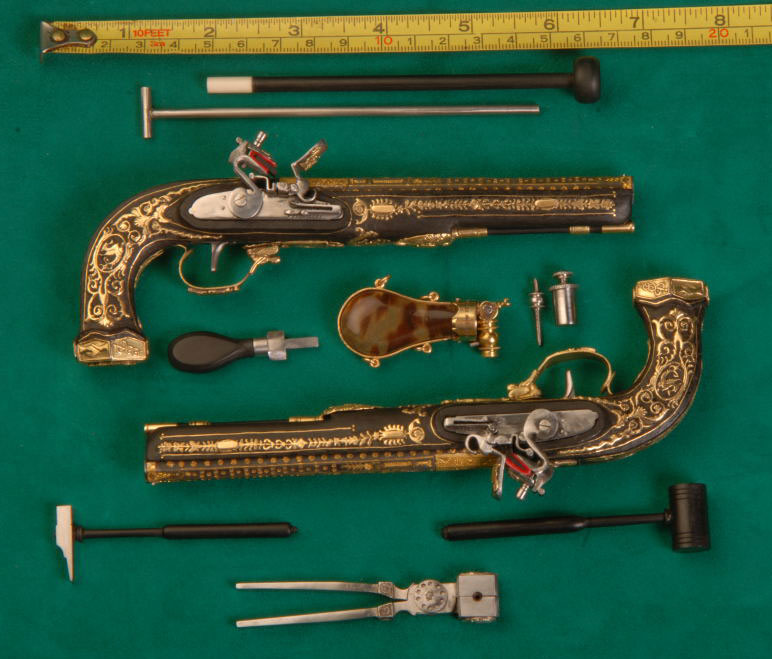
An ornate set of 1/3 scale Boutet dueling pistols. They feature two gold worked panel sections on the muzzles and over the breeches, which depict floral swags, geometric patterns, and classical symbols.
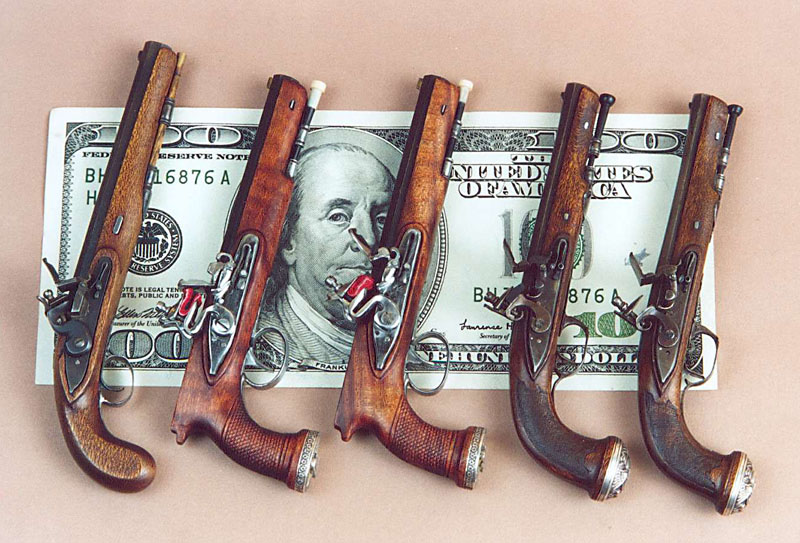
This photo shows miniature Wogdon, Manton, and Boutet flintlock dueling pistols on top of a US $100 bill. (The length of the banknote is 6.13”.)
Miniatures Worthy of the Finest Collections
When we last spoke to Mr. Rincón, many of his miniature creations belonged to some impressive collections. One such collector is Joseph A. Murphy, Ph.D, a decorated Vietnam veteran, banker, collector of impressionist art, and patron of the Morning Star Foundation.
Mr. Murphy is a keen collector of firearms, especially the Army pistols, Kentucky rifles, and other handguns from the Colt company. Mr. Murphy’s collection, which includes some of Antonio’s work, has been featured in the Miniature World museum in St. Louis, MO, alongside some of the most outstanding pieces in the field.
It’s worth noting that important private collectors, like Kennith Whichard of North Carolina and Brad Maxfield of Wisconsin, have been on Antonio’s waiting list for years. This is yet another demonstration of the highly prized nature of Mr. Rincón’s handmade pieces.
Antonio Rincón does not produce his miniatures in a series. Fortunately, he’s been able to make a living working as a representative for various tailors and industrial machinery companies, which enabled him to dedicate much of his time to the craft of making miniatures.
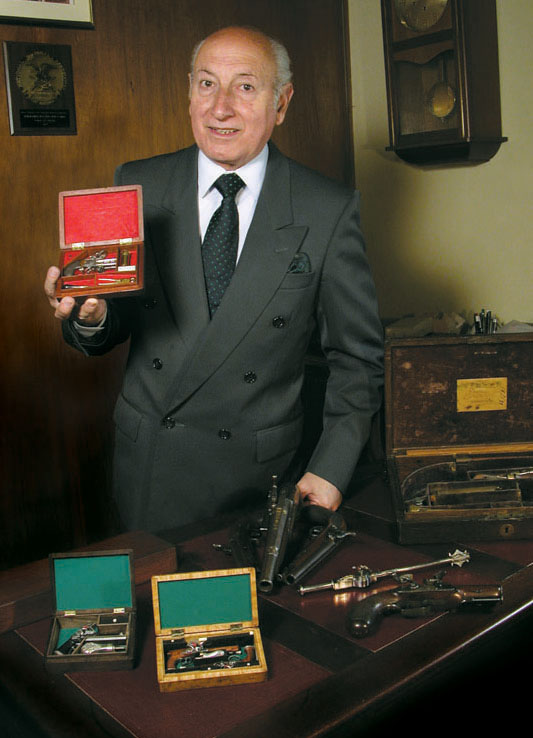
Antonio Rincón displays a portion of his collection. Note that Mr. Rincón has both full-size and miniature antique firearms.
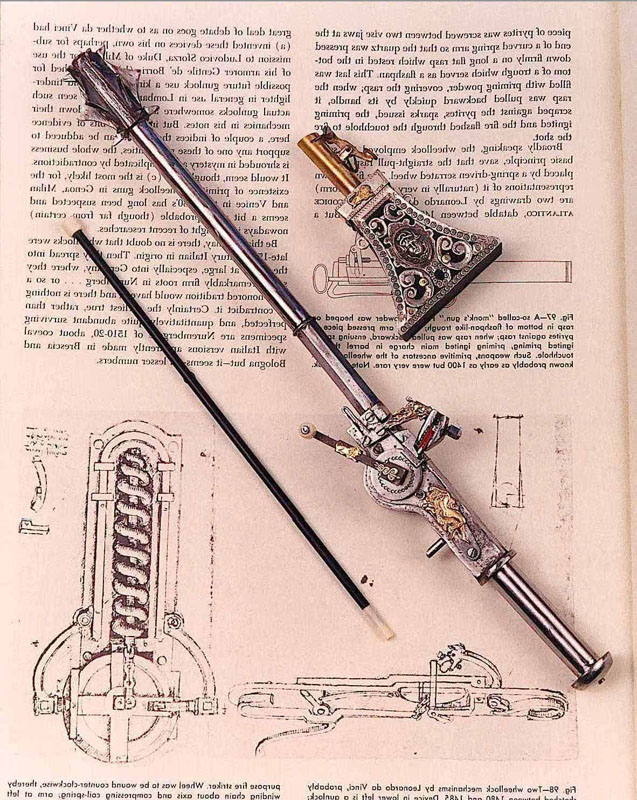
Antonio’s miniature wheel lock pistol combined with a medieval mace, along with accessories. The piece is displayed on a historical document that describes the original.
This singular passion has brought Antonio the distinction of being recognized as an authority on the subject, and is reflected in his perfect replicas. Mr. Rincón’s miniatures illustrate the history of arms to connoisseurs, amateurs, and enthusiasts alike.
The wonderful miniature work of Antonio Rincón takes viewers on a historical journey. It begins with iron weapons, passes through medieval times, and works all the way to nineteenth century firearms.
Publishing His Book, Great Arms in Miniature
Now, throughout his illustrious career Mr. Rincón has acquired a vast depth of knowledge on the topic of antique firearms. Not only has he replicated many weapons, but Antonio has also recorded some of his historical research in the field. In 2005, Mr. Rincón published his own book, Great Arms in Miniature, which covers the curious forms of early cutting weapons, the complex structures of catapults and trebuchets, the use of cannons, and the significance of the development of small arms.
Mr. Rincón illustrated this theme with his extraordinary miniature creations. Among other things, the book allows readers to appreciate: the serpentine, which was the first attempt to mechanize firearms; the complicated mechanism of the wheel lock; the simplicity of the flintlock; and the breakthrough represented by the percussion system.
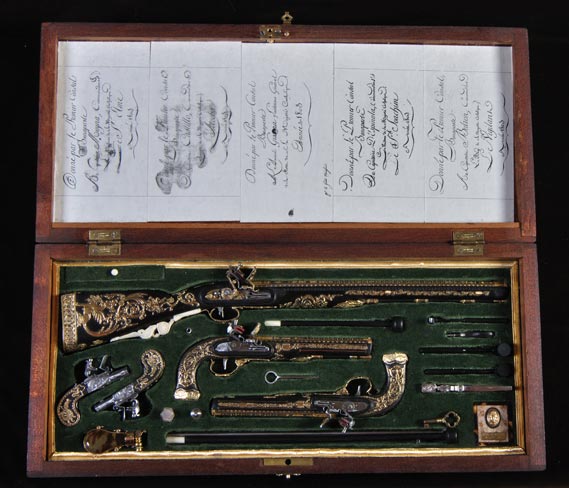
“LE GRAND NECESSAIRE D’ ARMES.” The magnificently cased five-piece garniture of gold mounted arms by the premier arms maker of early 19th century France, Nicolás Noël Boutet of Versailles. It is comprised of one carbine, two pairs of pistolets, and an assemblage of tools and accoutrements. The set also bears five extraordinary paper labels noting presentations of other Boutet arms by Premier Consul Bonaparte in 1803.
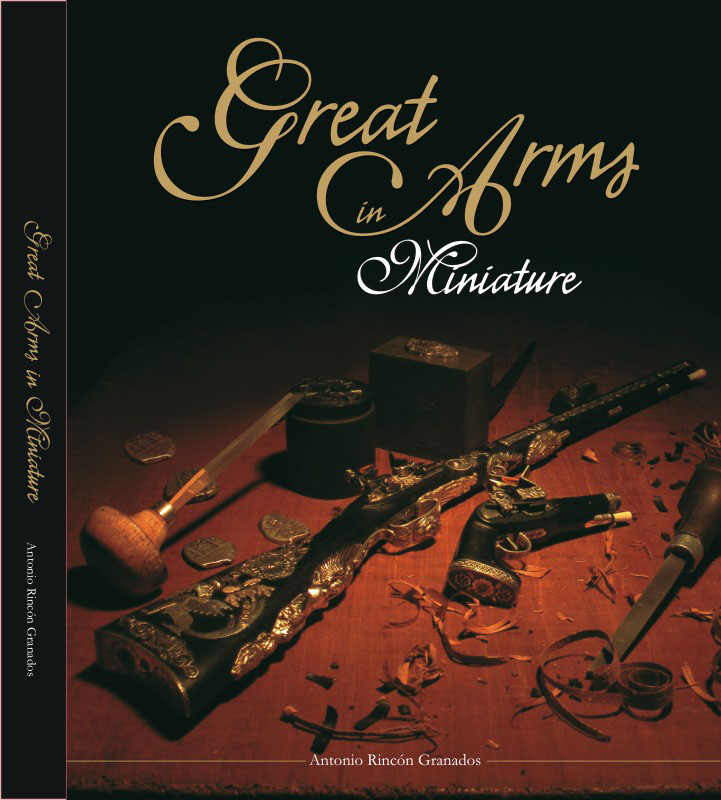
The cover of Antonio Rincón’s book, Great Arms in Miniature. The book was edited and released in 2005.
The work of Antonio Rincón is very unique, not least because there is no other collection of scale model arms with the characteristics that his display. Each one of the parts involved in the manufacture of his miniature weapons was made by hand. These are working models with the technical specifications of their respective periods. This allows observers to better understand a firearm’s place in time.
Antonio’s miniatures are different from those produced in series in a factory. His is the work of a true craftsman, and he takes us on a journey through history.
Read an article about Antonio’s book from the Miniature Arms Newsletter.
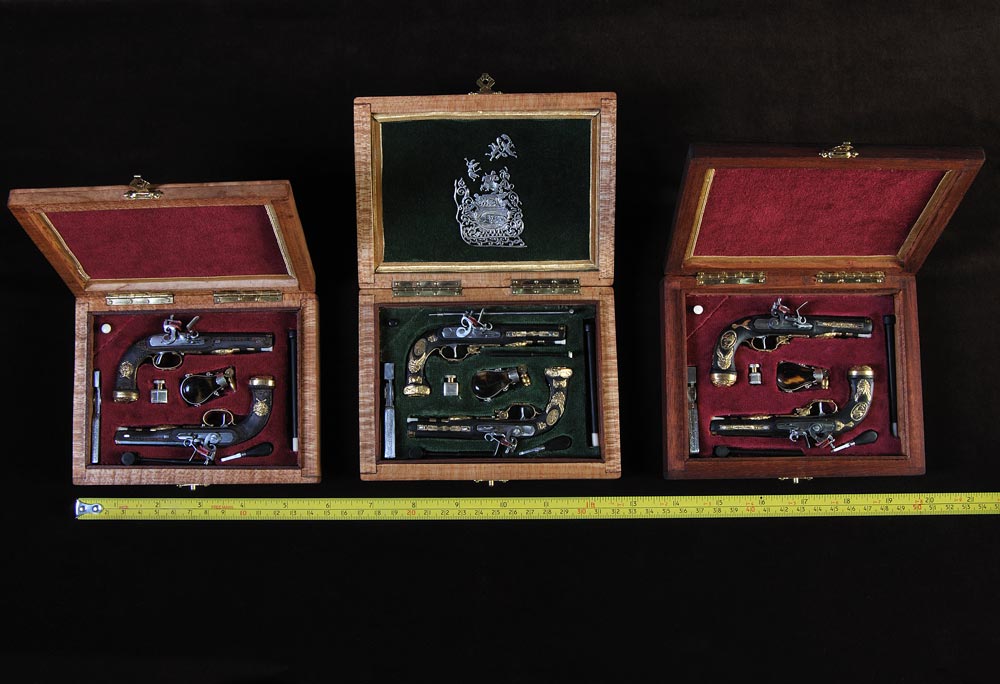
Three sets of 1/4 scale regulation pistols for various officers. Mr. Rincón said of these sets, “Model Vendémiaire AN-12—The regulation of Vendémiaire AN-12 (1803) established uniformity within the General Staff of the Consulate Empire. A type of regulation pistol was created for generals, admirals, and general’s staff officers, and a basic model was established. This 18 mm caliber pistol adhered to a specific aesthetic, and carried on the butt-plate a symbol in silver corresponding to the service.”
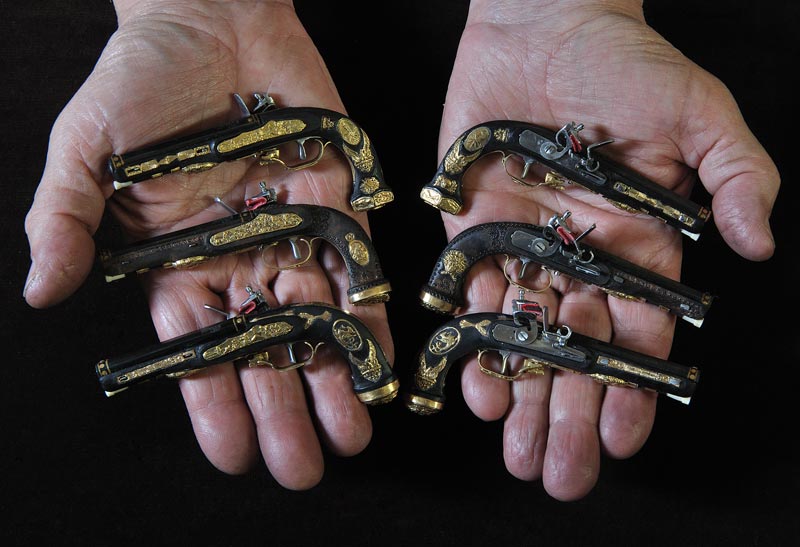
Antonio noted of these pistols, “The symbol for the Army (infantry-cavalry) was the head of Medusa or of Jupiter, that of the Navy was the head of Neptune, and the butt plate of the pistol for General staff had its own design: a Roman sword crossed by oak leaves and two crossed palms. The 18 mm barrel is grooved, decorated with Damascene work, and is fixed to the butt or mount by means of a screw at the end and two bolts at the base of the barrel.”
The Jewel of The Imperial Crown in Miniature
In late 2009, Antonio Rincón released another book, The Jewel of The Imperial Crown in Miniature. The cover features a photo of the LeGrand Arms set, with carbine, pistols, and accessories. Yet again, Mr. Rincón demonstrated both his master craftsmanship with the miniatures themselves, as well as his expert knowledge of the surrounding history.
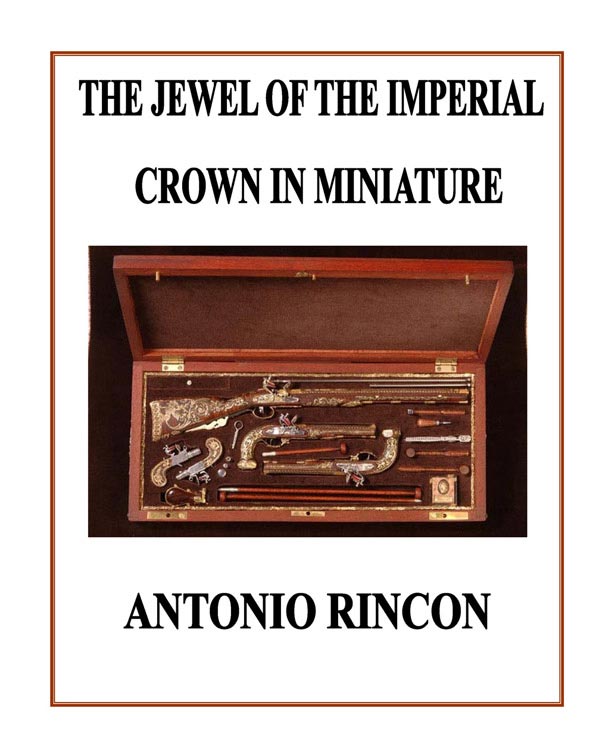
The cover of Antonio’s book, The Jewel of The Imperial Crown in Miniature.
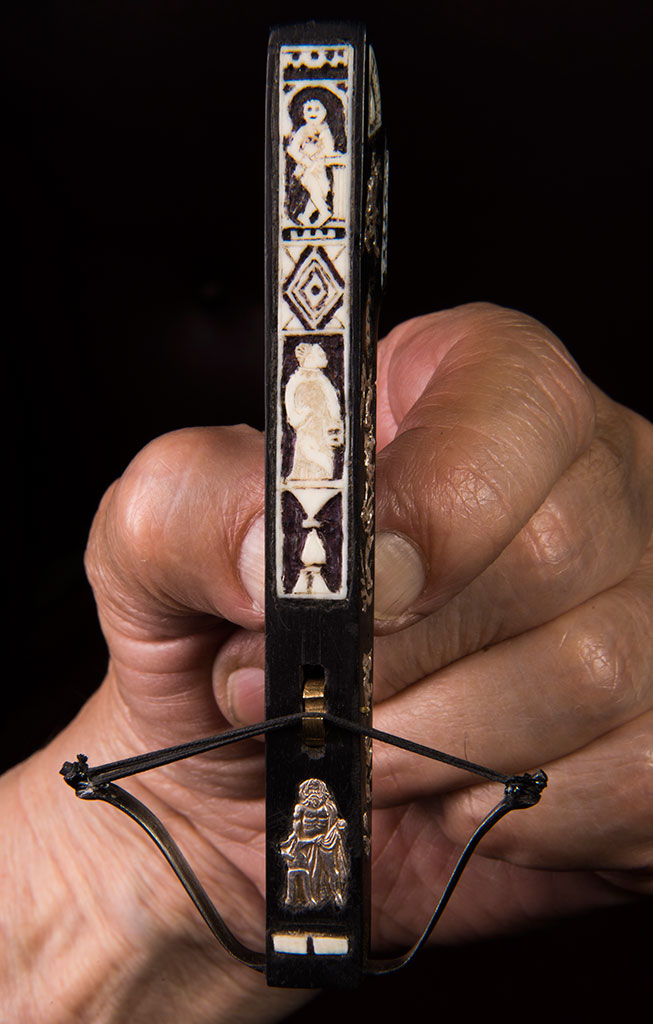
This miniature arbalest (a type of crossbow) was included in Mr. Rincón’s fifth book, Miniature Antique Firearms, Punishment Devices and Curiosa.
Antonio also submitted a timeline of significant dates for his career, outlining his major works and achievements.
Additionally, view more photos of Antonio Rincón’s masterful miniature firearms.