
A Passion for Building Detailed Wooden Models Since 1995

Sunia Reznik has crafted a wide variety of fine wooden models since the mid-1990’s. (All photos courtesy of Mike Reznik.)
Introduction
Sunia Reznik was born in Romania in 1932. In 1940, the area of Romania where he lived was occupied by Russia, and later became Moldova (one of the 15 republics of the former USSR). From the time he was a child, Sunia was always interested in building radios, speakers, amplifiers, and, of course, woodworking.
Sunia spent his career as an electrician, but taught himself carpentry and mechanics. He enjoys working on projects in both wood and metal, and is also an accomplished musician, although he has never taken a music lesson. Sunia came to the United States in 1975, and in 1994 he retired from the Philadelphia Water Department. In retirement, Mr. Reznik began working on his vast collection of wooden vehicles.
The subjects for Sunia’s models include everything from trains to heavy equipment to vintage coaches. His son, Mike Reznik, provided some details on how Sunia built one of his more complicated wooden projects—a Harley-Davidson motorcycle. Additionally, all photos are courtesy of Mike Reznik.
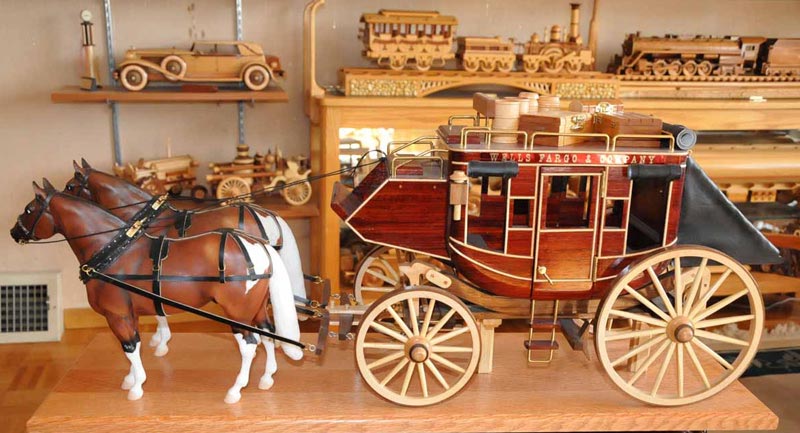
This Wells Fargo stagecoach project illustrates more than just woodworking mastery. While the woodworking itself is superb, Sunia also produced all of the leather harness details, along with metal parts like railings and door handles. The coach was made from padauk and hard maple. Some of Sunia’s other wooden models can be seen in the background.
Harley-Davidson Models
To start, Sunia began his Harley project after receiving a Franklin Mint model for his birthday. The end result is a wooden Harley Heritage Softail, which was built at 1/3 scale of the real motorcycle. It took Sunia approximately one year to complete the Harley, working pretty much 8-hour days.
The wooden motorcycle is 38” long, 23″ tall, and 10″ wide. Sunia used black walnut and hard maple for the wood. It’s a working model in the sense that it has a moving hydraulic suspension, ball bearing wheels with angled spokes, and more.
The model has working headlights that are activated by a switch on the handlebars, working turn signals (also activated by a handlebar-mounted switch), and brake lights that are activated by the hand break lever (or by depressing the foot brake pedal).
The throttle turns and operates just like a real Harley. When it’s turned over, the model produces a Harley engine sound via speaker and electronic module built into the saddle bags. Sunia also created a second Harley model in a slightly different scale, which also features a sidecar.
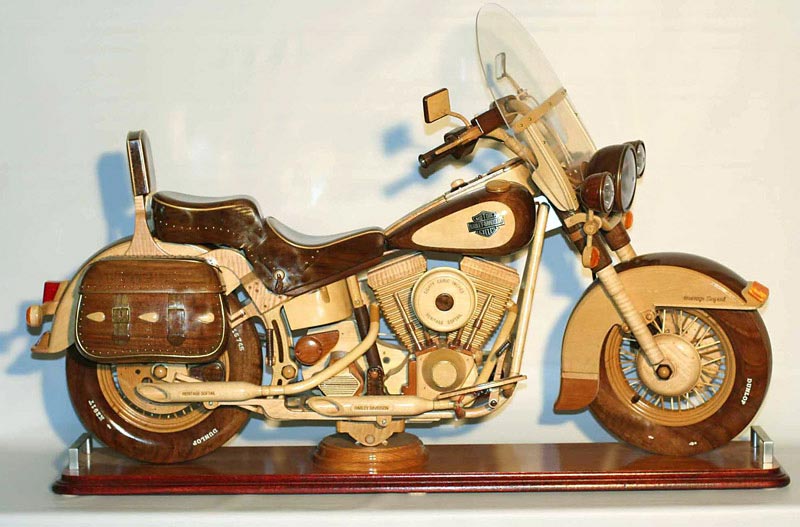
Sunia’s scale wooden Harley-Davidson Softail. This motorcycle is from the era of the 80 cubic inch motor. Sunia’s model is complete down to the carved fringe in the concho on the saddle, and the leather saddlebags.
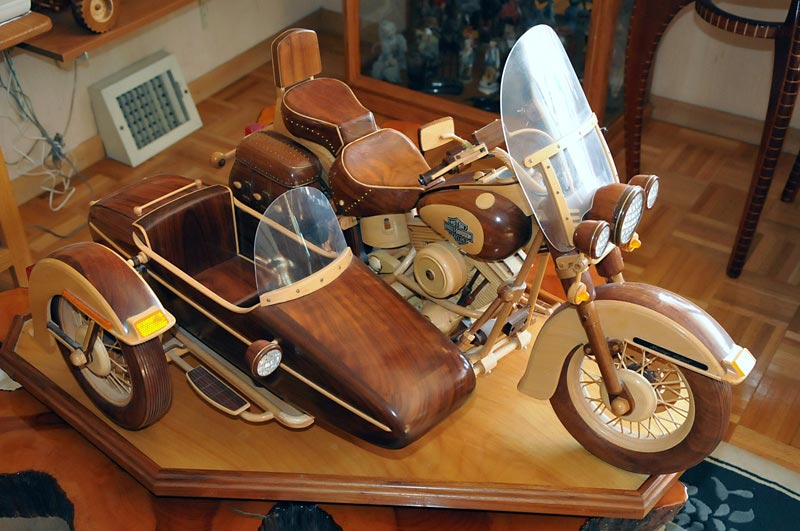
Sunia’s sidecar version captures another iconic Harley-Davidson shape, while adding an additional challenge to the build.
Fire Engine Memorial Project
After the 9/11 terrorist attacks, Sunia decided to make a fire engine to commemorate the fallen servicemen. For this project he used padauk (or padouk), white maple, cherry, and walnut. The model is 28″ long, and 7-1/2“ wide. The ladder extends to 35″. This project took Sunia approximately two months to complete.
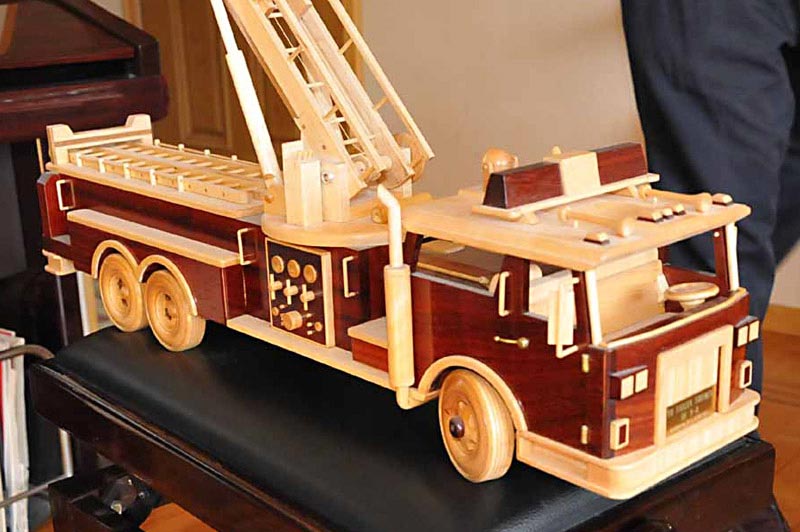
This wooden fire engine was dedicated to the firemen who lost their lives as a result of the 9/11 attacks.
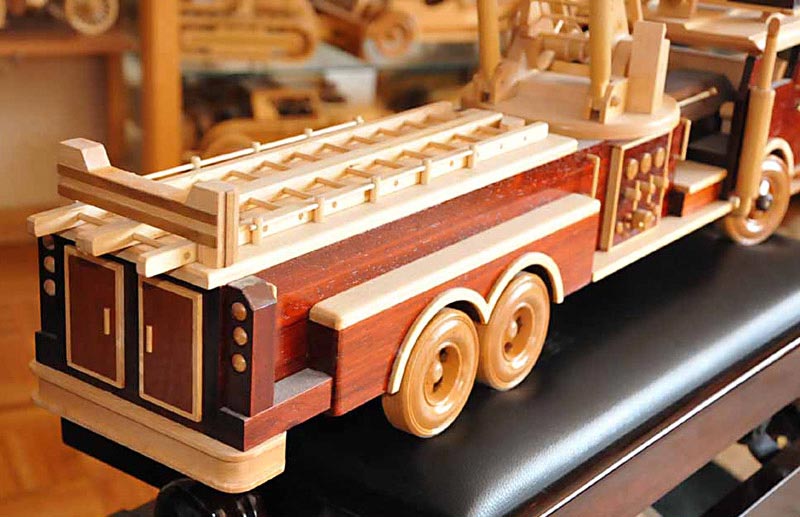
The engine was made from four different kinds of woods, featuring many contrasting colors and grains.
Other Projects
Sunia’s wooden road grader was made from walnut and maple. It measures 27” long, 12” wide, and 11” tall. The road grader took about four months to finish. As with all of his models, the hydraulics, operator’s controls, and engine features were crafted with careful attention to minute details. Sunia has also built many other projects over the course of more than 15 years, some of which can be seen here.
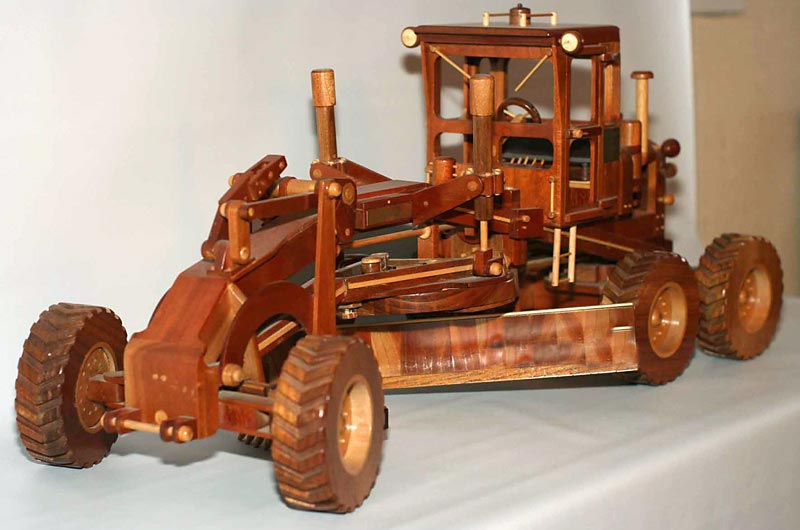
This 27” long road grader was made from walnut and maple.
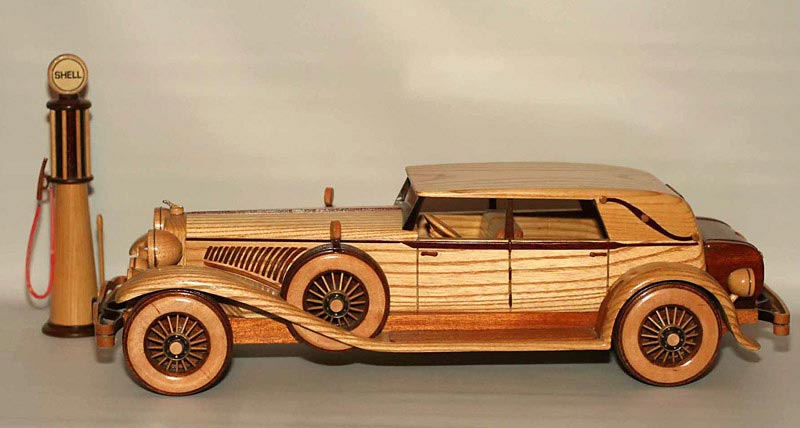
A sleek Duesenberg pulls up to a vintage gravity-fed gasoline pump, all carved from wood.
Mr. Reznik’s Workshop
For his projects, Sunia uses a milling machine, metal cutting lathe, table saw, router, drill press, sander, oscillating sander, planer, and a variety of other wood and metal hand tools. A few of his models were shown by invitation at the Fort Washington, Pennsylvania Expo woodworkers show, the Penn State Industries Woodworkers Supply showroom, and the Woodworkers Haven show in PA. Sunia’s work was also featured in an article published in WOOD magazine (Issue #124, June of 2000, page 104).
Mike Reznik noted that it can be slightly overwhelming to walk into Sunia’s house and see the volume of his work. It took days to properly photograph what Sunia had created since retirement in 1994. Mr. Reznik is a very humble craftsman, but Mike and the rest of his family are very proud of his work. They submitted these photos and his story with the hope that Sunia’s creations will inspire others to take on their dream work.
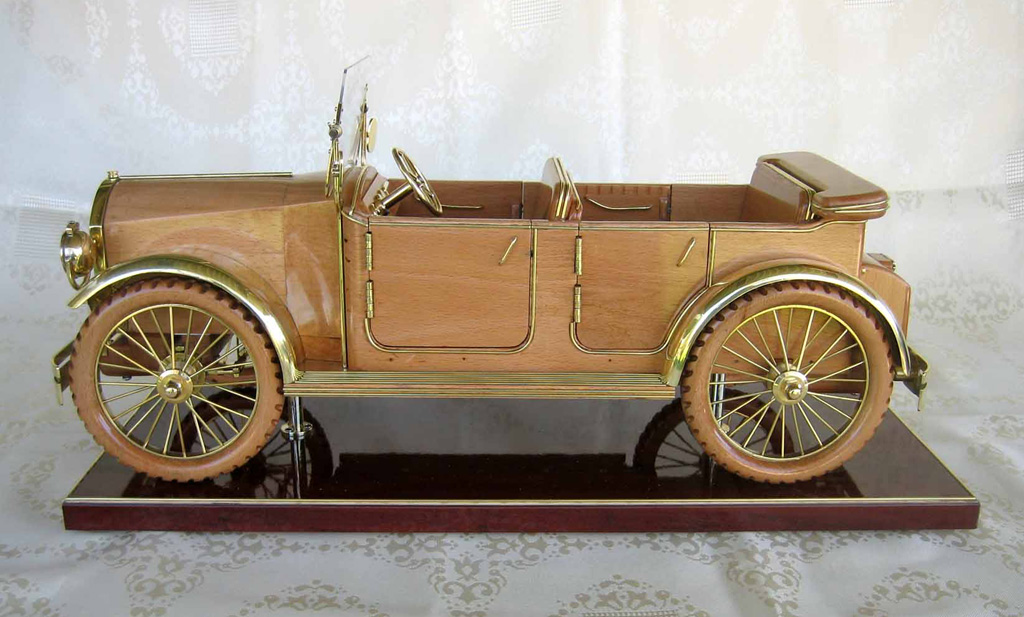
This model 1924 Bentley combines both wood and metal. Made from European Beech and brass, the car is about 19” long, and 8” wide.
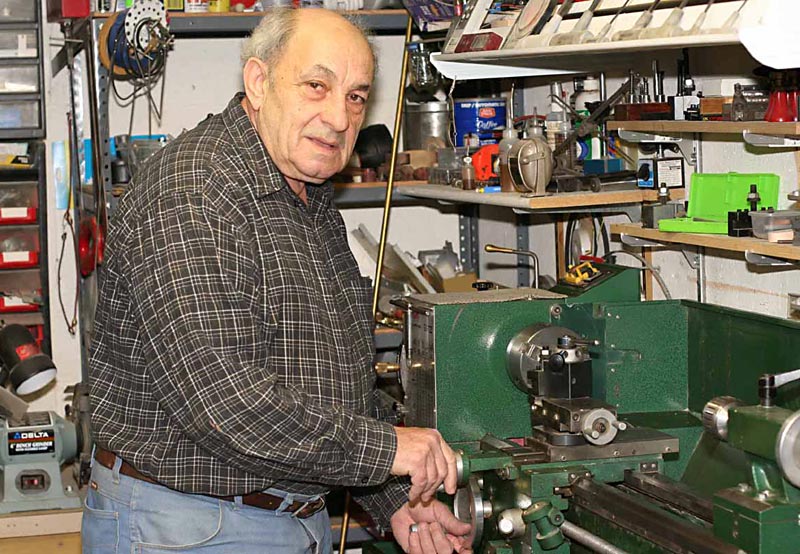
Sunia Reznik at work on the lathe in his home shop.
Watch a YouTube video of Mr. Reznik’s scale wooden Harley-Davidson motorcycle with sidecar. The shifter, lights, and horn all work!
View more photos of Sunia’s fine collection of wooden models, along with some of his metalworking projects.