The Internet Craftsmanship Museum Presents:

Other Engine Builders

In the early days of model airplane engines, a number of small companies sprang up to fill the demand for this new and growing hobby. Below are represented some of the other manufacturers that produced both production and prototype engines.

(Double click on any photo to view a larger image.)

Donated by Bob Stein, Lakeside, CA

Atwood & Adams Super Champion .62 cu in

Listed as a Model J, Class C engine, this 2-cycle, 2-port engine featured rotary valves. It has a bore of .94" and stroke of .900 to displace .6245 cubic inches. It is rated at .6 horsepower at 12,500 RPM. It has a compression ratio of 8:1 and weighs 12 oz without coil, condensor or fuel tank. It runs a Champion VR-2 spark plug, 2 of which were included with the donation as were two props.  In 1946, the Atwood & Adams Mfg. Co. was located at 732 N. Lake Street in Burbank, CA.

CLICK HERE to read the 4-page instruction sheet for the Atwood Super Champion in PDF format. (1.8 MB)

William E. Atwood (1910-1978) was one of the most prolific and successful engine designers in the 1930's to the 60's. He designed his first engine, a water cooled 30 cc design in 1932. The next year he designed the successful "Baby Cyclone" of which over 20,000 were sold. His Torpedo engine design was sold to and built by John Brodbeck of K&B engines. The Champion and Super Champion were made from 1946 to 1948. In 1948 he designed the Triumph engine line and the next year with Bob Holland produced the Wasp .49 which later became the Atwood .49. In 1960, he joined Cox Manufacturing where he designed the successful Tee Dee and Conquest engines and worked as a consultant up until his retirement in 1975. He was also a noted model flying competitor and is a member of the AMA Hall of Fame.

Photo one shows the Teflon coated version of this engine.

The last photo shows one of the wax bodies used in the lost wax molding process as well as the finished engine.


2012.7.2 and 2012.7.1      

Cooney .61 (Rear Port, Cast-in Carburetor)

Ralph Cooney designed a number of experimental engines using the investment casting method. Being able to make molds using EDM, he cast the components using the lost wax method. This particular design was cast in aluminum and featured a rear exhaust port and a built-in carburetor. His intention was to make a production cast aluminum engine that needed no steel cylinder sleeve by using what was a relatively new process in the 1980's to chrome plate aluminum. If the cylinder bore were chromed after boring to size a steel sleeve wouldn't be needed. Unfortunately, the only companies at the time successfully able to chrome plate aluminum were the large aerospace companies, so Ralph tried a Teflon coating to protect the aluminum. The dark grey engine on the left is Teflon coated, which resulted in the darker color. He ended up having to include a sleeve in the case anyway, and only 5 or 6 of these were ever produced. It was powerful and competitive with other engines at the time but never saw mass production.

   2012.7.3

  2012.7.5

The first photo shows the two mold halves with the cores in place. In the second photo the cores are removed.        

Cooney .61 (Rear Port)

Another rear exhaust port design, this one did not include a cast-in carburetor body. The rear exhaust port was angled upward and had a rotary restrictor plate.

Shown also is a set of molds produced to make a wax copy of the engine crancase from which a ceramic mold would be made. When the molten metal is poured into the ceramic mold surrounding the wax, it melts and flows out and is replaced by the metal. The mold is then broken open to remove the metal part. This is called the "lost wax" process of molding. For each metal piece, a wax piece is made from the aluminum mold and that wax iis then consumed in the final metal casting process. It is slow but yields high quality results for testing a design. It is not intended to make production quantities of parts, and this is the only existing version of this particular engine.

  2012.7.4

Cooney .61 (Side Port)

This engine design of Ralph Cooney's incorporates a side exhaust port  with a T-shaped bypass and a two-piece crankcase. It was made using the method described above and it is also the only one to be produced.

  2012.7.6 2012.7.7

The last photo shows several wax masters. Part of the fins are broken off in the first one. The wax feels like plastic and is hard and easily broken.

Engines and molds donated by Ralph Cooney.

Cooney .61 Mold and Wax Masters

The molds are shown here for the above side port engine. The first photo shows the mold halves with the cores in place in the right half. The second photo shows the molds with the cores removed. The cores must be made in pieces so they can be extracted at various angles from the wax master once it cools. They are what leave the hollow cavities inside the engine. Fits must be near perfect, meaning a whole lot of expert machining work is done before the first part can ever be cast.

Ralph Cooney also produced molds for an engine that was sold by Kraft Systems.

Donated by Joe Martin

DEW .51

This glow plug engine was built by the DEW Corporation in Kimball, NE, in the early 1960's. DEW stood for the initials of the owner, Dale E. Wood. According to Tim Dannels at the Model Engine Collector's Journal, the DEW engine was "not a totally successful venture although they were decent engines. By 1965 the engine was bought out by a Ray Kesteloot in California and re-marketed under the Kustom name. On these the word "DEW" was ground off of the bypass and replaced with a sticker.  There was also a .61 R/C version as well as a .51 Stunt."

This example came in the original box with instruction sheet and a receipt from 1962 showing the engine going to "D.C. Spring" in N. Hollywood, CA at no charge. The price on the box says "25.95." The engine is frozen up from lack of use, but it is complete.

Contributed by Joshua Vest, Vista, CA

Fitzpatrick 61 ABC

This 2-stroke, glow ignition, Schnuerle scavenged, ball bear engine was designed by the Fitzpatrick Brothers, Charlie and Mike of Chula Vista, CA. This engine was always noted as being one of the finest looking around. The first 100 or so castings for the original .60  were made in North Hollywood, but the bad business climate in California eventually drove production of the .61 to a company in Canada in the 1990's. The engine features high quality investment castings, CNC machined parts and real chrome (not nickel) plated finishes and fasteners. It was designed with twin ball bearings with a larger front bearing to prevent started damage. The specially grooved head was said to operate cooler than most engines. Other features included the serviceability of the carburetor and the way the very attractive muffler was attached to the engine. The bar stock connecting rods were bushed at each end and the crankshaft dynamically balanced. It turned up to 20,000 RPM.

Specifications
bullet

Bore: .941", Stroke: .876"

bullet

Displacement: .609 cu. in. (9.987 cc)

bullet

Compression ratio: 9.85:1

bullet

Weight: 25.2 oz. (with muffler)

CLICK HERE to read an article by Clarence Lee on the engine.

Donated by Mel Scott, Vista, CA

Gilbert Thunderhead .07

This .074 cubic inch engine was distributed by Polk's Model Craft Hobbies, Jersey City, NJ. This is one of two differently sized engines built by Gilbert and sold in kit form. The other size was a .11 cubic inch version. Gilbert, of American Flyer® trains, Erector® Set and Chemistry Set fame apparently tried their hand at nearly every aspect of popular youth hobbies in the 1950's and 1960's, and flying was no exception. The instructions show an exploded view and cover the assembly and running of the engine. The glow plug engine turned a 4" (diameter) by 3" (pitch) prop while the .11 version turned a 7" x 4" prop. At the conclusion of the instructions they read, "With each successive run the engine should sound much smoother, and a smooth hum will replace the sharp bark which you heard on the first starting."

CLICK HERE to see pages 1 and 4 of the instructions.

CLICK HERE to see pages 2 and 3 of the instructions.

G-Mark .30 Five-Cylinder Radial

Made in Japan

HP Silver Star .40 (Black head, front intake)

Gold Cup HP .40 (Gold head, front intake, black thermex coating)

HP.40F SPECIFICATIONS
Engine Weight: 9.4 oz
Muffler Weight: 3.6 oz
Power: 1.2hp @15,000rpm
Practical RPM's:2200-14,000
Prop Size: 10x6 --11x5

HP .61 Silver Star

Older HP .61

Donated by Jerry Nelson

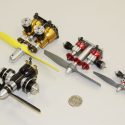
HP (Hirtenberger Patronen) Gold Cup and Silver Star .40 and .61 Cutaway engines

Located in the town of Hirtenberg south of Vienna, Austria, HP's primary business as an ammunition factory dates back to 1860. The word Patrone in their name means cartridge. Initially, HP produced hand made hunting cartridges but steadily expanded to manufacture a full range of ammunition. At its peak, during the Austro-Hungarian monarchy, the factory employed over 4000 workers. By 1937, one million cartridges per day were being manufactured to supply the axis powers. However, following World War II and the postwar occupation period, the factory was left an empty ruin until 1955. Production recommenced during 1957 under the guidance of the former president, Fritz Mandl.

With his interest, the model engine department was started in the early 1960's to develop a twin cylinder military drone engine. Then development of a .15 and .61 engine for the consumer market followed. Only the .61 went into full production. The first model of the .61 had a bell type rear rotary valve and Schnuerle porting design, both were unheard features of in the 1960's. Soon the .61 evolved into a front intake version which proved to be more suitable for conventional model airplanes. With the success of the .61, the HP .40 soon followed and gained a wide following which its descendant today still carries.

In the early 1980's the Austrian government took ownership of the munitions factory. During this time development began on a series of 4 stroke engines with a unique rotary valve design. These proved to be the quietest and most fuel efficient engines ever produced.

During the late 1980's the engine production was neglected as it was such a small portion of HP's business.

In 1990, after years of negotiation, RJL was able to purchase the model engine department from Hirtenberger and move the engine production to Southern California.

These cutaway models show the engine's internals. They are among some of last engines to be made in Austria before production was moved to the USA in 1990.

FEATURES OF HP 40 Engines: Forged and bushed con rod • Ringed ABC • Schnuerle ported • Double ball bearings • Weights only 9.5 oz. • Extremely high power to weight ratio • Same external size as most .25's

(History and stats from Model Engine Company of America™ web site at www.mecoa.com, who now supply HP engines.)

Donated by Robert Meltzer, Irvine, CA

MVVS .15 (2.5 cc) Diesel

This small Diesel was made in Czechoslovakia probably in the 1960's and the brand has remained popular for those flying RC models in the "vintage" categories. Though not technically a "vintage" engine, it has the look of an earlier era.

Donated by Richard T. Mack, Fallbrook, CA

Novoexport  .027 cc CO2 Engine

This engine is new in the package with all Russian writing. It was donated by Richard Mack, who purchased it during what he called "The Cold War Era." The crankcase is black plastic with a brass cylinder head. The engine package includes a black plastic charging cylinder to transfer CO2 from a larger cartridge to the smaller aluminum one that gives the .027 cc engine about 15 seconds of running time. An English translation of the instruction booklet was provided by a friend.

If you read Russian, more on this engine can be found at http://modelism.net/cox_motor.php.

Donated by Richard T. Mack, Fallbrook, CA

Novoexport 2.5KP 2-cycle Engine

This 2-cycle, 1-cylinder engine was also donated by Mr. Mack, who purchased it new during "The Cold War Era." Like the CO2 engine above it is still new in the molded styrofoam box and complete with instructions (in Russian) and spare parts. A very long aluminum tuned exhaust pipe is also included. It was distributed by Novoexport in Moscow, USSR. We presume by the name that it displaces 2.5 cc. Also included is a handsome pointed aluminum spinner for a 2-bladed propeller. A translation of the instructions is underway.

Donated by Jerry Nelson

Technopower II Seven-Cylinder Radial

Made in USA

From the Technopower web site:

The TechnoPower radial engine, originally based on the Armstrong-Siddeley Genet engine of the 1930's era, took over 5 years of design and development work, with continuing detail refinement. The result is a unique, aesthetic, practical, scale, flying engine of considerable engineering interest. These engines are fully functional, multicylinder, 4 stroke, O.H.V., glow ignition engines, each containing over 300 hand assembled parts. Each engine is assembled, checked and test run before leaving the factory in Santa Ana, CA.

STANDARD ENGINE SPECIFICATIONS

bulletOverhead valve, 4 cycle, glow ignition engines of 7 or 9 cylinders.
bullet1.35 to 4.0 cu. in. displacement
bulletNormal RPM range of 1200 - 8000
bulletHeavy Duty Crankshaft supported by dual Ball Bearings
bulletBillet Aluminum Master and Articulated Rods
bulletBillet Aluminum Pistons with Ductile Iron Rings
bulletHardened Steel Cams and Cam Followers
bulletHard Chromed and Ground Cylinder Bores
bulletStainless Steel Valves, Heat Treated, Ground and Lap Seated
bulletBronze Valve Guides and Cam Follower Bushings

Donated by Joe Martin

Webra Speed .91RC engine

This glow plug engine has had very limited use, if any. It came to us in the original box with the instruction sheets and tools. It was made in Germany by Webra Modellbau GMBH. The P5 version of this engine is still in production.

Donated by Joe Martin

Mystery Engine

The crankcase of this engine appears to be custom machined from billet stock. The head may be from an existing engine. The exhaust manifold provided with it would require an adapter for it to fit to the exhaust port, but none was present. We have no history on it at all. If anyone recognizes the engine, please contact us.

New Submissions Welcomed

If you have additional information on a project or builder shown on this site that your would like to contribute, please e-mail craig@CraftsmanshipMuseum.com. We also welcome new contributions. Please see our page at www.CraftsmanshipMuseum.com/newsubmit.htm for a submission form and guidelines for submitting descriptive copy and photos for a new project.

This section is sponsored by (sponsorship available).

(Your company logo and a link to your web site could go here)

To learn how your company or organization can sponsor a section in the Craftsmanship Museum, please contact craig@CraftsmanshipMuseum.com.

RETURN TO MUSEUM HOME PAGE

Copyright 2011, The Joe Martin Foundation for Exceptional Craftsmanship. All rights reserved.
 No part of this web site, including the text, photos or illustrations, may be reproduced or transmitted in any other form or by any means (electronic, photocopying, recording or otherwise) for commercial use without the prior written permission of The Joe Martin Foundation. Reproduction or reuse for educational and non-commercial use is permitted.