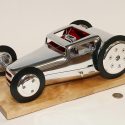
High quality models like this Bucyrus-Erie Shovel were never intended to be toys. At almost $1200 new and made in limited quantities, models like this were crafted by unknown experts in small numbers and are appreciated strictly for their detail and craftsmanship. Engines, more models, miniature guns and other projects are also on display as are some items remembered from the youth of many older craftsmen. (Click on photo to view a larger image and see below for more photos of this model.) Model donated by Les Cade.
The Craftsmanship Museum in Vista, CA has on display a number of pieces that are donated or on loan that are not shown on the web pages in this site that feature a particular craftsman. They are on display because we feel there is something particular about them that highlights an element of craftsmanship or because a craftsman is likely to find their function interesting. Shown below are all items you can examine in close detail if you visit the museum.
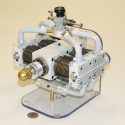
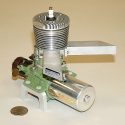
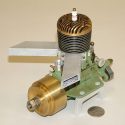
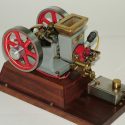
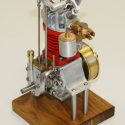
Shown here are some individual model engines in the museum's collection. Some are custom built and others are mass produced, but all share the common element of being actual working model engines that illustrate the function of a particular kind of powerplant.
|
(Click on any photo to view a larger image.) Donated by Les Cade |
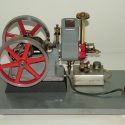
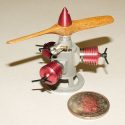
Solar "Flame Eater" Vacuum Engine Made by M.G. "Woody" Woods, circa 1986. #5 of 12 hand built PM Research now sells a reproduction of this particular design, but this is one of the few originals by engine builder Woody Woods. According to the www.stirlingengines.org.uk web page, a vacuum engine works as follows: "These engines work by drawing hot gasses or a flame into a cylinder to be cooled. Admission of the hot flame into the cylinder is controlled by a valve. There is a power stroke every revolution. On the outward stroke of the piston, the valve is open, and the flame is so drawn in to the cylinder. Just before the top of the stroke the valve is closed and the resulting drop in pressure draws back the piston, for the power stroke. One problem to be found running these engines is that of back-pressure at the end of the power stroke. The valve needs to be so constructed that it can lift and release any back-pressure. There have been a number of small power engines built, notably in Britain, but the vast amount of vacuum engines sold commercially have been as toys or models." Moving the flame closer to or farther from the valve opening adjusts the speed of the engine. A reproduction similar to this engine is available as "Solar #3" from PM Research at www.pmresearchinc.com. NOTE: If you like steam and Stirling engines, don't miss the page on Rudy Kouhoupt on this site. |
|
Donated by Frank and Craig Libuse |
Commercial Toy Model Steam Engine Circa 1930's, Manufacturer unknown This steam engine was a child's Christmas gift in Chicago in the late 1920's or early 1930's. An alcohol burner produces a flame that heats the water in the boiler to produce steam. The live steam powers the single cylinder vertical steam engine to spin a flywheel that could be used to run a belt to power other toy equipment. A pressure gauge, glass water level sight gauge and whistle are also included. Can you imagine the safety warnings that would have to be on a toy such as this in order for it to be sold to today's young model engineers? |
|
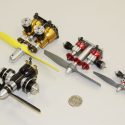
Courtesy of Joe Martin A US quarter is used for size reference. |
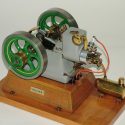
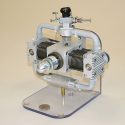
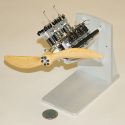
Solar Engines Stirling Cycle Engine—1817-1977 Solar Engines, Phoenix, AZ (now sold by PM Research, Wellsville, NY) Stirling engines were invented in the 1800's but are still being looked at today as potential sources of green energy. Requiring only a different temperature on either side of the displacer, they can run on as little as the heat from a cup of coffee or even the warmth of your hand in a cold room. Though not producing a lot of torque, in places where geothermal heat, solar heat from a parabolic mirror, heat from burning sawdust or natural gas or other source is available, they can run without any other fuel source. They have been used for everything from running a room fan from the heat of a candle flame, powering generators or pumps in the field from the heat of burning gas or other fuel to more modern applications as new lightweight materials and other advances keep the interest of scientists. Power for a Stirling engine is provided by the movement of air from one side of a displacer piston to the other as the air is heated on one side of the piston and cooled on the other. Accompanying this engine was an instruction manual and a book on Stirling engines by Andy Ross that explains how the Stirling Cycle Engine works. For more see www.pmresearchinc.com where this engine is available as "Solar #1." |
![]() Build by and on loan courtesy of Pamela Weiss |
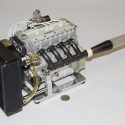
Offenhauser 270 4-Cylinder Racing Engine in progress Scale: 1:4, Designed by Ron Colonna This engine is well along with most of the machining on the block and head completed as well as are the pistons, rods, sleeves, cam drive gears, camshafts and piston rings. Unlike the original Offy, which did not have a separate head, the miniature version is made in two parts because of the difficulty in machining the valve seats in such a confined space. |
![]() Build by and on loan courtesy of Pamela Weiss |
Snow Horizontal Engine in progress From plans in The Home Shop Machinist Magazine This unique internal combustion engine has a combustion chamber at each end that houses a single cylinder that moves back and forth with spark plugs at each end, so it fires on both ends of the stroke. A single rod is connected to both pistons and drives the large flywheel. The original full-size engines were used in the natural gas fields to drive compressors to compress the natural gas and they were also powered by the same natural gas. Only two of the restored originals still exist in museums. The engine needs only ignition and a cooling tower to be completed. |
|
Courtesy of Rex Geivett |
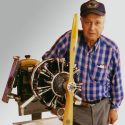
Model Steam Engines Rex Geivett was a museum visitor who admitted he had made a number of steam engines himself, but they were just stored away in his bedroom where no one could see them. We asked him to bring them in, and fine work they are indeed. We now have them on display in the steam engine section of the museum. They are made from various Stuart and other casting kits available mail order, and each is nicely machined and painted. If you are thinking of building one of these engines, come by and see how they should look. From top left: A Sanderson Beam Engine from 1845, a "Little Brother" hit-n-miss engine, a Stuart Turner D10 vertical twin-cylinder steam engine, a Stuart Turner H10 horizontal single-cylinder steam engine and a 2-cylinder V oscillating steam engine. |
![]() Donated by Paul White |
Model
Turbine Jet Engine The late Paul White was a race car and experimental aircraft sheet metal fabricator as well as a prolific modeler. He built IndyCars, worked for Dan Gurney's All American Racers on the Formula 1 car in the 1960's and fabricated parts for Rare Bear and other winning air race aircraft as well as making scale flying model airplanes from the usual materials plus aluminum and carbon fiber. He scratch built this running jet engine in about one month without the use of CNC machining just to see if he could get a jet engine to run. It did. He even built a scale looking engine stand for it. |
![]() |
Model engines by commercial
manufacturers A growing collection of model airplane, car and boat engines made by the early originators of the hobby can be viewed at the museum. This includes engines by Ohlsson & Rice, K&B, Clarence Lee, Super Tigre, O.S., Arden, MVVS, OK (Herkimer), Cox, Telco, NovoExport and Thuderhead to name a few. Some of these date back before the advent of radio control. Included are gas glow and spark engines as well as CO2 engines. Details about these and other engines can be found on the page dedicated to the early innovators in model flying on this web site. |
![]() |
Varo Amp-Champ 12 VDC Field Generator The Varo Amp-Champ was powered by an Ohlson & Rice 2-cycle, single cylinder model airplane engine (Type 122) that was rated at 3/4 HP at 6300 RPM. It ran on 70-80 octane pump gas mixed with oil at a 24:1 ratio. Joe Martin donated this engine, which was used in the field for starting model airplanes in place of a battery. We are also told that they were used during WWII and the Korean war as portable auxiliary power generators to run field radios for communication on the battlefield. Lighter than a large 12 Volt battery, they would also produce power as long as you had a source of gasoline for fuel. This is a good example of turning lemons into lemonade when the wartime market reduces demand for a hobby product like a model airplane engine. In typical government fashion, complete instructions for starting and running are printed on a decal on the engine so any soldier could get it running. Plug gap, points gap and magneto gap were all right there as were mixture and starting procedures. Although O&R engines were no doubt chosen for their famous reliability, it was noted in the instructions, "Clean cylinder exhaust ports when engine loses power." See More on Irv Ohlsson in the model engine manufacturers section. |
![]()
Made in small quantities, these models are not for kids. Commercial models are made for corporate display or for private collectors who have a particular love for the item being modeled--from cars to construction equipment.
|
Donated by Les Cade |
1983 Bucyrus-Erie 88B Series 4 Shovel Scale: 1:48 Classic Construction Models, Beaverton, OR One of a limited edition of 500, the last of these highly detailed models was sold in 1997. The company contracts with craftsmen in Korea to build and paint these brass models. They offer a very complete line of construction equipment. The original list price of this model was $1195.00, but it was sold out in 1997, so now the collector market will determine the value of any that happen to come up for private sale. Companies often contract with highly skilled craftsmen in other countries where labor rates are cheaper in order to produce high quality models at affordable prices. Construction quality, detail and paint must be totally authentic to sell to this discriminating audience of expert collectors. These are among the more expensive models available to collectors. Only 602 of the real cranes were built between 1949 and 1983, so almost as many models were made as were originals. For more offerings, see www.ccmodels.com. NOTE: If you like construction equipment models, don't miss the pages on Larry Simon and Jerry Brown on this site. |
![]() Courtesy of Craig Libuse |
1975 International TD-25 Serices C Crawler Tractor with Ripper First Gear Replicas, Peosta, IO Scale: First Gear is another company that specializes in construction and farm equipment. They are not done to the level of detail of the above shovel, but neither are they anywhere near the price. This crawler, for example sells for about $125-150 and includes an amazing amount of detail for the money. Also included with the model is a scaled-down reproduction of the original operating manual for the vehicle. A tiny shovel can be placed wherever you want on the model for additional detail, although I wouldn't want to try digging this monster out of the mud with it. Perhaps it was just for cleaning mud off the operator's boots... For more from this company see http://www.firstgearreplicas.com/. |
![]() Courtesy of Craig Libuse |
"Nitro Chicken" Blown Top Fuel Hydro Drag Boat Badass Diecast, Jacksonville, FL Scale: 1:18 The owner of this company is a drag racer himself, so the models are very authentic. They are also made in fairly small numbers, assuring a good investment for the collector. At $129.95 they are very reasonably priced considering the amount of detail, and there are several editions limited to 500 pieces for $149.95. This particular boat represents the IHBA Top Fuel Hydro #572 driven by Doug Verstuyft of San Antonio, TX that held the 1/4 mile record at 4.81 seconds @ 248 MPH. See more at http://www.diecast-badass.com. Their site also includes an illustrated history of the steps involved in making a diecast model from concept and drawings to finished prototype. |
|
Other companies produce models from museum quality to affordable collector pieces. Although we do not have any examples in the museum here are listings for a few of them:
|
|
These are items that were built to be played with, but offered not only amusement, but the owner ended up learning something about how things work by the time he was done. Many model engineers started out with toys like these before going on to build their own from scratch.
There are several other items on display that are hard to categorize, but are of interest to craftsmen. This section encompasses those items.
|
Joe Martin is seen examining the fine craftsmanship on the model Adler locomotive that was donated to the museum 11/9/09 by Szymon Klimek |
The 1835 Adler Locomotive Model The Adler (German for "Eagle") was a British-built, German steam locomotive with the wheel arrangement 2-2-2 and was the first locomotive to run successfully in Germany. It was built to order in 1835 by the British railway pioneers George and Robert Stephenson and delivered to the Bavarian Ludwigsbahn (Bayerische Ludwigsbahn) which ran between Nuremberg and Fürth. The Adler was furnished with a tender of the type 2 T 2. The locomotive was delivered to Nuremberg in over 100 individual components at a cost of 1750 pounds sterling. In 1835, the steam engine was assembled in the workshops of the Johann Wilhelm Spaeth engineering works. On December 7th, 1835 the Adler, driven by William Wilson, ran for the first time on the 7.45 kilometre long Ludwigsbahn. After running successfully for over twenty years the now technically-outdated locomotive was sold for scrap minus its wheels in 1857. Two replicas of it have been built, and a running replica is now being restored at the Meiningen Steam Locomotive Works for the DB Museum Nuremberg after a roundhouse fire in October, 2005 almost destroyed it. The restoration of the 1935 replica is expected to cost over 1 million Euros—many times the cost of the original. The Model by Szymon Klimek The model accurately represents the original Stephenson Adler design. The brass model contains extremely delicate detail characteristic of Mr. Klimek’s work. Though accurate in proportion and detail, Mr. Klimek takes his models past the realm of model engineering and into the world or art or jewelry. The display of the model inside a wine goblet is more in character with its creation as a piece of fine art than is normaly seen as a display for the usual model locomotive. Please take the time to examine it closely and marvel at the delicacy of the construction and the perfection of the presentation. More of Szymon Klimek’s work can be seen at www.CraftsmanshipMuseum.com/Klimek.htm or on his own web site at www.edrobiazg.com.pl (Szymon Klimek Minature Gallery). Szymon has plans to make a selection of his models available commercially soon. The Adler was donated to the Joe Martin Foundation by Mr. Klimek in November, 2009 and is on display at the Craftsmanship Museum in Vista, California. Mr. Klimek was the recipient of the Foundation’s Special Achievement Award in September, 2009. |
|
Donated by Young C. Park |
Aluminum P-51 Mustang and two F4U Corsair models Scale: 1/16 Young C. Park dedicated 10 years to the making of these three incredible models. The P-51 and one of the Corsairs are half cut-away models, meaning you can see all the detail inside the plane. The second Corsair is shown disassembled into four major parts as it was built in the factory. The models are completely hand fabricated from aluminum and brass and are detailed down to the hydraulic lines and functional control cables to the rudder, elevator and ailerons. The P-51 even has .50 Caliber ammunition fed from the ammo boxes into the 3 machine guns in the left wing. There are over 10,000 aluminum rivets used in the P-51 alone. These aircraft our the stars of the museum's collection, and it is unlikely you will ever see better models on display in any museum in the world. Young C. Park is the winner of the Foundation's Metalworking Craftsman of the Year Award for 2002. |
|
Donated by William R. Smith |
Strutt Epicyclic Train Clock NAWCC Gold Medal Winner, 2003 William R. Smith is will known in the watch and clock world for his many books on how to build various clocks. He also offers a series of instructional DVD's on how to set up a shop and build clocks. This particular clock won a gold medal at the National Association of Watch and Clock Collectors Horological Crafts Competition in 2003. The 8-day mechanism features an unusual Paradox Movement utilizing planetary gears to drive the minute and hour hands individually. In addition to Bill Smith's award winning clock, displayed with it are two partially complete versions of the clock—full size and half size—that are currently being built by Pamela Weiss from the instructions in Mr. Smith's book. William R. Smith is the winner of the Foundation's Metalworking Craftsman of the Year Award for 2000. |
|
Build and donated by Barry Jordan |
Model Bridgeport BRJ Milling Machine Scale: 1:14 Barry Jordan usually worked in a larger (1/5) scale to build models of famous metalworking machines, but for this model he took on a special challenge. The idea was to build a machine in a smaller scale than Jerry Kieffer's 1/12 scale machine tool models, and Barry certainly succeeded with this one. The model has functional machine slides in all directions, the tiny 60:1 rotary table works and even the spindle is driven by a tiny electric motor with batteries hidden in the display base. This is every machinist's favorite display in the Vista museum. Barry Jordan is the winner of the Foundation's Metalworking Craftsman of the Year Award for 2003. |
![]() Built by David Kucer. Courtesy of the Joe Martin Foundation. |
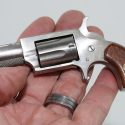
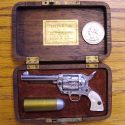
Miniature Smith & Wesson "Volcanic" Pistol Scale: 1:3 David Kucer and his son Xavier carry on the fine tradition of building miniature arms. This model represents a ground-breaking design by the "Volcanic Repeating Arms Company" in 1852 to produce the first repeating pistol with self-contained cartridges. It was a big advance over the cap and ball black powder pistols then in use. The designers eventually sold the company to their largest investor, Winchester who used the lever cocking action in his rifles. The designers, Smith & Wesson went on to form another successful company under their own names. This miniature is accurate in every way down to the types of metal and heat treating processes used in the full-size version. It would be capable of firing a miniature round if one were to be made, although that probably ruin it's value as a collectible miniature due to the corrosive nature of the powder residues. Cleaning a gun this small would require the expertise of the craftsman who built it. David Kucer was selected as the Foundation's Metalworking Craftsman of the Year for 2006 |
![]() Donated by Bob Mellman |
"Little .45" Miniature Colt .45 Pistol American Miniature Gun & Cartridge Co., Hollywood, CA This miniature replica of the famous Colt .45 Peacemaker, known as "the gun that won the West" actually fires small cartridge primers much like a cap gun. The primers are stored inside the cast plastic replica of a full-size .45 caliber bullet, which also serves to give a reference to size scale. This gun is purported to be a prototype for the manufactured version, but unfortunately the years have not been kind to the diecast cylinder, which has swollen and cracked and will no longer rotate in the frame. |
![]() Built by and on loan courtesy of Pamela Weiss |
Working Gatling Gun Scale: 1:2 (.22 Cal.) This working replica of an 8-barrel Gatling gun was built from plans available in many model engineering magazines. It took a lot of hours and a variety of machining, welding and woodworking skills to build all the parts. It fires .22 long rifle bullets at up to 600 rounds per minute if you can crank the handle fast enough. About 300 rounds have been test fired through it. |
|
Verge Twister Oiler Roger's Display Courtesy or Roger L. Ronnie |
Engraved Watchmaking Tools Gun engraver Roger Ronnie of South Dakota enjoys making watchmaking tools as a hobby. The brass tools are for specialized tasks required in the fine adjustment and construcion of watch parts, but he takes them a step further by applying intricate engraving to almost every surface. The first item shown is called a "Verge Twister." It's purpose is to offset the "flag" on a verge to the proper number of degrees to regulate the escapement. The other is an "Oiler" or a storage container for the rare and expensive whale eye gland oil used for lubrication. The lid keeps out contamination, and small tool with a fine gold tip is used to transfer just a tiny drop of oil to the right place in the watch. These tools have been featured in horological magazines covers that are normally reserved only for fine watches or clocks. Roger Ronnie was the Foundation's Metalworking Craftsman of the year for 2004. |
|
Courtesy of Craig Libuse |
Zero 2000 Pinhole Camera Zero Image Co., Hong Kong Pinhole cameras have no glass lens at all. Instead, light is allowed to pass through a tiny hole to expose the film. The image projected through the pinhole is seen upside-down projected on a plane behind the pinhole. The smaller the hole, the sharper the image, but the longer the exposure time required. This same principle—a piece of paper with a pinhole in it—can be used to safely view the sun during an eclipse by projecting its image (upside-down) onto another piece of paper where it can be safely viewed rather than looking directly at the sun. Known as a "camera obscura," this device was used as far back as Leonardo Da Vinci. This particular camera takes 120 size film. it is the deluxe model that features a remote shutter release fitting and exposure calculation dial. it is made form fine wood with highly polished lacquer finish. |
![]() Donated by Bob Mellman |
Yashica Autoron Miniature Spy Camera Designed along the lines of the famous Minox spy camera of WWII vintage, this tiny camera was introduced in 1965 by Yashica (now Kyosera). It is slightly larger than the Minox but uses the same 8 x 11 mm film cassette and has an automatic exposure meter. The focus on the Yashinon f2.8 18 mm 4-element lens is fixed. A flash attachment and filter are also included as is a sample roll of film. |
![]() Donated by Sean Wilmut |
Linear to Rotational Kinetic Energy Transference System—also known as an Engineer's Top Magic Touch Associates, New York, NY, Circa 1969 Proving once again that there is no concept too simple to be made incomprehensible by a good engineer, this item with the fancy name is actually just a kid's spinning top. The beautifully machined and balance components are housed in a handsome box with each component labeled. The best part is the booklet by Richard A. Gordon that accompanies the top, explaining in technical language, scientific formulas, complex charts and dimensioned diagrams over 24 pages the kinetic and aerodynamic principles behind the function of a top. It is tongue-in-cheek overkill at its best, but it is also done with great skill and in high quality. |
![]() Toroids donated by Jerry Hjeltness, core memory courtesy of Joe Martin |
Computer Memory Toroids/Ampex FA164 Core Memory Illustrating the first computer RAM The large component in the lower right of the photo is capable of storing 4 KB of memory. Ridiculously small by today's standards, that was state-of-the-art in the early days of computing. The earliest form of writeable Random Access Memory (RAM), the Magnetic Core Memory (Ferrite-Core Memory) was invented in 1951 by An Wang at Harvard University's Computation Lab and Jay Forrester at MIT. Core memory used the magnetic properties of materials to give them a similar functionality to transistors. They stored their information using the polarity of tiny magnetic ceramic rings (toroids) with wires threaded through them 90° to each other. Unlike today's RAM, core memory could store information even after the power was turned off. The small circle on the information plaque accompanying the core memory chip highlights two of the actual toroids that were used in the memory. Jerry Hjeltness of Escondido, CA was one of the first to produce tooling to punch out these tiny donuts using a Stokes press designed to make pills. A powdered metal was fused into the donut shape during the punch press process. They were made one at a time to tolerances of 50 millionths of an inch. The core memory was purchased at a scrap yard by Joe Martin many years ago. It has thousands of tiny wires in a bundle protruding from the back. Imagine trying to install it or trace down a problem in its function...all for 4 KB of memory. This component illustrates the craftsmanship that was required to physically produce the first memory before the use of the silicon chips we have today. |
In addition to the above projects, a number of craftsmen featured in the on-line museum have contributed work that is on display for visitors to the Vista Museum. Here are some of the projects and links to their sections:
• The lifetime steam and Stirling engine collection of Rudy Kouhoupt
• Miniature steam and compressed air engine projects—Scotty Hewitt
• The Miniature Engineering Museum IC engine collection—Paul and Paula Knapp
• The 1:32 scale Manitwoc Lift Crane built by museum volunteer Larry Simon
• The miniature steam engine and parts for other extremely miniature models by Jerry Kieffer
• Electroformed NASCAR "Goodyear Gold Car" trophy model cars and IndyCar model—Michael Dunlap
• The model airplane engine collection of the Joe Martin Foundation honoring early engine designers
• Miniature flaked arrowheads—Daniel White
• Miniature woodworking tools ("Original Rabbit Plane" and scale Mayo Patent plow plane)—Paul Hamler
If you have additional information on a project or builder shown on this site that your would like to contribute, please e-mail craig@CraftsmanshipMuseum.com. We also welcome new contributions. Please see our page at www.CraftsmanshipMuseum.com/newsubmit.htm for a submission form and guidelines for submitting descriptive copy and photos for a new project.
![]()
This section is currently not sponsored.
To learn how your company or organization can sponsor a section in the Craftsmanship Museum, please contact craig@CraftsmanshipMuseum.com.
RETURN TO MUSEUM HOME PAGE
Copyright 2009, The Joe Martin Foundation for Exceptional Craftsmanship. All
rights reserved.
No part of this web site, including the text, photos or illustrations, may be
reproduced or transmitted in any other form or by any means (electronic,
photocopying, recording or otherwise) for commercial use without the prior
written permission of The Joe Martin Foundation. Reproduction or reuse for
educational and non-commercial use is permitted.