
1913—1996
Innovator and Model Airplane Engine Builder
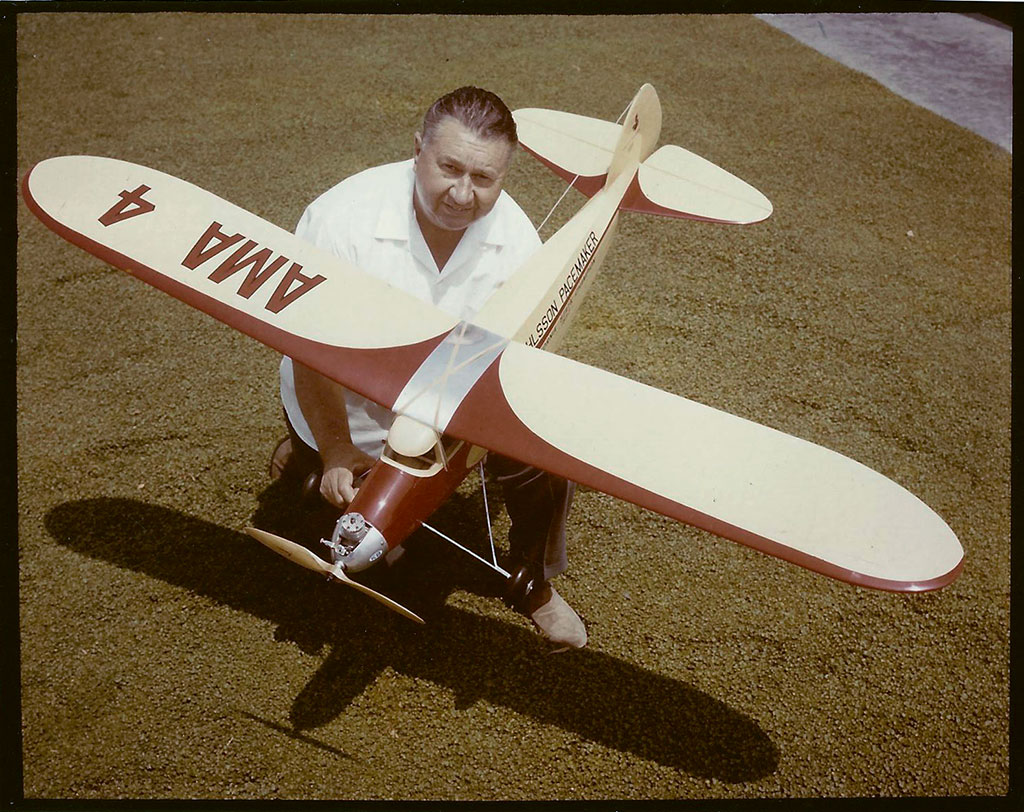
Irwin “Irv” Ohlsson, model airplane engine innovator and enthusiast. Irv cofounded Ohlsson & Rice Engines, which became one of the leading manufacturers in the industry.
A Love of Airplanes Started Early
When Irwin “Irv” Ohlsson was seven years old, he was already fascinated with airplanes. He would carve them out of solid wood and swing them around his head on a string to watch them fly. In 1927, Charles Lindbergh’s flight across the Atlantic inspired not only Irv Ohlsson, but also many others to a renewed interest in flight. At age 18, Irv had already built and flown a number of rubber band powered aircraft, and had won 11 major contest trophies. One was for a record-setting flight of 1 hour and 3 minutes, reaching an altitude of 4,300 feet and flying over 30 miles!
In 1932, Maxwell Bassett set the record for a model airplane powered by a gas engine. He used an engine built by Bill Brown. Only two years later, Irv Ohlsson took a 30 cc gas engine designed for model boat use, and fitted it to an airplane model of his own design. It had an 8-foot wingspan, weighed 10 pounds, and swung a 20-inch propeller. Irv put the model in his 1928 Ford and drove to a contest in Sacramento.
There were three other entries, all powered by Brown Jr. engines, but his with the modified boat engine. Two of the airplanes crashed. Dr. J. P. Young got his to fly for 26 minutes. When Irv’s turn came, his stayed aloft for an hour and 6 minutes—a record that stood for many years. A pilot in an airplane flying nearby reported sighting Irv’s plane at 5,500 feet in altitude.
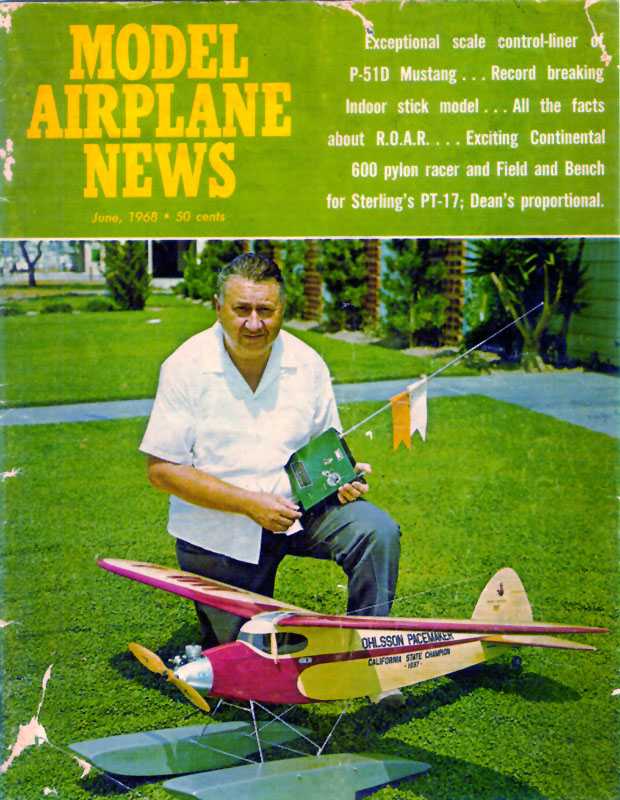
Irwin Ohlsson was featured on the cover of a 1968 issue of Model Airplane News, along with his “Pacemaker” amphibian. The photo was taken in front of the K&B plant in Downey, where Irv’s good friend Dan Lutz worked. Irv’s son recalled many weekends at Lake Elsinore, watching his dad fly this model airplane.
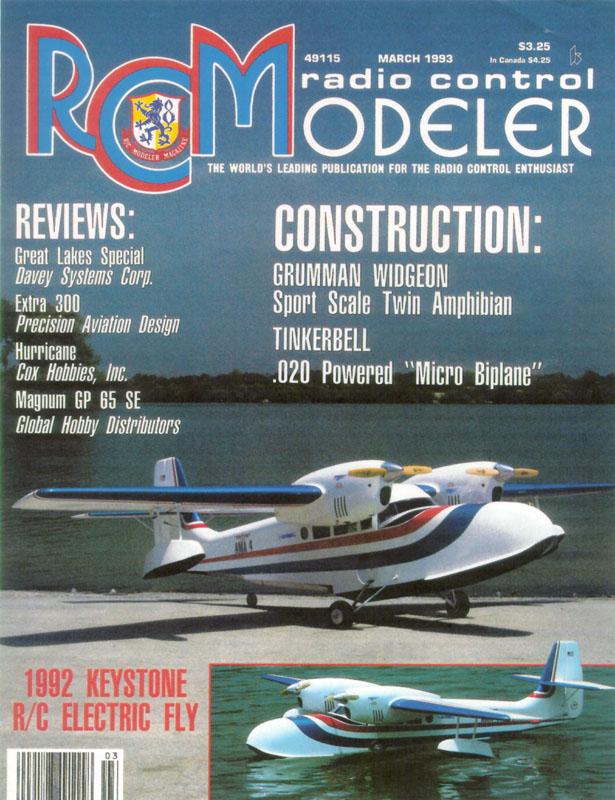
Another plane built by Irv was shown on the cover of the March, 1993 RC Modeler magazine. This modified Widgeon weighed 20 pounds, and was clocked at 85 mph! Irv would have expert flier Joe Bridi fly the plane because it was such a rocket. In Joe’s hands the plane could do 8-point rolls and fly inverted.
Graham Knight of Shepperton, England informed us that the first known recorded gas engine flight was made by D. Stanger of England with a record of 51 seconds in 1914. This record stood for 18 years until beaten by Colonel Bowden in 1932, with a flight of 71 seconds. Later in 1932, Maxwell Basset topped that time.
Mr. Basset held the record that Irv Ohlsson and others were shooting for in 1934. As you can see, the technology of model flight took some big steps between 1932 and 1934. It took 18 years to add 20 seconds to the record, but in two years the flight times went from just over a minute to more than an hour!
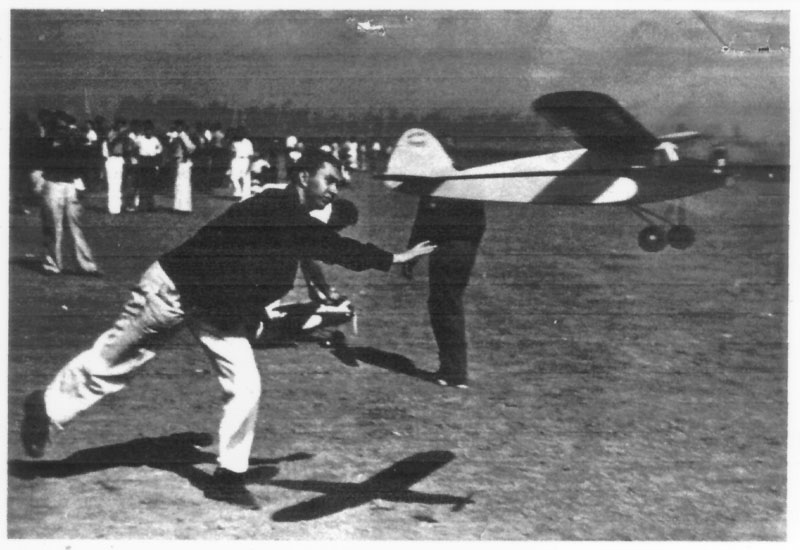
Irv launches his Pacemaker at the old Rosecrans and Western field. It was powered by an early “Gold Seal” engine. (Photo courtesy of Dick Tichenor.)
Newspaper Contest Spurs Development of a New Engine
In 1934, The Los Angeles Herald Examiner was looking for a small model aircraft they could use as an incentive for their delivery boys to boost circulation. Having gained a name for himself with his record-setting flights, Irv Ohlsson was asked to build the first prototype. To keep costs down, it was to be powered by a compressed-air engine, which burned a solid fuel stick to produce the gas for a 5-cylinder radial power plant.
It flew well, but the heat generated would often cause the airplane to catch fire after landing, so the project was abandoned. Later, however, Irv got an idea for how to build a gas powered engine that would be small enough for the project. Working with friend Roland Barney, in about two months they had produced two very small engines. The engines had a 1/2” bore and 5/8” stroke, resulting in a .12 cubic inch displacement.
These were smaller than the model engines being produced on the East Coast at the time, and a test at Muroc Dry Lake (now Edwards Air Force Base) showed that they could work. By this time, however, there was a different editor at the newspaper, and the model incentive project had been abandoned—but Irv Ohlsson was on his way to a career in model airplane engine design.
Irv lost track of his first prototype after selling the two engines. Fifty years later, he got a call from Erwin Schwartz, who said that Victor Savage had installed one of the engines on a high-wing monoplane back in the 30’s. Mr. Schwartz also had one of the engines and would return it to Irv. Several weeks later, Irv got back his very first Ohlsson engine. This was a piece of history that he was very grateful to have back. The old engine remains with his son, Irwin “Gus” Ohlsson Jr.
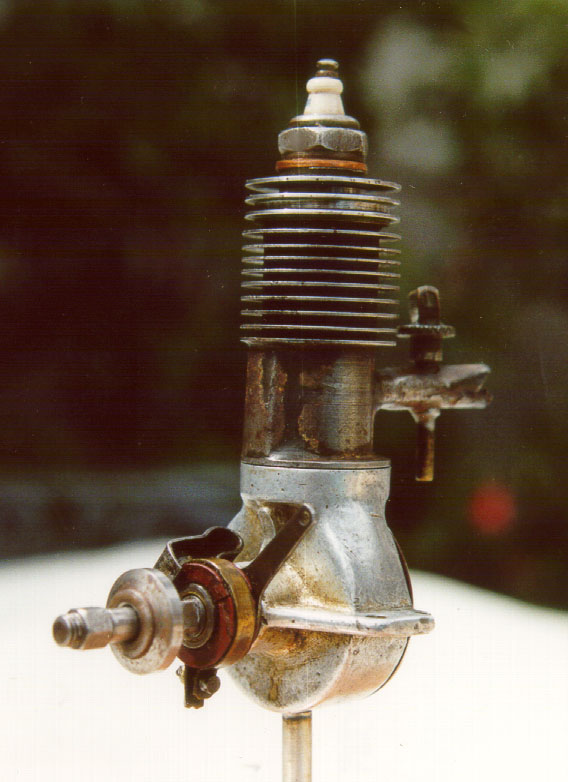
The original prototype engine that Irv designed in 1934, and built for a newspaper promotion. The two produced were sold shortly after completion. Irv was overjoyed when one of the original prototypes was returned to him nearly fifty years later.
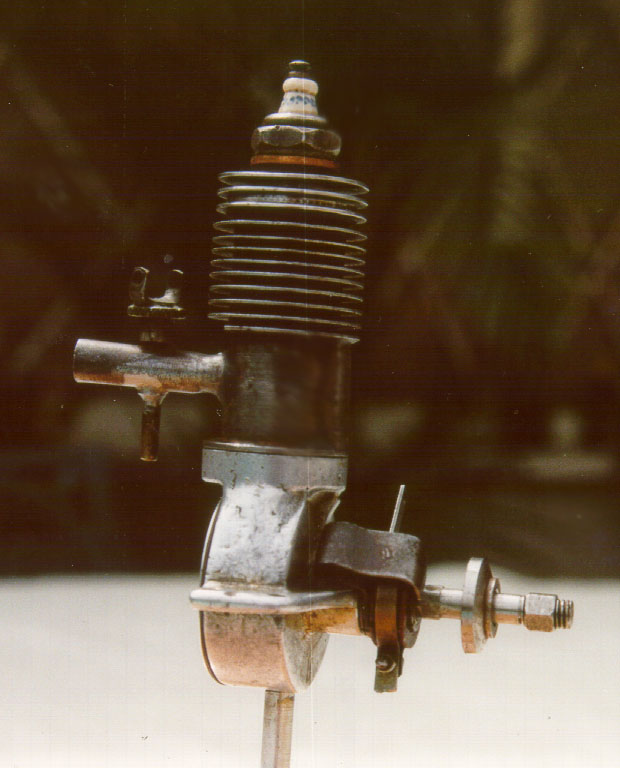
Another view of the original engine, which was passed down to Irv’s son, Irwin “Gus” Ohlsson, Jr. At the time it was designed, this was the smallest gas model engine in the world at .12 cubic inches displacement. (1/2” bore x 5/8” stroke.)
From a Hobby to a Business
After graduation, Irv went to work for Douglas Aircraft. However, his first love was model flying, and Irv soon left Douglas to open his own model shop in Los Angeles. He had come up with a good design for an engine and wanted to put it into production. Irv contacted his machinist friend, Harry Rice, and got a quote for the tooling needed to do a first run of the new engines.
The cost would be $2,600, which was a lot of money at the time. Irv borrowed $1,300 from his mother, and got his friend Frank Bertelli to borrow $1,300 from his parents to finance the first run of engines. They assembled and test ran each engine in their shop. This engine sold for $16.50, which was about a week’s pay for the average worker at the time. Many boys would recall saving every penny for a long time to buy that engine for their model airplanes.
The Ohlsson Mini was known as the “Gold Seal.” It had a displacement of .56 cubic inches, forged rods, and a 1-piece head and cylinder to prevent leakage. The engine produced about 5 pounds of thrust with a 14” prop at 7,000 rpm.
Irv also designed and sold several airplane kits. His first was made in 1934, and called the “Speedmark.” He combined it with a Brown Jr. engine. The five-foot wingspan model kit sold for $15.00, and the engine added another $18.00 to the price. If you bought both together, the price was $25.00, which was a lot of money in the 1930’s. In 1937, Irv came up with the “Pacemaker” design. This was a good looking and sturdy aircraft that was well suited to engines at the time, and many were built. The kit and engine again sold for $25.00.
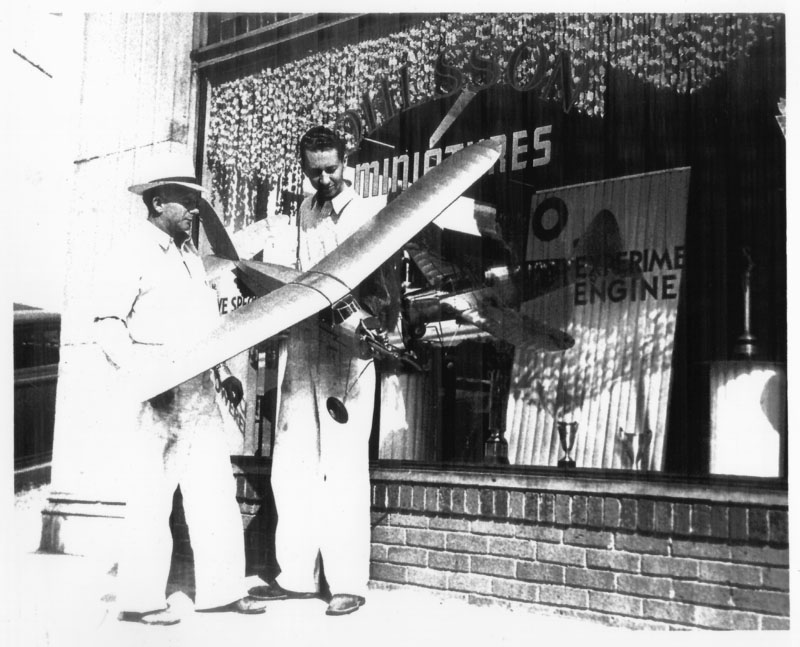
A photo from late 1936 shows Irv Ohlsson with Sam Kramer in front of the shop at 650 N. Alvarado Street in Los Angeles. Irv and Frank Bertelli built the airplane for Sam for a total cost of $45.00. Using the #1 engine, Sam put 1,000 flights on this airplane.
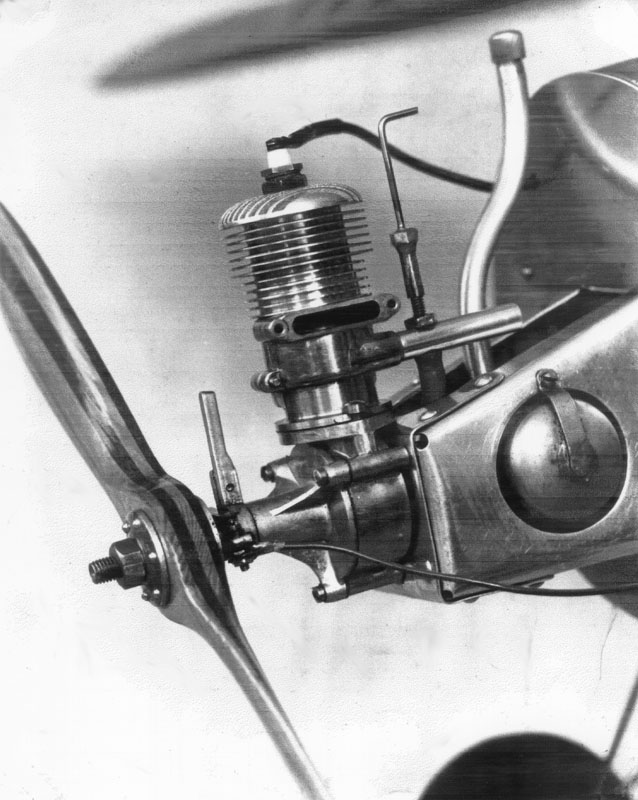
Irv’s first production engine, the #5 original Miniature .56 cubic inch, also known as the “Gold Seal.”
Ohlsson & Rice is Formed
By 1941, Irv Ohlsson had teamed up with Harry Rice and the firm of Ohlsson & Rice (O&R) was born. They produced a .19”, .23”, and .60” engine, all of which were highly popular. No other engines at the time combined the reliability, ease of maintenance, simplicity of operation, and unlimited life of the O&R engines. However, World War II put a temporary hold on their success, as all manufacturing facilities were turned over to military production. By the time the war shut down their production, O&R had produced about 75,000 engines.
As soon as the war was over, O&R got back into production. There was a shortage of needed materials, and their machines were somewhat worn by the 3-shift a day wartime production. Nevertheless, they jumped back into a market that had a seemingly endless demand for their products. Modelers were hungry to get back into flying, and O&R took advantage by buying the machinery needed to meet the huge demand. By the end of 1947, their production had risen to almost a thousand engines per working day.
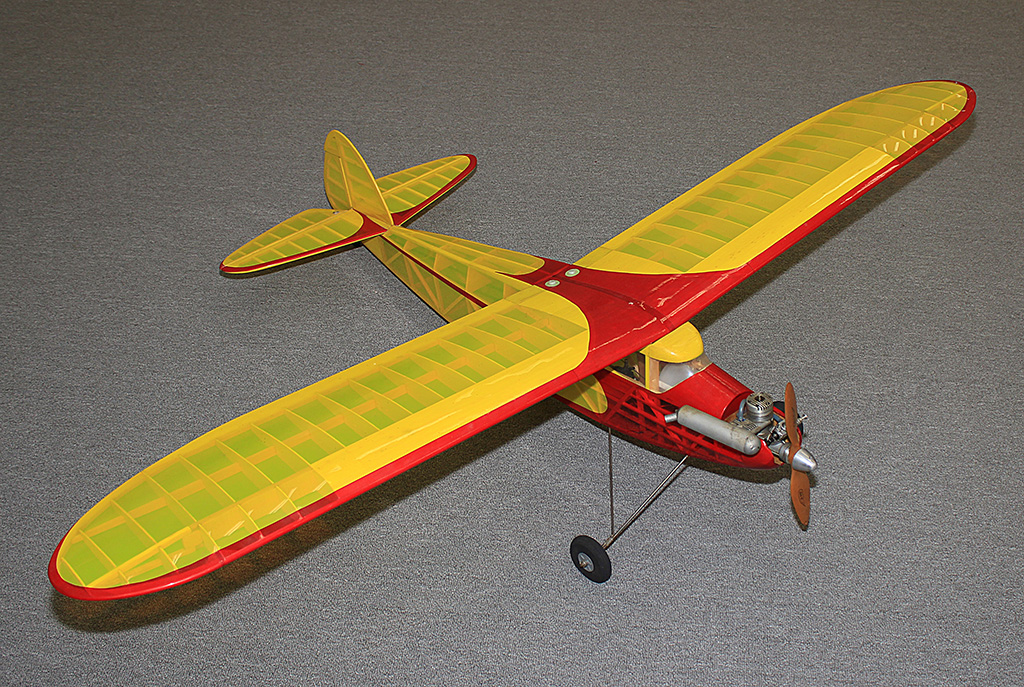
This Pacemaker won the 1937 California Freeflight Championship, and was patterned after a similar version that Irv built to compete in the 1934 National Championships. This model might be the original converted for use with radio control, and covered with a new skin of monokote to replace the original doped silk covering. It could also be a second version built to honor that plane.
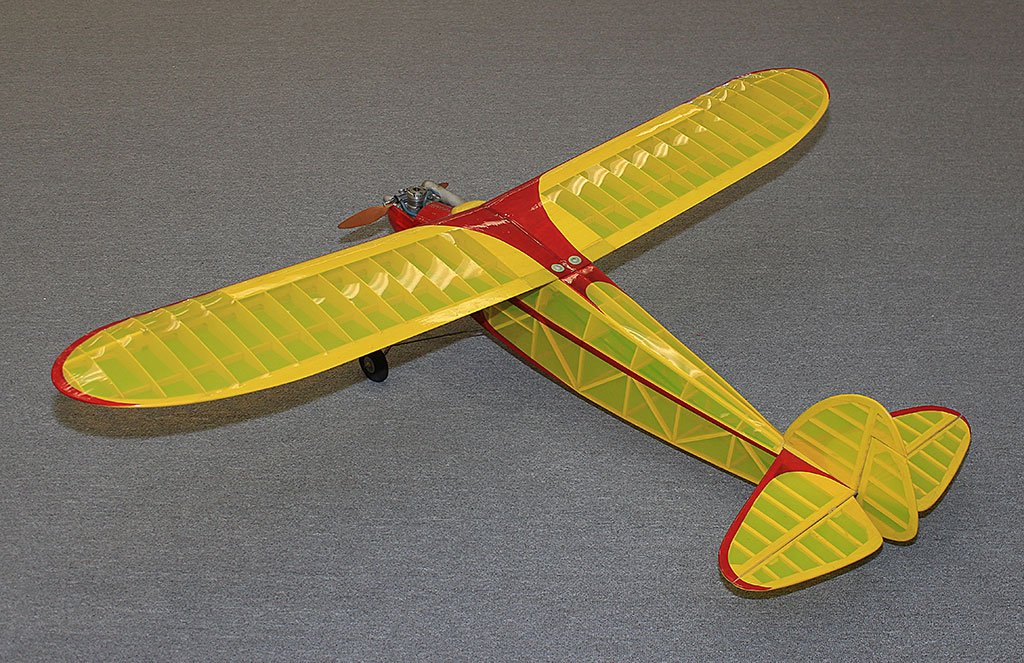
The fact that this plane is powered by a K&B .40 may indicate that it predates the Ohlsson & Rice production engines that Irv built later in the 1940’s and 1950’s. This plane was donated by Joe Bridi, who often acted as Ohlsson’s “test pilot” due to his skill in flying model aircraft.
When glow plug engines started to become popular in 1947, O&R was ready with their own designs. One of the problems with glow engines was the availability of the proper fuel, so they began manufacturing their own brand of fuel for both glow and ignition engines. O&R also started making propellers, metal-bodied model race cars, and a series of O&R glow plugs.
In 1949, they released their new “29,” which was basically a slightly reworked “23.” It was met with huge success. They quickly followed that with the “Redhead 33.” At this point, Ohlsson and Rice were at the pinnacle of their career, with the largest and wealthiest company in the hobby industry. Unfortunately, rushing so many new products to market at once had some serious ill effects on the quality of the engines.
The new designs started to show some flaws, which caused many engines to be returned to the factory for repair. Problems with the die-cast aluminum rod distorting and bending meant they had to be replaced with forged steel rods. This, however, pointed out another problem with the engine—when the stronger rods transferred stress to cylinder case base, causing the engines to fly apart when running on glow fuel.
The high number of engine returns caused financial stress that eventually led to the breakup of the partnership of Ohlsson and Rice, but not before they had produced well over a half million engines.
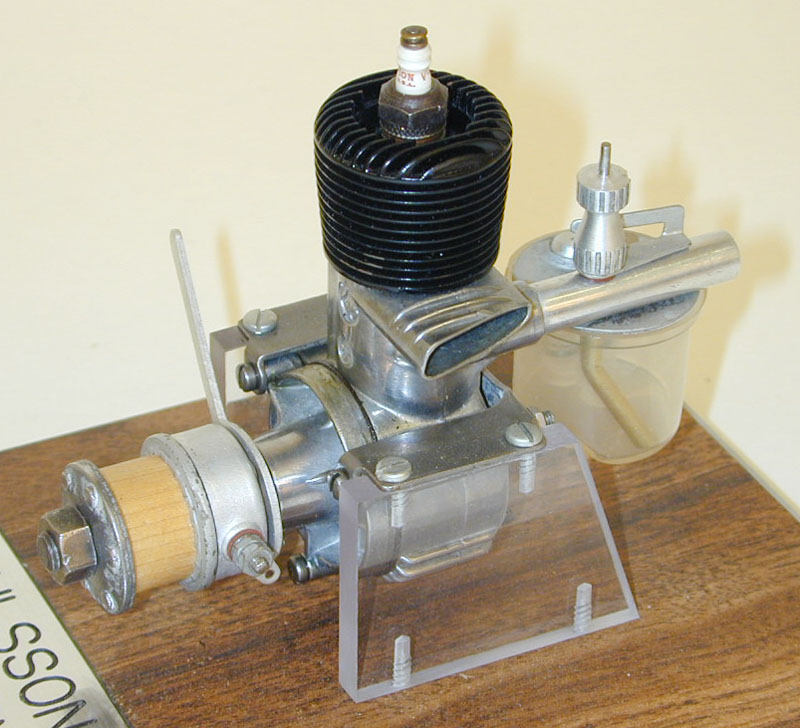
This Ohlsson .23 was purchased in 1947 by Carl Hammons, who later became Joe Martin’s business partner for many years. Their love of model airplane flying is what brought them together, and this engine was Carl’s first. The engine is now part of our collection at the Craftsmanship Museum in Carlsbad, CA.
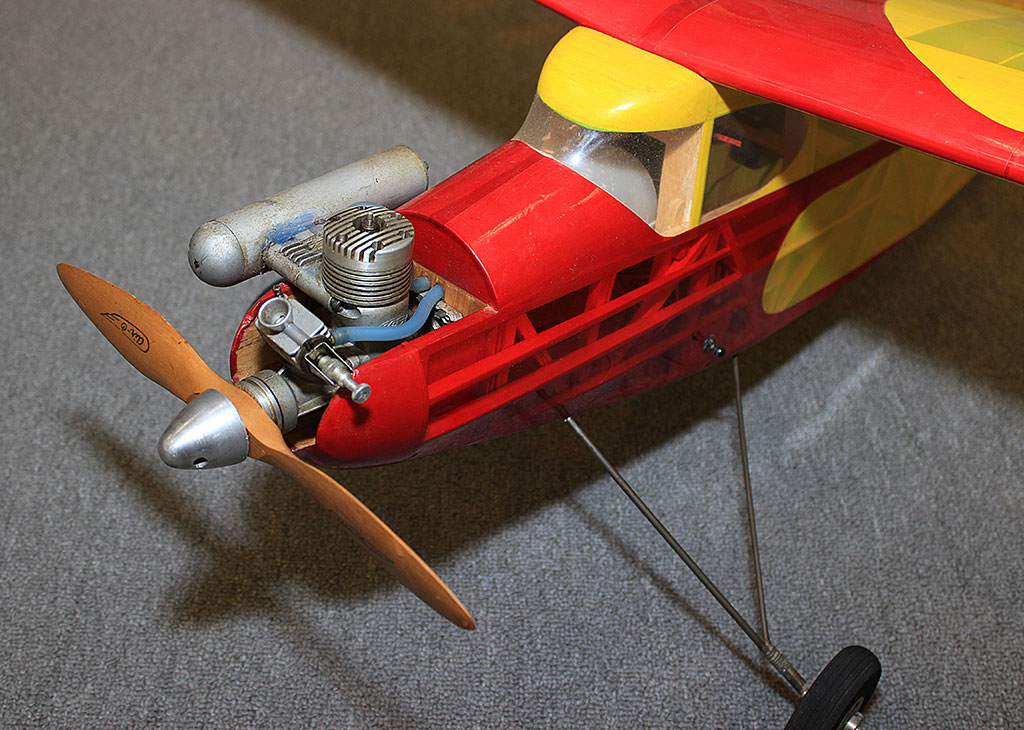
The Pacemaker has a wingspan of 68”. The fuselage and engine length is 48″. The championship winning Pacemaker is on display at the Craftsmanship Museum in Carlsbad, CA.
A Change of Direction Keeps the Ohlsson Name Alive
It wasn’t long before Irv Ohlsson got back into business when he purchased the old Spitfire Company facilities—including their large fuel packaging plant. He began producing his own line of glow plugs and fuel. Irv also packaged fuels for several other well-known model engine manufacturers under their own names.
Irv passed away in 1996, but his son, Irwin “Gus” Ohlsson Jr. continued to operate the business. Irv Ohlsson is often credited with being one of the major contributors to the hobby of model aircraft flying. Ohlsson engines were a large factor in the early growth of the sport of model airplane flying.
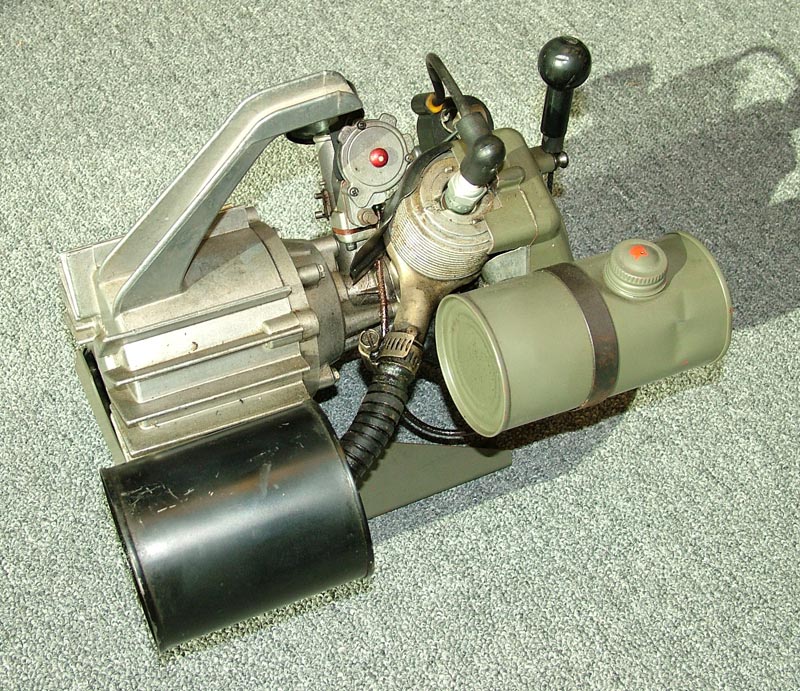
This Varo Amp-Champ generator was powered by an Ohlson & Rice 2-cycle, single-cylinder model airplane engine (Type 122). It was rated at 3/4 hp at 6,300 rpm. The engine ran on 70-80 octane pump gas mixed with oil at a 24:1 ratio. Joe Martin donated this engine, which was used in the field for starting model airplanes in place of a battery.
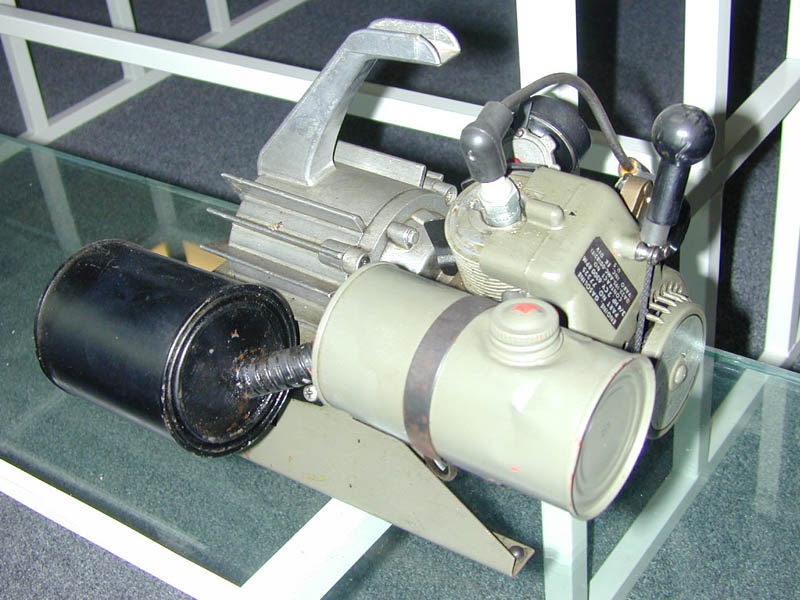
We are also told that these were used during WWII and the Korean War as portable auxiliary power generators to run field radios for communication on the battlefield. Lighter than a large 12-volt battery, they would also produce power as long as you had a source of gasoline for fuel.
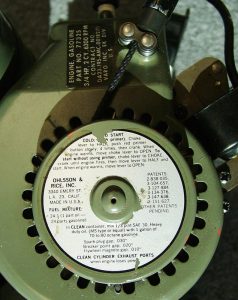
In typical government fashion, complete instructions for starting and running are printed on the engine so any soldier could get it going. Plug gap, points gap, and magneto gap were all right there—as were mixture and starting procedures. Although O&R engines were no doubt chosen for their famous reliability, it was noted in the instructions, “Clean cylinder exhaust ports when engine loses power.”
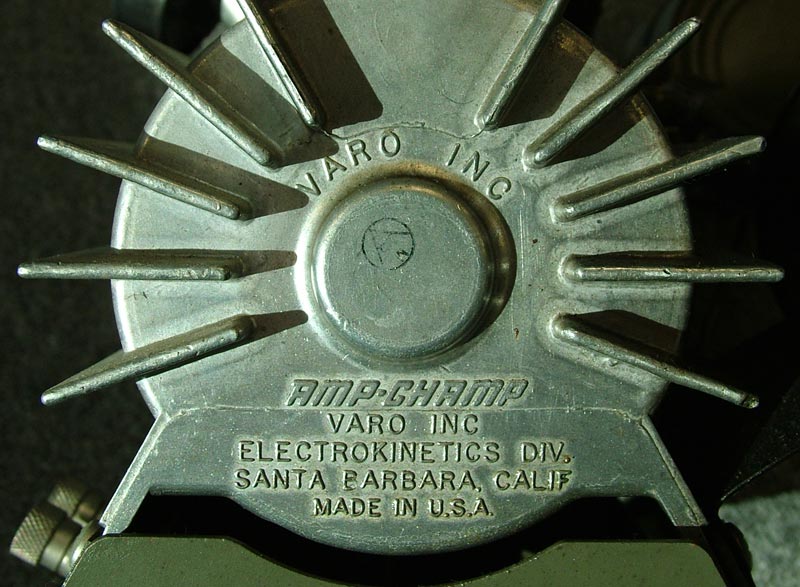
The Varo Amp-Champ is a good example of turning lemons into lemonade, when the wartime market reduced demand for a hobby product like model airplanes. This generator is part of our collection at the Craftsmanship Museum in Carlsbad, CA
Read a full biography of Irwin Ohlsson from the Academy of Model Aeronautics.