The Joe Martin Foundation Museum

Presents the

The Miniature Engineering Museum Collection of Internal Combustion Engines

on loan from Paul and Paula Knapp

On display starting May 1, 2008 at the Craftsmanship Museum in Vista, CA for at least the following year

Also visit Paul Knapp's Miniature Engineering Museum site—"Where engines gather"

Photos: Craig Libuse/Joe Martin Foundation

Paul Knapp and Joe Martin shake hands after Paul delivered the first fifty-one engines from his collection for display at the Vista Craftsmanship Museum. Some of the engines rest on countertops awaiting display in the glass cases. Since then more than 50 more engines have been added to the display. (Click photo to view larger image.)

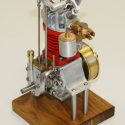
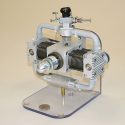
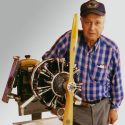
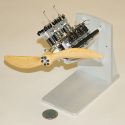
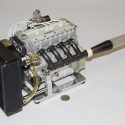
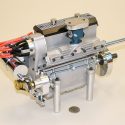
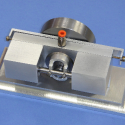
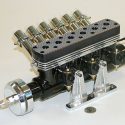
Paul Knapp is a fine craftsman himself, with a real love for internal combustion engines. His wife Paula is also very knowledgeable about the individual engines in the collection and very supportive of Paul's desire to acquire a truly impressive collection of the best from around the world. Over the past few years he has put together a collection of over 200 of some of the finest and most significant model engines to be found. As part of Paul's Miniature Engineering Museum, they have been on display at airports and museums throughout the West, and Paul is in the process of looking for a permanent home where the entire collection can be put on display. In the meantime, we were able to offer the Vista Craftsmanship Museum as home to a good part of the collection. The first display includes over 50 of Paul's finest engines. Over the following year we may rotate some of Paul's other engines through the display, but there will be plenty to look at here for some time to come. In the meantime, for those who can't get by the museum to look at these beautiful models first-hand, this page presents a photo of each engine and a little about it so you can tour the exhibit on your own computer.

This Bentley Rotary engine represents the kind of beauty and excellence in craftsmanship the engines in this collection represent. As an additional item of interest on this particular engine, Paul Knapp built it himself—one of two of the models in the display he built personally. Unlike a radial engine that looks similar, on a rotary engine like this, the propeller is actually attached to the engine itself and the entire engine spins with the propeller on a fixed hollow crankshaft that is attached to the airplane. (Click on photo to view larger image.)

Shown above are some of the engines in their display cases. The engines fill eleven glass display cases, and a descriptive card next to each makes a self-guided tour possible, although a museum guide is always on hand to answer questions. The 70" long display cases have been placed on 12" tall risers to make viewing easier. Take your time and enjoy the beautiful details of each engine. Photos documenting each can also be seen below. (Click either photo to view a larger image.)

Each engine is shown below with a bit of the history behind it and who built it. Click on any of the small thumbnails to see a larger image of the engine. Several views of each engine were photographed while we were doing the studio work, as we felt these engines were worth saving in an appropriate archive for future reference. The engines are displayed in order based on the number that Paul Knapp has assigned them in his collection.

The Miniature Engineering Museum Collection of Paul and Paula Knapp Featured at the Joe Martin Craftsmanship Foundation Museum, Vista, CA

(Click on any photo to enlarge. A U.S. Quarter Dollar coin is placed in each photo for size reference. It is 0.95" or 24.1 mm in diameter.)

Photo (Click to enlarge.)

Description of engine

(Click on any engine photo to view a larger version.)

02—Edwards 5-Cylinder Radial, designed and built by Forest Edwards, early 1980's, L=12", W=2", H=13"

Forest Edwards builds and flies scale model airplanes and engineers miniature engines.  He has won numerous awards for his scale airplanes, engines and flying skills. In the early 1980s, Edwards designed and developed this 5-cylinder radial engine to power his 1/4-scale Fleet model airplane, based on the 1930 Fleet Biplane. He received many requests to manufacture the engine, so between 1982 and 1994, Edwards produced 30 engines. Many were installed into model airplanes and some are still being flown today.

The 5-cylinder radial burns regular gasoline, incorporates a dry sump lubrication system and produces more than six horsepower. In his last few engines, Edwards added a centrifugal advance in the distributor and a crankshaft-driven supercharger for maximum performance.  Edwards’ engines are completely machined from 7075 aircraft-grade aluminum and are perhaps the most reliable model radial engines built to date.

To see a video of how a radial engine works CLICK HERE. The link is to a YouTube.com video generated in a 3D drawing program called Autodesk Inventor. The cutaway view shows the pistons in action on a 7-cylinder radial engine so you can see how all the internal movements are related.

03—Bentley BR2 Rotary Aero Engine, 1/4 scale model built by Paul Knapp, Arizona, 1993. The model weighs almost 23 pounds. L=14", W=12.5", H=14"

Paul Knapp constructed this model with the help of Lew Blackmore's book, Bently BR2 and computer aided design (CAD) drawings by Bill Mazak of Arizona. The engine is machined from stainless steel with aluminum cylinders and heads. The engine burns regular gasoline on spark ignition, has a pressurized lubrication system and a carburetor like its full-size counterpart.

The rotary engines of World War I rotated with the propeller. The hollow crankshaft that extended from the back of the engine was fixed to the airframe and the crankcase was attached to the propeller. Thus, the crankcase and cylinders rotate with the propeller about the stationary crankshaft.

The Bentley BR2 was produced in England and was the largest and most powerful rotary engine used in WWI. It powered many airplanes, most of them biplanes.

07—Conley Small-Block V8 Engine, designed (1988) by Gary Conley, Illinois, model built by Paul Knapp, Arizona, 1993. L=15", W=7", H=10"

This methanol-burning small-block V8 was built from a casting kit designed by Gary Conley.  It incorporates a fully functional scale 671 blower with dual carburetors.  It will turn approximately 12,000 revolutions per minute at full throttle.

10—Cirrus 4-Cylinder Inline Aero Engine, 1/4 scale model built by Merritt Zimmerman, circa 1989, L=19", W=8", H=10"

The 1/4 scale Cirrus 4-cylinder model is one of six made by Merritt Zimmerman. It operates on gasoline with oil mixed in for lubrication. Zimmerman also made 75 1/6-scale-model Cirrus 4-cylinder engines. (One 1/6-scale model also is on display.)

Zimmerman began building miniature engines in the 1940s.  He designed and produced his own castings and also did his own machining. At 83, in less than six weeks, Zimmerman designed, built and tested a 1/4-scale model of the 5-cylinder Kinner radial engine. His engine and drawings were published in 1993 in construction articles in Strictly IC magazine (www.strictlyic.com).

The in-line engine has cylinders in a straight row, or in two rows side-by-side.  The full-size Cirrus 4-cylinder was commonly used in the Avro Baby (designed in 1918) and the de Havilland D.H. 60 Moth (1930-1936).

14—Seidel ST540 5-Cylinder Radial Model Aircraft Engine, designed and built by Wolfgang Seidel, Germany, 1992. L=9", W=8", H=9"

Wolfgang Seidel designed and built several custom radial engines. The ST540, ST770 and ST996 were among the smaller series of radial engines that were used in one-fifth scale and one-fourth scale model aircraft. These engines varied in size from about 8 inches to 11 inches in diameter.

The ST540 is the smaller 5-cylinder 40cc (2.43 cubic inch) radial engine with a speed range of 1,100 to 6,800 revolutions per minute, using a 22-6 propeller. It burns methanol with castor oil mixed in for lubrication, and it is capable of producing 2.8 horsepower.

15—Seidel ST 770 7-Cylinder Radial Model Aircraft Engine, designed and built by Wolfgang Seidel, Germany, 1992, L=10", W=10", H=12"

Wolfgang Seidel designed and built several custom radial engines. The ST540, ST770 and ST996 were among the smaller series of radial engines that were used in one-fifth-scale and one-fourth-scale model aircraft. These engines varied in size from approximately 8 inches to 11 inches in diameter.

The ST770 is a 7-cylinder 70cc (4.17 cubic inch) radial engine with a speed range or 1,000 to 6, 000 revolutions per minute (rpm), using a 26-10 propeller. Its maximum speed is 6300 rpm. It burns methanol with castor oil mixed in for lubrication, and is capable of producing 4.0 horsepower.

16—Seidel ST 996 9-Cylinder Radial Model Aircraft Engine, designed and built by Wolfgang Seidel, Germany, 1993. L=9", W=11", H=13"

Wolfgang Seidel designed and built several custom radial engines.  The ST540, ST770 and ST996 were among the smaller series of radial engines that were used in one-fifth-scale and one-fourth-scale model aircraft. These engines varied in size from approximately 8 inches to 11 inches in diameter.

The ST996 9-cylinder 96cc (5.9 cubic inches) is the largest of the three in this series of engines. It has a speed range of 1,000 to 5,000 revolutions per minute using a 26-10 propeller. It burns methanol with castor oil mixed in for lubrication, and it is capable of producing 5.4 horsepower.

20—Morton M5 Radial Model Aircraft Engine (cutaway), built by Dennis Fadden, Canada, 1990s. L=7", W=6", H=7"

Bruce Satra, of Utah reproduced a Morton M5 engine from 1940s plans and made aluminum castings from the model. Dennis Fadden used Satra’s castings to build this cutaway. Fadden’s M5 has a master-rod that is in the top cylinder with the remaining articulating rods attached to the master. This is a perfect example of how a typical 5-cylinder radial engine operates.

The Morton M5 was originally manufactured in the 1940s and was the first miniature radial engine made for model airplanes. It was designed by Glen Morton of Morton Aviation and was based on the full-size LeBlond radial aircraft engine made in 1928. The radial engine was much more powerful and reliable than the old rotary design. It was used to power large aircraft such as airliners and World War II-era bombers.

34—Cirrus 4-Cylinder In-Line Aero Engine, 1/6-scale model built by Merritt Zimmerman, 1980-1994. L=7", W=3", H=5" 

Merritt Zimmerman produced his own castings to build 75 of this 1/6-scale Cirrus engine (glow ignition) from about 1980 to 1994. He sold many more castings in kit form for miniature engine builders during the same period. To differentiate his engines from those built by others, an oval-shaped embossed emblem with the name Z H Cirrus was bonded to the crankcase identifying those engines completed by him. The oval emblem was not sold or included in any of the kits.

This engine differs from Zimmerman’s prototype in that the cylinders are independent of each other as in the full-size engine. The head is one piece but machined to give the appearance of individual heads characteristic of the full-size engine.  The cam was relocated to the correct side of the engine and the induction system changed to provide lubrication to the internal parts before entering the combustion chamber, typical for a glow-ignition engine.

40—Miniature SJ7 Pulsejet Engine, built by Mike Early, Arizona, circa 1996. L=29", W=13", H=10"

Perhaps the most famous pulsejet engine is the Argus V1 “Buzz Bomb” made by Germans in World War II. Fuel was sprayed directly into the engine through a 3 x 3 array of nine nozzles behind a valve grid—a direct-injection pulsejet. The fuel supply was pressurized by the tank of compressed air that was also used to drive the gyros and operate the control surfaces of the V1 airframe.

This miniature pulsejet engine operates exactly like the V1. It burns regular gasoline and has a variable thrust range from 1/2 to 6 1/2 pounds. Mike Early developed and built the engine, and made the aluminum castings for the intake. He fabricated the combustion chamber and tailpipe from stainless-steel sheet metal. Early produced approximately 12 models from 1996 to 1998.

Anyone who has ever heard a pulsejet run will not forget the sound. It is LOUD, as it is essentially one long controlled explosion.

43—de Havilland Gipsy I 4-Cylinder Inline Engine, 1/4-scale model built by Pat Loop, 1990s. L=8", W=4", H=8", Weight = 9 lb, 2 oz.

Pat Loop handcrafted this miniature Gipsy right down to the spark plugs. It runs on gasoline with spark ignition and a pressurized wet sump lubrication system. Les Chenery provided the castings.

Inline engines have cylinders in a straight row, or in two rows side-by-side. The Gipsy I upright, air-cooled engine was commonly used in the de Havilland 60G and 60M Gipsy Moth and the de Havilland 60T Gipsy Moth trainer. The first de Havilland 60 Moth was built in 1925 as a sports aircraft and a trainer. In 1928, a Gipsy engine was “sealed” and flown for 600 hours.

44—Kinner 5-Cylinder Airplane Engine, 1/4-scale model designed and built by Merritt Zimmerman, Michigan, 1994. L=9", W=11", H=12"

The Kinner Airplane & Motor Corp. of California began building 5-cylinder engines in 1919. The company also built light aircraft from 1931 to 1937. In 1939, the company changed its name to Kinner Motors and produced engines for thousands of World War II training aircraft.

At the age of 83, Merritt Zimmerman designed, drafted, fabricated and tested this scale model within six weeks.

47—Berger 7-Cylinder Radial Model Airplane Engine, designed and built by Lee Berger, California, circa 2001. L=8", W=8", H=9"

This is the first successful 2-cycle radial engine using a common crankshaft with a master rod and articulating rods inside a common crankcase. Since every cylinder of a 2-cycle engine fires on every revolution, an even or odd number of cylinders can be used. In 4-cycle engines, however, each cylinder fires every other revolution, thus requiring an odd number of cylinders.

Two-cycle engines require pressure inside the crankcase to force fuel into the combustion chamber on the intake cycle. In order to accomplish this, Lee Berger designed a positive-pressure pump (supercharger) in the back of the crankcase that maintains constant pressure in the crankcase during operation. A supercharger increases the atmospheric pressure to create more horsepower.

48—Conley V8 Engine, designed and built by Gary Conley, Illinois, 1985. L=8", W=6", H=6"

Gary Conley built several machined V8 engines. He also built a few V4, V6 and V12 models. In 1988-89, he fabricated the molds and patterns to produce a casting kit for his V8 and made it available in several variations. Most commonly, it was supplied with a carburetor, but later versions included multiple carburetors with velocity stacks (specially configured tubes that increase the velocity and direct the air into the carburetor).  Other variations came with miniature superchargers, such as the Roots-style 671 blower commonly seen on hotrods and dragsters in the 1960s.

(See Gary Conley's site at www.conleyprecision.com.)

55—Seidel ST 726 7-Cylinder Radial Model Aircraft Engine, designed and built by Wolfgang Seidel, Germany, 2000. L=10", W=14", H=16"

Wolfgang Seidel designed and produced many small 5-, 7- and 9-cylinder radial engines for model airplanes in the early 1990s. In the late 1990s, his designs led to larger engines, including 5-, 7- and 14-cylinder two-row radials.

The ST 726 is a 7-cylinder 260cc (15.6 cubic inch) radial that weighs approximately 16 pounds.  It burns methanol with castor oil mixed in for lubrication. It swings a 32-12 propeller at 4,500 revolutions per minute.

56—Seidel ST 1426 14-Cylinder Radial Model Aircraft Engine, designed and built by Wolfgang Seidel, Germany, 2000. L=14", W=14", H=16", 31 lb 8 oz with display stand

Wolfgang Seidel custom designed and built several radial engines. The ST540, ST770 and ST996 were among the smaller series of radial engines that were used in one-fifth scale and one-fourth scale model aircraft. In the late 1990s, Seidel designed a larger series of radial engines that are commonly used in the larger one-quarter scale or smaller one-third scale model aircraft.

The ST1426 is the largest engine in the series, and perhaps the largest model airplane engine commercially sold. It is a 14-cylinder two-row 520cc (31.2 cubic inch) radial that is 14 inches in diameter, weighing 28 pounds and turning approximately 4,000 revolutions per minute.

57—“Kitty Hawk” 4-Cylinder Inline Engine, 1/4-scale model made by Lloyd Butler, Ohio, 1980s. L=9", W=10", H=6"

The engine used in the 1903 Wright brothers’ flyer was a 4-cylinder, 4-cycle, internal-combustion engine that lifted the world’s first airplane and its pilot into the air in 1903. The engine was designed and built by Charlie Taylor and the Wright brothers. The engine had no fuel pump, carburetor or spark plugs. It was water cooled and generated 12 horsepower.

Lloyd Butler’s miniature “first engine of flight” model is liquid cooled and burns gasoline on a make-and-break ignition system—just like the full-size engine. A spark is generated between electrodes by breaking contact between them, a system specially adapted for internal combustion engines.

60—Micro Cirrus 4-Cylinder Inline Engine, designed by Merritt Zimmerman, 19741/12-scale models, built in Ukraine, 2001 and 2003. L=5", W=6", H=4"

Two variations of the model Cirrus engine are these micro engines from Ukraine. (See also #112 below for the V-8 version.) They run on methanol with glow ignition and are among the smallest multi-cylinder 4-cycle engines in the world. The custom glow plugs are only a 5mm hex with a 3.5mm thread. The engines are less than 4 inches long and have a mere .5cc displacement in each cylinder, making the 4-cylinder only 2cc and the V8 only 4cc total displacement. Initial test results proved these micro engines would spin their 7- and 8-inch propellers to 13,000 revolutions per minute.
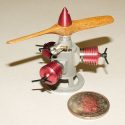
Only 25 of the 1/12-scale 4-cylinder air-cooled engines were produced in 2001 and another 25 of a water-cooled version. In 2003, the remaining parts for the 4-cylinder engines were used to manufacture less than a half dozen each of the air-cooled and water-cooled V8 engines.

62—"Triscamp" 3-Cylinder Miniature Radial Engine, designed and built by Robert Washburn, Washington, circa 1990

Robert Washburn designed and fabricated eight of these tiny 3-cylinder, 2-cycle, methanol-burning radial engines by gearing together three individual engines into one housing.  Lubrication is provided by castor oil mixed with the fuel.

Frances and Robert Washburn published Strictly IC magazine from 1987 until 2001. At the time it was the only publication devoted to the design, development, machining and construction of miniature internal combustion engines. All back issues are still available at www.strictlyic.com.

66—Wall "Wizard" 2-Cylinder Opposed Engine, designed and manufactured by Elmer A. Wall, Wall's Model Engine Laboratory, Chicahg, Illinois, 1940's. L=8", W=12", H=7"

Elmer A. Wall began designing and manufacturing casting kits for miniature internal combustion engines during the Great Depression (1929-1941) and continued until his death in 1948. Among his designs was this 45 cc air cooled 4-cycle engine with overhead valves. He advertised that the engine was so well balanced that it would "start on the first turn-over if machined properly and that it would idle down to a tick or roar full speed when the throttle is opened."

67—Zimmerman “Cirrus” 4-Cycle V8 Engine, 1/6-scale model built by Profi M.E., 2001. L=14", W=6", H=6"

Modifications to the original Zimmerman design are the addition of 4 cylinders and a geared flywheel instead of a propeller hub, making it suitable for a small automobile or power boat. The gear on the flywheel drives a water pump for circulating coolant around the cylinders, through the heads, and into the radiator. Each of the two carburetors fuels one bank of four cylinders.

The connecting rod journals on the crankshaft are located opposite each other at 180 degrees, while the pistons and cylinders are mounted 90 degrees apart. The internal parts are lubricated with a small amount of oil in the crankcase, and with oil mixed in the fuel. The external rockers require manual oiling before running the engine.

70—Seidel ST525 5-Cylinder Radial Model Airplane Engine, designed and built by Wolfgang Seidel, Germany, 2000. L=14", W=12", H=12", Weight=14 lb 12 oz with display stand

This is among the largest 5-cylinder model-airplane engines built to date. It measures approximately 12 inches in diameter and 10 inches in length. It weighs approximately 12 pounds with 8 cubic inches (128cc) total displacement.  It runs on methanol with spark ignition. This is one of a few that has Wolfgang Seidel’s custom electronic ignition on the back of the engine.

75—Eldon I 2636 6-Cylinder Model Boat Engine, designed and built by Eldon Dwyer, New Mexico, early 1980s. L=14", W=8", H=7"

After building a prototype from bar stock, Dwyer made the patterns and castings to produce a second engine that he used in his power boat in 1982. It was modified for an electric starter since it was not readily accessible once mounted in the boat.

In the early 1980s, Dwyer started a company called Robotronics that produced and sold a casting kit and drawings for the engine. It is not known how many kits he manufactured and sold. In the early 1990s, Paul Knapp's Miniature Engineering Museum acquired his patterns, prototype, and this engine.

76—Gay 4-Cylinder Engine, designed and built in, San Diego, California, 1927. L=10", W=7", H=8", Weight=12 lb 4 0z

An instructor (Mr. Gay) and his class at the Naval Machinist School produced this 4-cycle air-cooled overhead-valve engine from aluminum castings, bronze and iron. The crankcase is cast in bronze, making the engine somewhat heavy, but eliminating the need to fabricate and insert crankshaft bearings. The crankcase is the oil reservoir for lubricating the internal parts. The crankshaft slings the oil as it spins. The external overhead rocker assembly is manually lubricated before running the engine.

The spark plugs were originally located on the side of the cylinder block, common for lower-compression engines. Perhaps to improve starting the engine or to improve its performance the plugs were relocated to the top of the head. An aluminum extension (slug) was bolted to the top of each piston to increase compression. The original spark-plug holes were then filled with brass plugs.

84—"Little Dominator" Model Aircraft Engine, designed and built by Noel Jensen, Montana, circa 1993. L=8", W=8", H=9"

When Noel Jensen needed an engine for his model airplane he drew a couple sketches, went into his workshop and produced a rotary valve, twin cylinder, air cooled engine that he called the Little Dominator. His engineering and machining skills led him to a simple design and efficient powerplant. The engine’s one-inch bore and 1.1-inch stroke turns a 16/6 propeller at 6000 revolutions per minute. The engine burns methanol on glow ignition and utilizes belt driven rotary (cylindrical) valves for induction and exhaust.


85—"Dominator" Model Aircraft Engine, designed and built by Noel Jensen, Montana, circa 1993. L=8", W=8", H=9"

See the "Little Dominator" engine above for Noel Jensen's basic design specifications. To achieve more power, Jensen added two more cylinders and produced the flat 4-cylinder opposed model he dubbed the Dominator. It sports ringed pistons, bronze-bushed rods, ball bearing crankshaft and stainless steel cylindrical rotors for valves. Its one-inch bore and stroke will spin a 20/8 propeller at 6000 revolutions per minute.

91—Clarke 1-Cylinder Trolling Boat Motor, 1/3-scale model built by Profi M. E., Ukraine, 2000. L=5", W=3", H=8"

The full-size motor was originally manufactured in Michigan in the 1930s. The propeller is mounted directly to the crankshaft and the entire engine is submerged under water for cooling.  It was only 21 inches long, so it was convenient to transport and to mount to the back of a boat. The operator would tilt the motor out of the water, wind a rope around the pulley and then quickly pull the rope to start the motor (like starting a lawnmower). The curved splash guard above the propeller protected the operator from becoming soaked while tipping the running motor back into the water. The aluminum tube carried the exhaust from the motor up and out of the water to prevent water from entering the motor when it was turned off.

This model is a copy of the full-size 1– horsepower motor.

92—Clarke 2-Cylinder Trolling Boat Motor, 1/3-scale model built by Profi M. E., Ukraine, 2002. L=6", W=3", H=10"

Like the model above, the full-size version of this motor was originally manufactured in Michigan in the 1930s. It operates in the same manner, with the entire motor operating underwater to keep it cool while air is ducted down through the cast case. The copper exhaust pipe runs up above water level and then back down to exhaust under water. This keeps water from entering the motor through the exhaust pipe when the motor is not running.

This model is a copy of the full-size 2-horsepower motor.

93—Luhrs Mini Single-Cylinder, 4-Cycle Engine, built by George Luhrs, Long Island, NY, circa 2001. L=6", W=3", H=6"

Two limiting factors in the miniaturization of gasoline engines are the size of the air and fuel molecules. George Luhrs dispelled the theory that gasoline burning, spark ignition engines can be miniaturized only so far, considering this engines is one of the largest he has built. With a bore and stroke of only 1/8 of an inch, one of his smaller four-cycle, single-cylinder gasoline engines nearly fits inside the gas tank of this engine, and his tiny works of art run magnificently.

George is a master at micro engineering, machining and finishing and has produced a five-cylinder, four-cycle, spark ignition radial engine that fits inside a coffee cup. He has won many awards for his efforts.

109—Stover Type “K” Stationary Engine, Freeport, Illinois, 1920s, model built by George Luhrs, NY, 1990s. L=5", W=3", H=4"

Stationary engines were extensively used to power machinery and equipment in all industries from the late 1800’s into the mid 1940’s. D.C. Stover was a prolific inventor and began manufacturing various products in 1862. In 1916 he formed the Stover Manufacturing and Engine Company and production peaked in 1919. Before closing their doors in February 1942 Stover shipped 277,558 engines. 

George Luhrs is known for producing the smallest engines in the world and his miniature Stover is no exception. He machines every part from bar stock and utilizes no castings. It burns gasoline on spark ignition and, just as its full-size counterpart, requires manual lubrication before operation. Spark is produced by a small coil and battery located in the base.

The engine is accompanied by a box to transport it. The wood for the box and base match, and the lid of the box contains a few special tools to aid in running the motor.

112—"Micro Cirrus" V8 Engine, designed by Merritt Zimmerman, 1974, 1/12-scale model manufactured by Profi ME, Ukraine, 2001 - 2003 

Two variations of the model Cirrus engine are these micro engines from Ukraine. (The 4-cylinder version can be seen as #60 above.) They run on methanol with glow ignition and are among the smallest multi-cylinder 4-cycle engines in the world. The custom glow plugs are only a 5mm hex with a 3.5mm thread. The engines are less than 4 inches long and have a mere .5cc displacement in each cylinder, making the 4-cylinder only 2cc and the V8 only 4cc total displacement. Initial test results proved these micro engines would spin their 7- and 8-inch propellers to 13,000 revolutions per minute.

Only 25 of the 1/12-scale 4-cylinder air-cooled engines were produced in 2001 and another 25 of a water-cooled version. In 2003, the remaining parts for the 4-cylinder engines were used to manufacture less than a half dozen each of the air-cooled and water-cooled V8 engines.

114—Gnome 160 Rotary Airplane Engine, 1/3 Scale model built by Ray Williams, New York, 2001. L=24", W=16", H=19", Display weight=47 lb 10 oz

Ray Williams built both a 1/3 scale model of the Gnome 160 horsepower rotary engine and the World War I Avro 504K airplane that was designed in 1913 in the United Kingdom. Williams flew his model in December, 2001 making this the first model rotary engine ever to fly.

The model engine, as in the full-size engine, operates on gasoline with spark ignition and a pressurized oil system. It has a displacement of 27 cu. in. and the engine itself weighs 11 pounds. The scale model Avro 504K into which it was fitted had a 12-foot wingspan.

The first successful air cooled rotary engine was developed in 1896 in the United States. The French-built Gnome rotary was used extensively in airplanes during World War I. A typical rotary engine has a fixed crankshaft with rotating cylinders and crankcase that carry the propeller. Since the oil cannot be reclaimed from a rotating engine, it is discharged after combustion. (This is known as a "total loss" oiling system.) WWI pilots would constantly have to wipe off their goggles and windscreens from this oil spray during flight.

115—Valentine "Blitz" 1-cylinder Diesel Engine, designed and built by Ron Valentine, Germany, circa 1993

This and the following engine are among the smallest engines in the world. (Note the U.S. quarter dollar coin used as the support base for a size reference.) These 2-cycle diesel engines burn a special diesel fuel that is less viscous and produces combustion when head and pressure are applied. The piston and cylinder are lapped, a machining process that matches the piston to the cylinder so closely in size (within millionths of an inch) that  piston rings are not needed.

A diesel engine has no spark plug. As the piston compresses the fuel and air mixture into the top of the combustion chamber, the heat caused by compression eventually causes it to explode.

116—Valentine "Rasant" 1-cylinder Diesel Engine, designed and built by Ron Valentine, Germany, circa 1993

This and the previous engine are among the smallest engines in the world. (Note the U.S. quarter dollar coin used as the support base for a size reference.) These 2-cycle diesel engines burn a special diesel fuel that is less viscous and produces combustion when head and pressure are applied. The piston and cylinder are lapped, a machining process that matches the piston to the cylinder so closely in size (within millionths of an inch) that  piston rings are not needed.

A diesel engine has no spark plug. As the piston compresses the fuel and air mixture into the top of the combustion chamber, the heat caused by compression eventually causes it to explode.

124—"Sea Lion" 4-Cylinder, 4-Cycle, Water Cooled Marine Engine, built by Jim Hawk, circa 1980's.  L=13", W=6", H=9"

This tiny marine engine was designed and sold as a casting kit by Edgar Westbury of England. Jim Hawk made several modifications to the original design to improve efficiency and performance. He increased the flow of coolant by fabricating centrifugal water pump to replace the original small gear pump. He designed a new dry sump lubrication system and improved the compression ratio by fabricating pistons with oil control rings, a stronger head and combustion chamber as well as stronger, lighter alloy connecting rods. 
126—"Maxse T-Seven" 7-cylinder Radial Model Airplane Engine, built by Maxse Tayler, B.C., Canada, circa 1996. L=31", W=31", H=21" on table stand

Closely resembling the Jacobs 7-cylinder radial engine, Maxse Tayler used the piston and cylinder assemblies from the commercially manufactured Saito 120 model airplane engines. Everything else was fabricated or machined from bar stock. It sports a full compliment of accessories including electronic ignition, shielded wiring, fuel primer pump, fuel-air mixture control, high altitude carburetor pre-heater, two oil pumps, two generators and dual magnetos. The lubrication system uses a dry sump and two-stage oil pump.

It took Maxse several months just to design and fabricate the tooling to balance the master rod assembly. After completion it was equipped with oil pressure and vacuum gages for monitoring performance during operation. It took approximately 7 years to complete.

132—"Green Dragon" Model Airplane Engine, built by John Nuovo, California, early 1990's. L=7", W=5", H=6"

John Nuovo acquired the castings from Australia and produced six engines that he dubbed "Green Dragon" after applying the crackle green finish. This is an air cooled aircraft version with a light weight cast iron lined aluminum cylinder. It burns methanol with castor oil mixed in for lubrication on spark ignition. The fuel is contained within the machined aluminum tank mounted to the back of the engine. he is well known for his precise machining skills and engine building capability to produce engines for airplanes, boats and tether cars.

In 1940, a similar engine was commercially sold as a "Silver Crown Champion" from Champion Products, Co. Los Angeles, CA. The Silver Crown was primarily a boat engine with dual carburetors mounted above the crankshaft, large swept exhaust stacks, parallel head fins and a clamp-on bypass and exhaust manifold.

133—"Green Dragon" Model Automobile Engine, built by John Nuovo, California, early 1990's. L-=7", W=5", H=6"

Like the engine shown above (#132) the two-cycle, air cooled engine was dubbed "Green Dragon" due to its green crackle paint finish. A similar engine was sold commercially in the 1940's under the name "Silver Crown" from Silver Crown Co. in Los Angeles. John Nuovo acquired the aluminum castings and machined the cylinder from steel and the head from bronze. It has two carburetors mounted above the crankshaft, large swept exhaust stacks, parallel head fins and a clamp-on bypass and exhaust manifold. It runs on spark ignition and burns methanol with castor oil mixed in for lubrication. It has a pulley on the flywheel for rope starting and an adjustable timer (with points) in front for setting the spark advance.

135—"Rasant MK III" Diesel Radial Model Airplane Engine, built by Ron Vanlentine, Germany, 2004. L=2.5", W=3", H=2"

Although radial in appearance, the engine operates like an inline engine. Instead of a master rod with its articulating rods in the same plane, the three cylinders are staggered from front to back. Thererfore, the crankshaft is linear, similar to that used in an inline engine. The journals on the crank are spaced to match the cylinders at 120 degrees apart so all of the cylinders fire at the same time. It burns a special form of diesel fuel (less viscous) that produces combustion when heat and pressure is applied. The piston and cylinder are lapped together to within a tolerance of several millionths of an inch, eliminating the need for piston rings. The fuel provides a liquid seal in the cylinder and as the piston compresses the fuel-air mixture into the combustion chamber, it is ignited by heating through compression. Diesel engines require no form of mechanical or electrical ignition but can be difficult to start on cool days.

140—Manx 250IL 2-Cylinder Inline Model Airplane Engine, designed and built by Robert Hoskins, Tennessee, 1979

Robert Hoskins, President of Aero Tech Inc. (Tennessee) developed this engine in 1979 to fly his model airplane. He wanted scale sound; something the 2-cycle engines could not produce. Striving for light weight reliability, he machined this model from aluminum bar stock and engineered 13 ball bearings into it—6 that support the crankshaft alone. Although expensive to construct, the reliability and power output were worth the effort. The engine turned 7500 revolutions per minute with a 20-6 propeller on glow ignition and flew his 35-pound airplane with ease.

Responding to requests from friends Robert began to manufacture the engines for sale. It was never mass produced, but rather individually custom machined, inspected and assembled for maximum quality and reliability. Construction time was long and deliveries were slow, which led to only a few engines actually completed and sold.

143—5-Cylinder Radial Model Airplane Engine, designed and built by Barry Robinson, England, 1998. L=7", W=10", H=10"

This is an all aluminum bar stock engine with a bore of 19 mm, stroke of 19.2 mm and a total displacement of 27.21 cc. The cylinders are lined with chrome plated brass liners and the pistons incorporate compression rings. it measures about 7" in diameter and burns methanol on glow ignition. Barry constructed three of these 5-cylinder radials as well as a few 9-cylinder radials and two-cylinder opposed engines. many of the components such as the piston and cylinder assemblies are common to all of his engines.

144—2-Cylinder Opposed Model Airplane Engine, made by Barry Robinson, England, early 1990's. L=6", W=8", H=4:

Barry Robinson machined the entire engine from bar stock. It has a bore of 19 mm and a stroke of 19.2 mm for a total displacement of 10.9 cc. The cylinders are lined with chrome plated brass liners, and the pistons incorporate compression rings. It burns methanol on glow ignition. Castor oil is mixed with the fuel for internal lubrication, but the rocker arms require manual lubrication before running the engine. Barry constructed only three of these 2-cylinder airplane engines as well as a few 5-cylinder and 9-cylinder radial engines. Several of the components in this engine were used to construct the other variations he designed.

145—JT 1800 9-Cylinder Radial Model Airplane Engine, designed and built by John v. Thompson, Kansas, early 1990's. L=14", W=28" (prop), H=14"

John Thompson employed Saito 120 model airplane engine cylinder assemblies for this radial, but from that point on it is his design. Each cylinder has its own pair of cams that operate the inlet and exhaust valves. it weighs in a t 28 pounds and has a 1.25-inch (32 mm) bore and a 1-inch (24.8 mm) stroke with a total displacement of 10.8 cu. in. (180 cc). Initial tests with a 28-14 propeller indicated it produces 18+ horsepower. John incorporated a Borg Warner 1SH`1 2-inch, 10-blade turbocharger compressor for fuel distribution and atomization located within the intake manifold in the rear of the engine. it runs on glow ignition and burns gasoline with oil mixed in for lubrication. It sports his custom designed hydraulic controlled variable pitch propeller.

146—Thompson "Tarantula" 9-Engine Radial Model Aircraft Engine, designed and built by John V. Thompson, Kansas, 1970's. L=12", W=18", H=11"

Construction articles fro John's Tarantula were published in Strictly IC magazine in the 1980's. The "9-engine" part of the name is not a typo. It is because the engine consists of nine individual Cox .049 1-cylinder model airplane engines geared together in an aluminum crankcase hidden within a plastic Williams Brother Pratt & Whitney R-985 model engine kit. The nine engines are geared to the propeller shaft and all cylinders fire at the same time. It's a 9-engine engine.

The engine performed flawlessly and, surprisingly, the heat did not distort the plastic kit during operation. A single carburetor is mounted on a centralized intake manifold in the back, which has nine tubes extending from the manifold to each engine resembling the legs of a spider...thus the name, "Tarantula." The second photo shows this manifold on the back side of the engine.

147—Thompson Designs Flat Four Model Airplane Engine, model by John V. Thompson, Kansas, 1990's. L=13", W=13", H=11"

John used the cylinder assemblies from Honda weed-eater engines to produce this flat four aero engine. His custom crankcase holds the oil for lubrication and the engine runs gasoline with spark ignition. Spark is provided by a remote electronic capacitor discharge ignition with a spark advance linked to the carburetor linkage. Instead of making an intake manifold to operate all four cylinders from one carburetor, John chose to leave each cylinder assembly as it came from the factory with the carburetor attached to the head. Then he designed a geared linkage to connect and operate the four carburetors from one throttle cable. it swings a 24-10 propeller but no recorded specifications were found to verify its capacity or performance.

148—John Deere Type "E" 1-1/2 HP Stationary Engine, Gene Dettmar prototype, Dettmar Industries, Waterloo, IA, 1980's. L=16", W=10", H=12"

Dettmar Industries of Waterloo, IA began to produce this 1/2 scale model of the John Deere Type "E" stationary engine in the 1980's. Little is known about the company's outcome, but few if any became available for purchase. Since the late 80's, only a small number of casting kits and completed engines have appeared.

This example is a gasoline burning stationary (hit-n-miss) engine with a 1.8-inch bore and 2-inch stroke, enclosed crankcase and a make-and-break ignition system. Oil is held in the crankcase and splashed (slung) around by the crankshaft to lubricate the internal parts while the external components require manual oiling periodically. The model swings the two massive flywheels at an average speed of 600 RPM. The flywheels store the energy necessary to power other machinery and equipment. The full-size engine used a magneto to provide the spark for ignition; however, the model uses a small battery and coil or electronic ignition to spark the contact points within the combustion chamber.

158—Morton M-42 4-cylinder, In-line, Flathead Model Car Engine, made by Jim Hawk, Oklahoma, circa 2006. L=9", W=5", H=5"

In 1944, many of the components used in the Morton M5 radial engine and M-4 inline were to be incorporated into this newly proposed M-42 flathead engine. The drawings for the M-42 were completed, but the engine never made it to production. From only one drawing that survived the Morton Company, Jim Hawk fabricated the wooden patterns, produced his own aluminum castings and machined the components to complete this running model. It burns gasoline on spark ignition and will turn a 14-6 propeller in excess of 6500 RPM.

Flathead engine were commonly called side-valve engines because the valves are  positioned in the block alongside the cylinders. Overhead valves are positioned in the head above the combustion chamber. since overhead valves ere not developed until the 1950's, the heads for the side-valve engines were flat, resulting in the name "flathead."

164—Heinen Motore (HEMO) V-4, designed and built by Jurgen Heinen, Germany, 1994. L=12", W=6", H=7"

Jurgen Heinen machined the engine from aluminum bar stock and produced the finish by hand. it has a bore of 32 mm and a stroke of 28 mm with a total displacement of 20 cc. It is a belt driven dual overhead cam single-cylinder with 4 valves—two for the intake and two for the exhaust. It burns methanol on glow ignition and spins a 20 x 8 propeller up to 14,000 RPM.

166—Sopwith Snipe Instrument Panel, 1/4-museum-scale model built by Robert Cooper, Georgia, 2003. L=6", W=9", H=8"

Robert Cooper built a “museum-scale” model of the 1918 British Sopwith Snipe fighter aircraft.  A museum-scale model contains everything as close to the real thing as possible. For example:  Most aircraft are riveted together with thousands of rivets. In a scale model the builder makes fake rivets with glue drops for each rivet. For museum scale, the model builder makes the rivets, installs them and sets them just like the full-size airplane.

Cooper’s model airplanes have several functional features including the Bentley BR2 rotary engine built by Paul Knapp with throttle quadrant, tamper valve, fuel pump and fuel filter.

This is a copy of the instrument panel from Cooper’s model. It features operating lights from individual toggle switches located in the accumulator box (lower right). The magneto switches (lower left) are below the pulsator (glass tube oil pressure gage). The turn-and-bank indicator and fuel gage are lower center. The second photo shot in low light shows the lights shining on each instrument, powered by a set of batteries on the back of the panel. The tiny switches in the lower right corner of the panel actually activate each light individually.

The pulsator and fuel gage have operational petcocks for emergency shut-off in case of glass breakage. On top are a tachometer, air speed indicator, clock and altimeter. Directly below the air speed indicator is a famous air compass type 5/17 that actually tracks true north just like its full-size counterpart.

171—Tadpole, 1/3-Scale Model of the 1939 Dooling Brother’s “Frog” Tether Car, designed and built by Ted Maciag, Florida, 2006. L=8", W=4", H=2"

Before the advent of radio control, miniature automobile races were accomplished by suspending the model car with a cable (tether) from the center of a 100-foot circular track. The speed of the car could be accurately calculated since the time to complete a lap was recorded and the distance was known. In the late 1930's the Dooling Brothers .60 cubic inch powered aluminum car called the “Frog” made history as it spun around the track at about 80 miles per hour. Ted’s miniature Frog, dubbed “Tadpole”, is powered by a Cox .01 cubic inch engine with a 2:1 gear ratio driving the rear wheels. It runs on alcohol and 25% nitro-methane for fuel and will achieve speeds of about 30 miles per hour.

177—V12 Air-Cooled OHV Model Aircraft Engine, designed by Martin Ohrendorf, Germany, builder unknown, 2000

This 60-degree, overhead valve V-12 is machined from billet aluminum (bar stock) with cast iron lined cylinders. It has a bore of 21 mm and stroke is 21 mm, making the total displacement 87 cc. It burns methanol on glow ignition and spins its 24/10 propeller at 4,500 RPM. Each carburetor supplies fuel to four opposed cylinders, and the three carburetors are linked together for smooth operation. 

189—“Eldon I 2636” 6-Cylinder, Two-Cycle, In-line Model Boat Engine, deigned by Eldon Dwyer, New Mexico, early 1980s, built by Jim Hawk, Oklahoma, late 1980s. L=13", W=7", H=7"

After building a prototype from bar stock, Dwyer made the patterns and castings to produce a second engine that he used in his power boat in 1982. He started a company called Robotronics that produced and sold a casting kit and drawings for the engine. It is not known how many kits he manufactured and sold, but this example is one of three built by Jim Hawk. It is water cooled (including the exhaust), sports a 120-degree crankshaft and burns methanol on glow ignition. In the early 1990s, the Miniature Engineering Museum acquired the patterns, prototype and Eldon’s power boat engine.

Engines added to the museum display on July 24, 2008

04—14-Cylinder, Twin-Row Radial Engine, 1/8 scale, designed and built by Dennis Fadden, Canada, circa 1996. L=8', W=6", H=7".

The model operates on regular gasoline with spark ignition and swings a 12-inch diameter propeller. Dennis Fadden used cylinder and head castings produced by Bruce Satra, Utah, rather than machining them himself. However, most of Fadden's model engines are machined from bar stock rather than using castings.

Fadden's engines vary from simple single-cylinder model airplane engines to complex in-line and opposed multi-cylinder engines. Fadden also has produced an array of custom designed model inboard and outboard boat motors. he does not produce or use any drawings to create his engines.

The radial engine was originally developed in the 1920's. The model is based on engines built by several manufacturers in the 1930's and 1940's for use in World War II aircraft.

05 and 06—Fadden 1-cylinder and 3-cylinder Engines, designed and built by Dennis Fadden, Canada, early 1990's. L=7", W=6", H=8".

Dennis Fadden designed both the 1-cylinder and the 3-cylinder engines. Bruce Satra, Utah, made the cylinder and head castings for both engines, but Fadden machined the crankcase for the 1-cylinder engine from bar stock (billet) material.

To produce the 3-cylinder radial engine, Fadden made patterns from wood and used the patterns to sand cast the crankcase and gear case from aluminum. Then he machined the castings and internal parts.

Both engines have spark ignition and burn regular gasoline or methanol mixed with oil for lubrication. Most 1-cylinder spark ignition engines utilize a timer assembly (moveable set of points) governed by the crankshaft to trip the coil that fires the spark plug. In a 4-cycle engine, the spark plug fires every revolution, wasting the spark on exhaust fumes. To eliminate this problem in the 1-cylinder engine, Fadden added the camshaft-driven distributor with a rotor to direct the high tension electricity from the coil to the spark plug.

11—Mason "Mastiff" 4-Cylinder Opposed Engine, designed by L.C. Mason, England, built by T.E. Murphy, Phoenix, AZ, 1982. L=13", W=8", H= 9", Weight = 13 lb.

After L.C. Mason designed this water cooled engine he published a book on how to machine and construct a running engine. T.E. Murphy fabricated everything for this dual carburetor version, including his own spark plugs. The engine burns gasoline on spark ignition. it has a 19 mm bore with a 22.2 mm stroke. Total displacement is 24 cc.

22—Loop Aircraft Tachometer, 1/4 scale, designed and built by Pat Loop, Washington, 1995.

Tachometers display the speed of an engine in revolutions per minute (rpm) and this is one of the smallest mechanical tachometers in the world. Pat Loop created this miniature tach to confirm that it could function and display rpm as accurately as a full-size tach. Extensive testing proved that it could. It displayed accurate readings from 0 to 7000 rpm.

Tachometers are usually driven by a flexible shaft or cable attached to the engine's camshaft. Within its mechanism, the rotating shaft generates a magnetic field that creates needle movement as the engine's speed changes. This mechanism can be calibrated so the needle accurately displays the engine's exact running speed.

37—Coholic 3-Cylinder Radial Engine, designed and built by Andrew Coholic, Canada, 1999. L=8", W=4", H=9".

Andrew Coholic created this tiny 2-cycle radial engine by mounting three Cox .049 engines into a common crankcase. The engines are geared together with a common propeller shaft, and they alternately fire every 120 degrees. The carburetor is mounted to a manifold that feeds fuel to each engine upon its intake cycle.

Two-cycle engine usually require pressure in the crankcase to force fuel into the combustion chamber on the intake cycle. The gearing of individual 2-cycle engine together eliminates the need for a pressurized crankcase.

A 1-cylinder, 2-cycle engine produces the necessary pressure as the piston is driven down toward the crankcase from combustion. Since radial engines have pistons traveling away from the crankcase at the same time other pistons travel towards the crankcase, the pressure is cancelled. Therefore, 2-cycle radial engines require a pump or supercharger to increase and maintain pressure in the crankcase during operation.

41—18-Cylinder, Two-row Radial Engine, 1/4 scale, made by Harold Beckett, circa 1995

Harold Becket is a retired United Airlines pilot who handcrafted this engine from drawings provided by Sam and Lee Hodgeson. The model operates on regular gasoline with dual spark ignition. It has a pressurized lubrication system.

The radial engine was much more powerful and reliable than the old rotary design (where the whole engine turns). It was used to power large aircraft such as airliners and bombers. Two-row radials were used extensively in World War II aircraft. The Pratt & Whitney R-1830 (14-cylinder two-row radial) was produced in greater numbers than any piston aircraft engine. it was used in the Consolidated B-24 and PBY-2 as well as the Douglas C-47/DC-3.

In 1939, the Pratt & Whitney R-1830 was installed in the Grumman F4F-3 and was the world's first engine to use a two-stage supercharger—two years ahead of the first two-stage Rolls Royce Merlin V-12 engines.

49—Kavan FK50 MKI 2-Cylinder, Opposed Miniature Airplane Engine, designed and built by Franz Kavan, Germany, mid-1980's. L=9", W=11", H=8", Weight = 9 lb-10 oz.

The engine burns methanol on glow ignition. Later production engines became available with a shielded spark ignition. Placing the spark plug wires into a metal casing (braided tubing) eliminates radio interference generated by the spark plugs, essential when flying radio controlled model aircraft.

This is one of the earliest model airplane engines with an oil sump that holds lubricating oil for the crankcase components. This is known as a "splash" oil system. The crankshaft is partially submerged into the oil level in the sump. As it spins, it slings oil throughout the entire crankcase assembly. The upper combustion chamber, rocker arms and valves are lubricated by oil mixed with the fuel.

This engine resembles half of the 4-cylinder Continental C-85 commonly used in the Piper Cub airplane shown below.

54—Continental C-85 Opposed Aircraft Engine, 1/4 scale, built by Dennis Fadden, Canada, circa 1990. L=10", W=10", H=9", Weight = 8lb.

Dennis Fadden's Continental C-85 is a "true-to-scale" model of the full-size version that was commonly used in light aircraft during the post-World War II period—most notably in the Piper Cub.

The model burns gasoline, has a dual spark ignition and a pressurized oil system. Fadden detailed the engine right down to the embossed valve covers and the true-to-scale air cleaner. The crankcase is an aluminum casting produced from hand crafted wooden patterns that Fadden made himself. This C-85 model is the first of only two produced by Dennis Fadden.

63—Satra 0-440 4-cylinder Opposed Model Aircraft Engine, designed and built by Bruce Satra, Utah, mid-1980's.

Bruce Satra engineered and fabricated this 40 cc, 4-cylinder opposed model aircraft engine for a series of construction articles that were published in Strictly IC and Engineering in Miniature magazines.

69—Anzani 3-Cylinder Radial Aircraft Engine, 1/4 scale, designed by Les Chenery, England, built by Roger Butzen, California, circa 1995. L=15", @=23", H=12", Weight = 14 lb-2 oz.

This scale model runs on gasoline with spark ignition and pressurized lubrication system. The cylinders are spaced 120° apart, thus creating a radial configuration. Engine drawings and castings for the crankcase, cylinders and carburetor were provided by Les Chenery.

In the early 1900's, Italian-born Alessandro Anzani began building engines in France. his first success was a 2-cylinder motorcycle engine that established a world speed record in 1905. A few years later, Anzani turned to making an aeroplane engine.

Anzani tried various designs, and then, in 1910 he simply added a third cylinder to his twin cylinder, air-cooled motorcycle engine. he did this by arranging the cylinders first in a fan shape (model engine also on display) and later in radial form. In this way he eliminated the radiator and all water cooling apparatus, reducing engine weight significantly.

73—Schillings 4-Cylinder In-line DOHC Engine, designed and built by Hubert Schillings, Germany, circa 1975. L=11", W=6", H=6", Weight = 7 lb-2 oz.

Hubert Schillings designed several miniature engines from 1970 to 1980. Configurations vary from 1-cylinder aircraft engines to 2-, 3-, 4-, 6- and 8-cylinder inline and V-type engines for both aircraft and automobiles. Most of his engines were machined from aluminum bar stock, but a few were machined from magnesium.

The 4-cylinder in-line dual overhead cam (DOHC) engine has cylinders in a row vertical to the crankshaft. Each cylinder has four valves (two for intake and two for exhaust) to improve performance and efficiency. Two camshafts operate the valves. One camshaft operates the intake valves and the other the exhaust valves, thus "dual overhead cams."

Typically, Schillings used belts to drive the cams rather than gears, but rarely enclosed the belt drive system in a housing as is seen here. It is not known how many of these 4-cylinder DOHC engines he produced.

77—Holt 75 Caterpillar Engine, Model by Reinhold Krieger, Germany, 2001. L=12", W=7", H=10", Weight = 15 lb.

The Holt 75 Caterpillar casting kit was first introduced by Cole's Power Models of Ventura, CA around 1940, but after WWII it lay dormant. Coles re-activated it in 1970 after a new set of patterns was made to comply with the modern foundry practices. It is a 4-cylinder, 4-cycle, water cooled in-line engine that was, in full size, most successfully used in tanks of WWI. The speed of the engine is controlled by a centrifugal fly-ball governor that was commonly used for governing the speed of steam engines. The model engine has a bore of 1 inch and a stroke of 1-1/4". The crankcase holds the lubricating oil that is distributed by the crankshaft as it spins, but external rocker arms must be manually lubricated before operating the engine. it is water cooled and burns gasoline using a spark ignition.

79—Wall Duplex Mariner, built by Elmer A. Wall, circa 1940-41. L=9", W=6", H=8".

Elmer A. Wall, an engineer/inventor of considerable ability, operated a motor car manufacturing company in Chicago before Ford made his Model "T." He also designed and built an electrical power system supplying part of the city before Consolidated Edison existed. He had many associates in the engineering profession in this country and abroad. During the depression he began designing and manufacturing casting kits for miniature internal combustion engines such as this Duplex Mariner.

Wall's Model Engine Laboratory was located in Chicago, IL and the catalog cover read:

"Build Your Model Internal Combustion Engines with

WALL CASTINGS and DETAILED DRAWINGS

on your own lathe in your own work shop.

Easy to Build and Interesting to Run.

Suitable for Model Aircraft and

Record-Breaking Model Power Boats.

Also

Has it ever occurred to you that in buying these construction sets you are purchasing knowledge which has taken some other man, an expert at his job, a lifetime to acquire?"

86—Miniature 7-Cylinder Radial Engine, designed and built by Pius Job, Switzerland, 1993. L=10", W=9", H=15" (on stand).

Pius Job, a Swiss engineer, worked for Esec USA when he fabricated this engine from aircraft grade aluminum and steel. The lightweight aluminum cylinders are lined with cast iron sleeves to support ringed pistons, and the crankshaft and cam ring ride in ball bearings. it burns methanol (with oil mixed in for lubrication) on glow ignition and turns a 24-10 propeller at 6,000 rpm. The external rocker arms require manual lubrication before operating the engine.

98—Fadden 1-Cylinder Model Airplane Engine, designed by Bruce Satra, Utah, 2000 and built by Dennis Fadden, Canada, 2002. L-5", W=4", H=5".

Dennis Fadden built this model engine using castings made by Bruce Satra. The cylinder and head assembly is from a 1/6 scale model of the Pratt & Whitney R-985 Wasp Jr. 9-cylinder engine that Satra manufactures and sells as a kit.

Utilizing just one cylinder assembly, Satra designed and engineered this new product. After machining his first engines from aluminum bar stock, Satra produced castings for the crankcase and began selling this little single Pratt in kit form too.

100—Anzani 3-Cylinder Fan Engine, 1/4 scale, designed by Alfred Eichinger, Austria, custom built in Ukraine, 2002. L-8", W=12", H=9", Weight = 3 lb- 13 oz.

The automatic inlet valves are situated inside the head where the intake pipe connects. The exhaust valves are mechanically operated at the back of the combustion chamber. The model has spark ignition and burns gasoline mixed with oil for lubrication.

In 1910, Italian born Alessandro Anzani added a third cylinder to his twin-cylinder, air-cooled motorcycle engine to create this fan-type aircraft engine. Anzani's fan engine carried Frenchman Louis Blériot in his monoplane over the English Channel in 1909—the world's first flight over a large body of water in a "heavier-than-air" craft.

Anzani later revised the fan design moving the three cylinders from above the centerline into a radial design. The three cylinders were spaced 120° apart for smother operation. this is one of six Alfred Eichinger models custom built in the Ukraine in 2002.

106—1-Cylinder, 4-Cycle Model Boat Motor, designed and built by Henry Parohl, NY, 1960's. L=5", W=4", H=4".

“On September 8, 1935 at the annual Walter Elliot Memorial Race in New York’s Central Park, Henry was crowned a new champion when his gas driven Elanor 2 powerboat was clocked at 26.77 mph in 5 laps around a 750 foot circular coarse. The precision necessary in the construction of the motor was nothing new to the owner, who in private life, was a craftsman making tiny dies for a wrist watch company.”

   —From The Model Craftsman, November, 1935

Little information is known about Henry Parohl’s engines, but most were designed to power model boats.  It is estimated he built about 350 model engines of varying configurations from single-cylinder 2and 4-cycle engines to complex multi-cylinder boat and airplane engines. Toward the end of his model engine building career he designed and constructed a few model (Mazda type) rotary engines and began to fabricate a small jet engine. 

121—Supercharged Thunderbird Miniature Engine, manufactured by Scott Motors, Inc., Arizona, 1940s. L=6", W=3", H=6".

In 1946, the Thunderbird was advertised as the only miniature engine with a genuine supercharger, “just like the big ones!” Supercharging increases atmospheric pressure in the engine to produce more horsepower.

The ad described the engine as “the perfect racing engine for airplanes, cars and boats.”

Scott Motors, Inc., was located at Sky Harbor Airport. It was owned by John Connelly and Leland Hayward. Connelly ran the aircraft overhaul facility at the airport and Hayward had some connection with the airline industry. The company was named after Connelly’s son, Scott.

123—Wankel (Mazda Type) Rotary Engine, model designed and built by Henry Parohl, NY, 1960s. L=6", W=7", H=6".

Henry Parohl miniaturized almost every configuration of internal combustion engine that was invented, including this Wankel (Mazda type) rotary engine. It is a two-cycle engine that burns gasoline with oil mixed in for lubrication. The tank sits above the engine and the fuel is gravity fed into carburetor’s float bowl (cylindrical tank next to the carburetor. The float bowl retains a steady level of fuel and maintains constant pressure for the fuel available to the carburetor. The spark for the ignition is provided by an external battery and coil.

125—Parohl Single-Cylinder, Overhead Valve (OHV) 4-valve Model Boat Engine, designed and built by Henry Parohl, New York, 1960s. L=9", W=9", H=10".

To gain efficiency and performance Henry Parohl installed 4 valves in the head of this engine. The two rocker-arm shafts are controlled by a single camshaft behind, and at the base of the cylinder. Gasoline is gravity fed into the float bowl (of carburetor), which maintains a constant pressure and steady volume of fuel available to the carburetor. Lubrication is accomplished by gravity from a small transparent reservoir that the operator must fill before running the engine. It is located behind the fuel tank and slowly meters oil from the reservoir into the engine for lubrication during operation. The rocker-arms and shafts must be manually lubricated before running the engine. Typically model air-cooled engines are designed for aircraft, but Parohl fitted this one with a flywheel and rope-start pulley for a model powerboat or automobile.

130—Fadden .010 Outboard Boat Motor, designed and built by Dennis Fadden, Canada, 2005. L=3", W=1", H=3.5"

This is one of two miniature boat motors Dennis Fadden machined from bar stock that incorporated a Cox .010 engine. Because of the complex contours and radii of the lower end, most were hand formed. First, material is removed by rough machining on conventional equipment with straight linear cuts. Then, the contours are created by hand with files. It’s precise, requiring a good eye, patience and a tremendous amount of time.

142—Racing Thunderbird (Hayward-Connelly), manufactured by Scott Motors, Inc., 1940’s. L=5", W=4, H=6".

Scott Motors, Inc., was located at Sky Harbor Airport in Phoenix, AZ. It was owned by John Connelly and Leland Hayward.  Connelly ran the aircraft overhaul facility at the airport and Hayward had some connection with the airline industry. The company was named after Connelly’s son, Scott. The Racing Thunderbird engines were developed and tested in the Phoenix facility, but it is not known if any were actually sold between 1946 and 1948 when the company relocated to the San Francisco Municipal Airport. Just as production was getting underway on the Racing Thunderbird a fire destroyed much of the manufacturing facility, which put a halt to continued work. 

At that time, the introduction of the glow plug made the already manufactured parts and engines obsolete; combined with tumbling prices for model airplane engines Scott Motors closed its doors forever.

154—Boxer 2-Cylinder Opposed Aircraft Engine, designed and built by unknown maker, Germany, unknown date. L=9", W=9", H=7"

The 4-cyle engine appears to be made from castings, but was actually constructed from aluminum, brass and steel bar stock. Much of it was roughed out on conventional machine shop equipment. Many hours were spent hand-forming the parts using files and scrapers. The finish was applied by glass beading the surfaces and then nickel-plating the steel parts, such as the rocker arms and propeller hub.

The most unique feature is two exhaust ports for each cylinder. This was accomplished by drilling into the head from the front, cross drilling from the top to the bottom, and then plugging the original hole ahead of the exhaust pipes.

Someone in Germany restored this engine for display. For a finishing touch, he plated the steel exhaust pipes with chrome and then heated them with a torch until blue. This gives the appearance that the engine has been run since the restoration.

167—K-35 Single-Cylinder, Two Cycle Model Airplane Engine, designed and built by Fred Kunze, Arizona, 1975. L=8", W=4", H=5"

Fred constructed and sold 39 of his model K-35 airplane engine. It has a 13/16 inch bore, 3/4 inch stroke, and burns methanol on glow ignition. It swings a 12-6 propeller over 8, 000 revolutions per minute.

168—Supercharged V-8 Racing Engine, designed and built by James Weber, Riverton, Wyoming, 2004.

Closely resembling the Chrysler 300 ‘Hemi’ from the early 60s this 1/3-scale model has a 1.0 inch bore and .900 inch stroke for a total displacement of 5.65 cubic inches. The engine burns gasoline or methanol (methyl alcohol) on dual electronic spark ignition and incorporates a two-stage pressurized dry-sump lubrication system. His custom designed Roots type sliding-vane supercharger with dual carburetors pushes the engine speed to 12,000 revolutions per minute.

James spent 5 years in the design and development of this engine and it is machined entirely from aircraft grade aluminum and steel bar stock. He is a self-taught machinist who honed his skills and techniques within his home machine shop. His quest is to educate and encourage others to learn machining and enter into the world of miniature engineering.  Visit his site or contact him at: www.weberprecision.com

172—Vega 50 T Two-Cylinder, Opposed Model Airplane Engine, manufactured by J.C. Harbone, England, 1980. L=7", W=7", H=5".

The valves, lifters, and pushrods are integral within the finned portion of the cylinders giving it the appearance of a 2-cycle engine. In reality it is an 8.5 cc four-cycle, side-valve (or flat-head) two cylinder aircraft engine that burns methanol (methyl alcohol) on glow ignition. The valves are positioned parallel to and behind the cylinder rather than above the cylinder and inside the heads.

174—Single-Cylinder, Air-Cooled, Four Cycle OHV Engine, United Kingdom, builder unknown, date unknown. L=5", W=12", H=9".

 The striking features of this engine are the complexity of the carburetor and the use of only one threaded stud to mount both the intake and exhaust manifold. The crankcase is filled with motor oil for internal splash lubrication; however the unusual overhead rocker and valve assembly must be manually lubricated before operation. It burns gasoline on spark ignition and the large Bosch spark plug indicates it may have been built in the early 1920s or 30s.

175—Three-Cylinder, Air-Cooled, Radial Model Air