The Internet Craftsmanship Museum Presents:

Building a Howell V-4 IC engine

A second group project with parts made by model engineers around the world

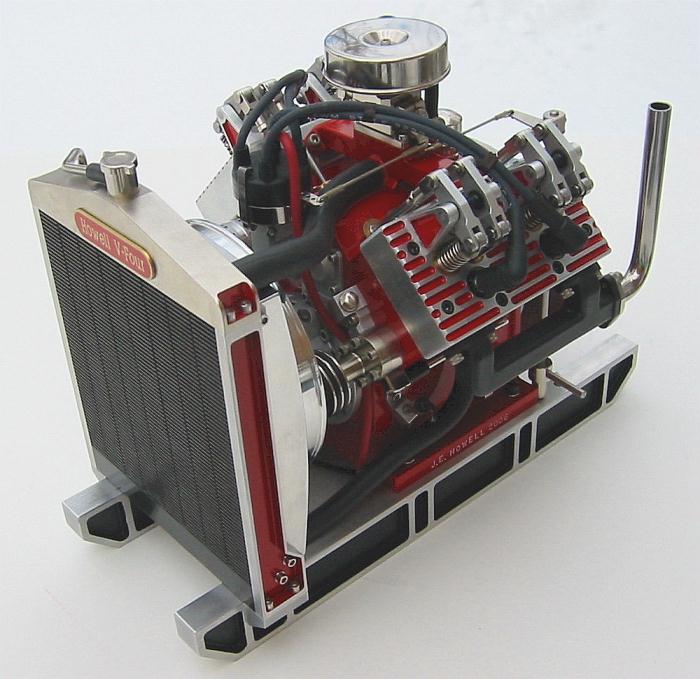
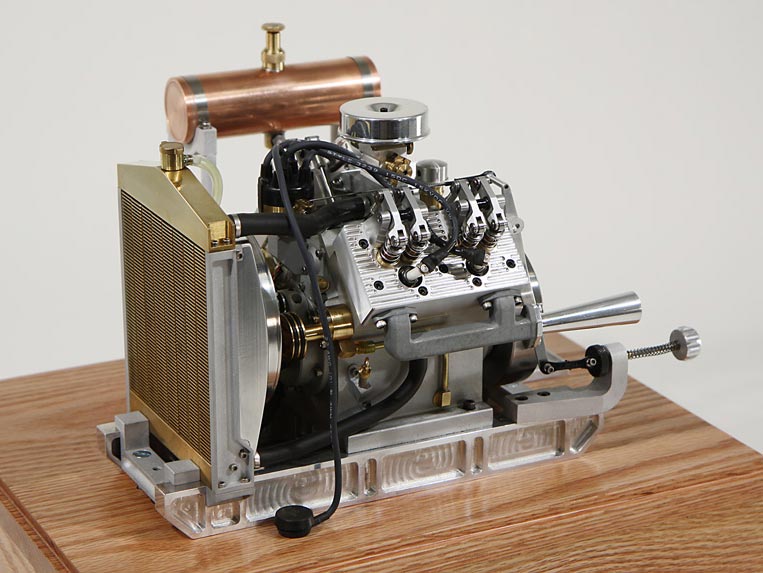
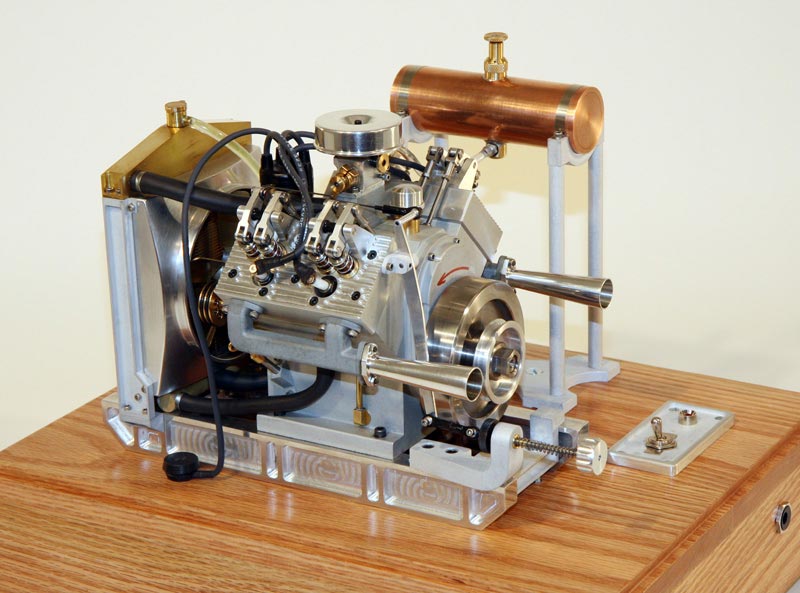
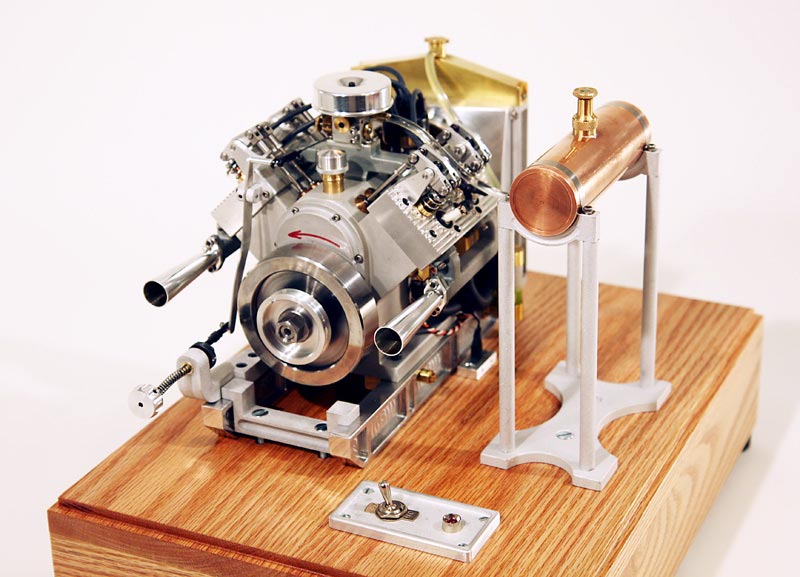
Here are a couple of photos of Jerry Howell's finished 90° V-4. Jerry has done a beautiful job in both the design and construction department. The engine has a solid look to it and is beautifully machined and finished. We will have a hard time topping Jerry's fine craftsmanship. You can be a part of this project too. Read on to find out how. A list of model engineers who contributed parts when the engine is finished will be displayed along with the engine in the Craftsmanship Museum in Vista, CA. (Click on a photo to view a larger image.)

Video of Engine Running

Click on one of the images below* to view a video of the engine being started and run. Jerry disconnects the battery so the starter becomes a generator that lights two light bulbs and then revs the engine. 60 seconds.

Smaller WMV file, 7.2 Mb (352 x 240 pixels, 29.97 fps) Windows® only

Larger MPEG file, 14 Mb (720 x 480 pixels, 29.97 fps) Windows or Mac

Engine Specifications

Designer: Jerry E. Howell, Colorado Springs, CO

Type: 4-cycle, water cooled, twin cam, 90° V-4

Size: 7.6" L (with radiator) x 5.75" W x 7.07" H (on skid)

Displacement: 1.95 cu. in. (32 cc)

Bore: .875"

Stroke: .812"

Flywheel Diameter: 3.0"

Carburetor: 2 jet

Ignition: Hall effect distributor

Fuel: 30% white gas/70% methanol

Project began: 09/25/07

*NOTE: For smoother viewing we recommend you right click on one of the video link images and choose "save target as," saving the file to your desktop or a videos folder. Then play the file. You may save the file for replay later without having to download again.


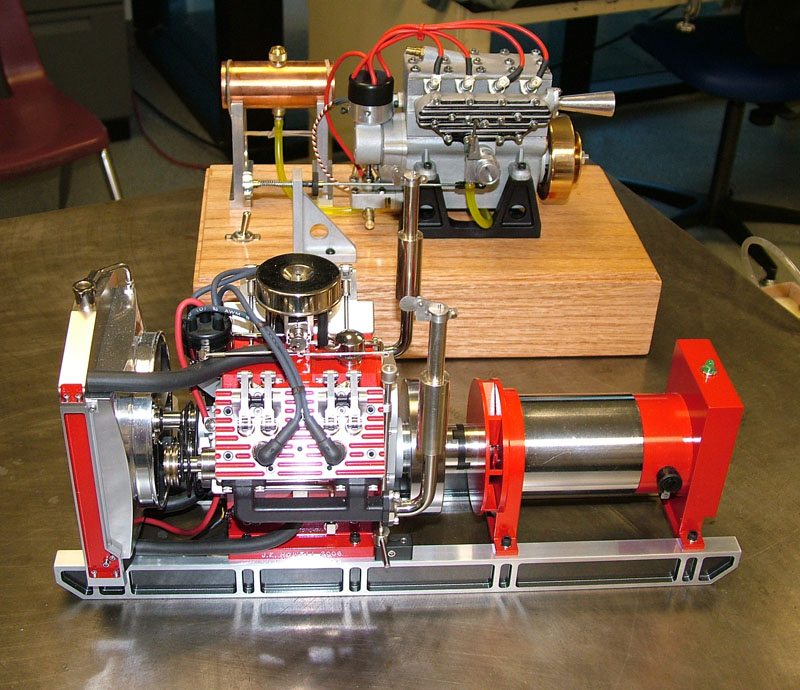
Past and future—Jerry Howells' V4 sits in front of our first project, the Seal engine. (Click on photo to enlarge.)

The Howell V-4 Engine Project—How you can be part of the build team!

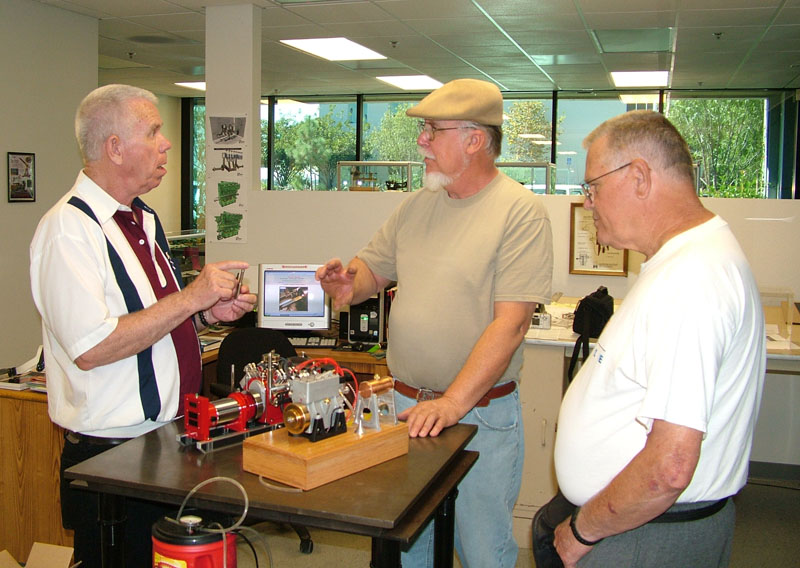
(L to R) In October, 2007 Jerry Howell visited with shop craftsman Tom Boyer and founder Joe Martin. Jerry stopped by the museum for a visit and brought the prototype V4 with him to inspire us.

The Joe Martin Foundation is beginning the construction of a second internal combustion 4-cylinder engine that will eventually be displayed and run as part of the museum's collection in Vista, CA. We have obtained a set of plans from Jerry Howell and Tom Boyer of the museum's shop will once again act as both lead machinist and job coordinator. We invite model engineers from around the world to participate in this project with us. We will be glad to make available dimensioned plans for the needed pieces to those who would like to make parts for the engine. Once completed, the engine will be displayed along with a credit list noting the names of all who participated. A list of available parts will be made available on this web page soon. Tom will be machining the block and Joe will be making the camshafts, but there will be plenty of other parts to be made for this fine engine. Now that we have the Seal engine under our belts, this one should proceed more rapidly.

If you have questions or comments or would like to specifically request a particular part to build, contact shop foreman and project manager Tom Boyer.

Phone: (Tuesday through Friday, 9 AM-3 PM, Pacific)--(760) 727-9492

e-mail: craig@craftsmanshipmuseum.com or tom@craftsmanshipmuseum.com

These photos showJerry's finished V4 prototype. Note the finned (but non-functional) alternator running on the belt drive in the 3rd detail photo. Finishes on Jerry's model are so perfect this is going to be a tough act to follow. (Click on any photo to view a larger image.)

The Build Team

A US Quarter Dollar coin is used for size reference in some part photos. (Click on any photo to view a larger image.)

BUILDER NAME/DETAILS COMPONENTS BUILT
Jerry Howell, Colorado Springs, CO

Designed engine, drew CAD plans and built first running prototype. Jerry is shown at the left holding the prototype V4, which gives a good idea of its size.

Tom Boyer, Escondido, CA

Tom is the museum shop foreman and resident craftsman. He will machine the block, make small fittings and parts as needed and do final assembly.

Tom holds the billet of aluminum that will become the engine block.

Joe Martin, Oceanside, CA

The museum's founder, Joe created a machine and a program to grind the camshaft on a specially modified Sherline CNC mill. Joe will be building the crankshaft for the V-4.

Joe is shown making helical distributor gears for the Seal project.

Bob Seigelkoff, Hayward, CA

Project: Four aluminum pistons plus a fifth for a spare.

Adam Krichbaum, West Lafayette, IN

Project: Engine/Radiator Mounting Skid Rails

Dave Eggert, Mission Viejo, CA

Project: Air Cleaner

Pam Weiss, Vista, CA

Project: Fan blade programming and cutting

Larry Simon, Carlsbad, CA

Project: Assorted tools and fixtures

Craig Libuse, San Marcos, CA

Craig maintains the web site, takes the photos for this page to document the project and is coordinating the program and keeping the builders and public informed on progress.

N/A

Click on any photo above to view a larger image.

Plans  available for the Howell V-4 and other interesting engines

If you’d like to build your own Howell V-4, this and other engine plans can be found at Jerry Howell's site at www.jerry-howell.com. Jerry was kind enough to contribute a set of plans to the foundation for this build, but you can obtain your own complete set for $63.00 plus $2.00 shipping/handling. Included are 64 sheets of CAD plans plus 5 pages of building notes.

Here are photos of the Howell V-4 engine in progress:

(Click photos to view larger images. During the build, this section is oriented with the most recent photo at the top and the oldest at the bottom for those checking on the progress. Once the project is completed, the order will be reversed so you can follow the build from beginning to end.)

This is what we are shooting for. Here are some excellent photos of Jerry Howell's completed V-4 that can be found on his web site at http://www.jerry-howell.com/V-Four.html. Eventually these photos will be replaced with ones of our own completed engine. Compared to the photos at the top of the page, these photos show the longer rails (cut on a Sherline CNC mill) and generator at the end of the engine. Mounted on the end of the generator is a small LED engine hour meter. Jerry also made some tilting covers to keep "rain" out of the vertical exhaust pipes.

September 19, 2007

Ya gotta start somewhere... Here is the block of 7075 aluminum Pam cut out on Sherline's FlowJet water jet cutter. A US Quarter shows size. It will become the engine block of the V-4. Tom is seen holding it here in hopes we will soon be able to take a similar shot of him holding the completed block and eventually the completed engine.

September 25, 2007

The billet of material has been squared up to size and is shown in the first photo bolted to a fixture on a faceplate while the crankshaft hole is bored. The second photo shows the other side of the block after the flange on the second side has been turned and the two internal counter-bores have been added.

October 4, 2007

1. One of the surfaces for the head has just been cut smooth with an end mill and finished with a fly cutter.

2. The cylinder holes on the first side are drilled to make a clearance hole for the boring tool.

October 5, 2007

1. A boring tool is seen bringing the cylinder holes to size.

2. Both cylinder holes on the first bank are completed. The scribed line in the red Dychem shows where the second face will be machined for cylinders 3 and 4.

October 9, 2007

1. Tom has machined the second cylinder head flat, and now the block is beginning to take on the "V" shape. A drill is set to make the clearance hole to bore the second bank of cylinder holes.

2. A boring bar is used in the mill to open up the cylinder holes to exact size.

October 9, 2007

The block with all 4 cylinders bored.

October 19, 2007

The block is mounted to a large faceplate on the lathe and a dial indicator is used to find the center of the cylinder holes. The second photo shows the block removed from the faceplate after each cylinder hole has been counter-bored.

The bottom of the block as of late November shows the access to the crankcase. At this point about half of the original material has been removed.

This setup on the Sherline mill was used to open up the five lightening holes called for in the intermediate cam gear. The holes were first drilled and then (as seen in the photo) a 3/8" end mill was used to true them up. The plans for the part can be seen in the background.

December 26, 2007

1. Machining the spark plug hole and counter bore at a compound angle. The silver vise is being held at a 12° while the head on the mill is tilted to 8°.

2. Using a ball end mill to form part of the combustion chamber.

3. A different angle of view for the above process.

The head with spark plugs installed seen from what will be the top side.

From the bottom side you can see tow pairs of holes for the valves and the spark plug holes nestled between them.

January 3, 2008

Photo 1 shows a small end mill being used in the Sherline 2000 mill to cut the cooling slots in the top of the head.

Photo 2 shows the two heads with the cooling slots cut.

January10, 2007

This setup shows the radius on the end of the rocker arm brackets being cut using the rotary table. Note the special clamp Tom made to hold the brackets during machining.

The finished rocker arm brackets. After machining, a couple of passes on a stone or piece of fine sandpaper on a flat surface remove the machining marks and allow the part to transition smoothly from flat sides into the radius.

January 24, 2008

One of the heads with rocker arm brackets and spark plugs installed.

Bob Seigelkoff made these four aluminum pistons plus a spare.

Tom Boyer machines a round boss on the distributor drive housing/camshaft end cover using a rotary table on the museum shop's Sherline Model 2000 mill.

January 30, 2008

The finished distributor drive housing (L) and camshaft end cover is shown before and after it is split. The two halves will be installed separately side-by-side on the finished engine using two common bolts in the center.

February 7, 2008

The distributor spark advance arm was milled from a solid piece of brass. The curve in the upright portion was done using the rotary table.

February 8, 2008

The brass distributor housing was completed and the spark advance arm seen above is now attached with two small screws.

February 20, 2008

The completed distributor and drive unit is shown assembled and disassembled.

February 21, 2008

The body of the brass oil pump inlet elbow is being milled to the 1/8" OD using the rotary table.

Two different views show the completed oil pump inlet elbow. Though small, this part required a number of different machining operations. The finished elbow is smaller than a dime.

March 10, 2008

The timing gears are complete thanks to some help from Fred Smittle. They were made utilizing a Sherline mill and P/N 8700 CNC rotary indexer.

The air cleaner cover has been completed by Dave Eggert of Mission Viejo, CA and he sent photos of the part. He is still working on some of the brass fittings for the cover and we won't need it until the engine is completed, so for now we just have his photo to enjoy, but it looks like he did a really nice job.

March 20, 2008

The front face of the block has been relieved, leaving an oval boss. The front cover exactly matches this shape and also has a raised circular area that fits into a matching countersunk area of the block in front of the main bearing. The second photo shows the cover in place but not bolted on. These operations required several different setups on the rotary table to cut the oval shapes. So you beginning machinists won't feel bad, Tom had about four hours of machining in the cover the other day and stopped to take some video of the curve being cut on the rotary table. Distracted by trying to shoot video while making the cut he turned the handwheel the wrong way, scrapping out the part. We won't be showing that video...

April 10, 2008

Tom snapped the left-hand photo while the block was still mounted to the Bridgdeport mill table. The sides of the block are shown being milled away, removing the hold-down fixture holes used earlier and finally leaving the classic "V" shape profile. The second photo shows the block after it was removed from the mill and the sharp corners were broken slightly with a file. The raw block of 7075 aluminum started out at a weight of 6.32 pounds. At this point it now ways just 1.42 pounds. Almost 5 pounds of metal has been removed by the many machining processes over the past seven months. With this many hours of work invested in one part, each operation is approached with great care, as Tom would definitely not want to have to start over now. Refer back to the earlier photo taken on 9/19/07 of Tom holding the raw billet block to see how far it's come.

May 12, 2008

Dave Eggert sent in the completed air cleaner cover and mounting components. Although we are still a ways from being ready to mount them, it is nice to add them to the parts collection. The finishes are really beautiful. Nice job Dave!

Meanwhile, Tom has been working on the eight aluminum rocker arms and they are completed too. The last photo shows the fixture Tom used in the rotary table to machine the outer shape of the rocker arms with their rounded ends.

Progress on the block continues. Shown also are some of the many fixtures Tom has had to make to complete parts and operations.

May 16, 2007

Today's mail brought Adam Krichbaum's CNC machined and polished rails that the engine and radiator will eventually rest on. Nice job.

June 6, 2008

Tom has been working on the radiator for a couple of weeks. The tedious part is making the eight brass, finned rods out of square bar stock. Many grooves are cut using the parting tool and then a hole is drilled down the middle from each end. A top and bottom tank are then made to connect all eight finned rods. Aluminum side pieces bolt to the top and bottom tanks to act as a support. Photos show the fins being cut on a Sherline lathe, the assembled eight finned rods with bottom tank, the top tank and the full assembly placed on a set of plans.

The final assembly shows the aluminum side supports bolted in place. The radiator assembly is now almost ready for soldering to seal it.

June 13, 2008

The radiator lower mounting brackets were fabricated and the radiator can now be bolted onto the frame rails.

July 30, 2008

The connecting rods were just completed, and Tom's photos are shown here. They are a split base type rod because the V-4 arrangement of this engine has the two banks of pistons directly opposite each other as on a double V-twin motorcycle arrangement. Because the crankshaft is built up inside the case, the bases of the rods do not need to be split and bolted back together. Bronze bushings will be pressed in to provide a wear surface.

August 28, 2008

(Photo 1) The aluminum connecting rods now have their bronze bushings turned and pressed in. (Photo 2) Tom is  turning the four steel piston sleeves that will be secured in the block using O-rings. The closest cylinder hole in the block has a sleeve in place, while the other sleeve is displayed outside the block. A US Quarter is used for size reference.

September 9, 2008

Bronze valve guides have been machined for the block and head--8 each plus a spare. The plans actually call for the pushrod guides in the block to be square, but they were easier to make round, and that's the way they are on Jerry's prototype, so Tom made them that way too.

October 10, 2008

The built-up crankshaft is now in progress. The flywheel, collet, pulley and nut are shown assembled in the first photo with the other three pieces of the crank laid out behind it. The second photo shows all the parts separate. The crank elements will need to be machined to shape and drilled, and the pins that connect them must be turned to complete the crank.

November 19, 2008

The crankshaft counterweights have now been fully machined and it is shown ready for installation in the engine block. The second photo shows the crankshaft center bearing holder installed in the block. The final photo shows the crank installed in the block yesterday as a test, and it spins "smooth as butter," as they say.

The completed carburetor is shown by itself and with the air cleaner made by Dave Eggert installed.

January 30, 2009

Photo 1 shows the rocker arms with the rocker arm pins and ball bearings installed. Photo 2 shows the valves with the valve spring retainers ready to go.


March 5, 2009

1. Tom and Joe have decided to grind the camshafts in the conventional manner rather than use individually machined, glued-on lobes as the plans call for. This will give Joe another chance to try out the Sherline CNC cam grinder he developed and that was used to make the Seal engine camshaft. (Tom turned an extra set of blanks just in case......)

2. Eight stainless steel clevises and nuts for the pushrod ends with a US Quarter for size reference.

3. Pushrods have threaded ends to attach to the clevises.

4. The intake manifold casting was machined to fit and bolted in place between the heads. Here it is seen with the carburetor and air cleaner unit installed on top and one of the pushrods in place through the bronze guide.

April 8, 2009

Tom has finished the components of the oil pump. The gear teeth were cut from cold-rolled gear stock. The pump halves are assembled with four small socket head screws.

The pump was tested and run in by powering it with the Sherline lathe for a few hours. The intake hose is in the foreground. Coming from the left side of the pump itself is a stream of oil created by the interlocking pump gears.

April 24, 2009

The aluminum oil galley is shown with its brass plug. On the right is the galley installed between the block and oil pump.

Joe Martin is seen here setting up and using the Sherline cam grinder to finish the two overhead camshafts on Howell V8. Computer controlled axes move the camshaft back and forth and rotate it while the spinning grinding wheel takes them down to size and shape one pass at a time. Jerry's plans call for individual cam lobes to be glued onto the camshaft blank, but we decided to grind them in one piece. The next step will be to case harden the camshafts, which Tom will do in the museum shop.

The two finished, ground camshafts were completed on the Sherline CNC cam grinder. Sherline is considering making a limited production run of this machine. Anyone interested?

May 22, 2009

Pam Weiss programmed the fan blade profile into Sherline's Flo-Jet water jet cutter and cut five blades from a sheet of brass, leaving only a few small tabs to retain them in the sheet. Tom then cut the tabs and filed the blades to shape before putting the required foil curve into each blade using the fixture shown at the left. The first photo shows the straight blade before the vise is closed, and the second shows the curved blade after the vise was tightened.

The blades were glued and pinned into slots on the fan hub. The final photo shows the fan in place on the engine along with the pulleys.

Here is a detail of the fan pulley on its shaft before the fan was attached. The second photo shows the crankshaft pulley.

May 16, 2009

The oil pump pulley, collet and nut are shown as built and installed along with the other pulleys.

Larry Simon has been working on tooling for the engine. They are, starting at the top and going clockwise is the Piston Installing Tool, Cam Setting Tool, Flywheel Puller, Cam Positioning Sleeve, Cam Gear Setting Tool and Piston Ring Thinning Holder.

June 17, 2009

Tom has turned the 8 valve lifters and 4 wrist pins.

The cylinder liners were installed and the connecting rods installed on the crankshaft and connected to the pistons to make sure everything was in alignment. There are no rings on the pistons yet, so it turns over easily, but it did give Tom some relief knowing that everything lines up and works smoothly when the crankshaft rotates.

July 2, 2009

This shot is of the water pump parts. Starting at the 12 o'clock position and going clockwise: Main housing, water outlet, cover and pulley assembly consisting of the pulley, 5 rare earth magnets and 2 ball bearings and the black plastic cover. On the bottom is the mounting bracket followed by the impeller assembly consisting of the impeller, shaft and 5 rare earth magnets, and finally the water inlet. In the center above the dime is the cutwater. The magnets in the pulley drive the impeller by magnetic attraction, thereby eliminating the need for a shaft seal. (See Jerry Howell's drawing.)

The first photo shows the assembled Positive Crankcase Ventilation (PCV) valve with O-ring in place. The second photo shows the individual parts that make it up. (Left to Right) Check valve disk, breather top with brass valve with disk travel limiter installed and finally the breather bottom and check valve body assembly.
Tom's highly polished tapered megaphone exhaust tips depart from Jerry's prototype. These give a racier character to the somewhat industrial looking engine. We also liked the way the first one sounded on the Seal engine. It is not likely to be mistaken for a sewing machine.

New Submissions Welcomed

If you have additional information on a project or builder shown on this site that your would like to contribute, please e-mail craig@CraftsmanshipMuseum.com or craig@sherline.com. We also welcome new contributions. Please see our page at www.CraftsmanshipMuseum.com/newsubmit.htm for a submission form and guidelines for submitting descriptive copy and photos for a new project.

This section is not yet sponsored.

To learn how your company or organization can sponsor a section in the Craftsmanship Museum, please contact craig@CraftsmanshipMuseum.com.

RETURN TO MUSEUM HOME PAGE

Copyright 2009, The Joe Martin Foundation for Exceptional Craftsmanship. All rights reserved.
No part of this web site, including the text, photos or illustrations, may be reproduced or transmitted in any other form or by any means (electronic, photocopying, recording or otherwise) for commercial use without the prior written permission of The Joe Martin Foundation. Reproduction or reuse for educational and non-commercial use is permitted.