
Conley Precision—Manufacturer of 1/4 Scale V-8 Engines
Joe Martin Foundation Craftsman of the Year Award Winner for 2012
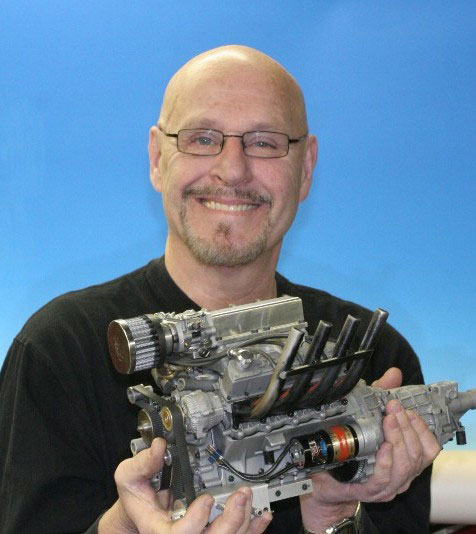
Gary Conley, of Conley Precision Engines, is shown with his Stinger 609 engine.
The Man Behind the Conley V-8 Introduces a New One
Those who know of the Conley V-8 are already aware of the Conley name. The story of the production of that engine, along with the Viper V-10 and the Stinger V-8, is one of both talent and perseverance. There are few people with the skill, knowledge, and determination to make a living doing what they love—but Gary is one of them. Despite setbacks that would have caused others to quit, Gary stuck with it, and the world of small engine building is better for it. The following page details one of his newer creations, as well as some of the earlier projects which helped to garner Mr. Conley the Craftsman of the Year award for 2012.
Perfection is Almost Good Enough
Now, the motto at Conley Precision Engines is, “Perfection is almost good enough.” This is a motto that Gary tries to live by daily. Over the years, he’s found that it’s better to explain a delay than to apologize for the quality of workmanship later on. Gary’s business has been in the same location and growing steadily over the last 30 plus years. He firmly believes that this longevity was due in part to the way customers are treated. The customer loyalty that he inspired through the quality of his craftsmanship paid dividends when Gary needed it—and that much will be evident as you read his story.
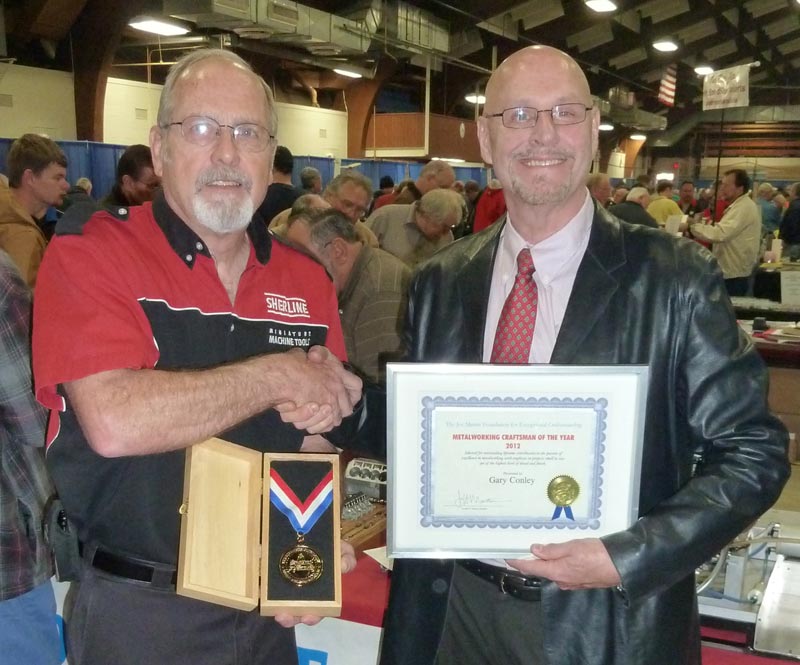
On April 12, 2012 Gary accepted his award from Joe Martin Foundation Director Craig Libuse. The award was presented at the North American Model Engineering Society Expo at the Yack Arena in Wyandotte, MI. Gary received an engraved medallion, award plaque, custom book on the foundation, and a check for $2000.00. Mr. Conley is the 16th winner of the foundation’s highest award. At the show, Gary brought and ran his 1/4 scale Stinger 609 V-8 for spectators.
A Start in Teaching Takes the Backseat to Gary’s Dream Work
Early on, Gary completed his Master’s Degree in Industry and Technology at Northern Illinois University. He then spent about five years teaching Vocation Machine Technology at Morton West High School in Berwyn, Illinois. During this time, Gary led many of his advanced students in machining and constructing various steam and internal combustion engines.
However, when education became more “baby sitting” than teaching, Gary decided to start his own business. He had one product, a very limited budget, and a lot of hopes and dreams. Gary stressed that without his wife, Cheryl, none of this would have been possible. He noted that she’s allowed him to “chase a dream” for almost 30 years.
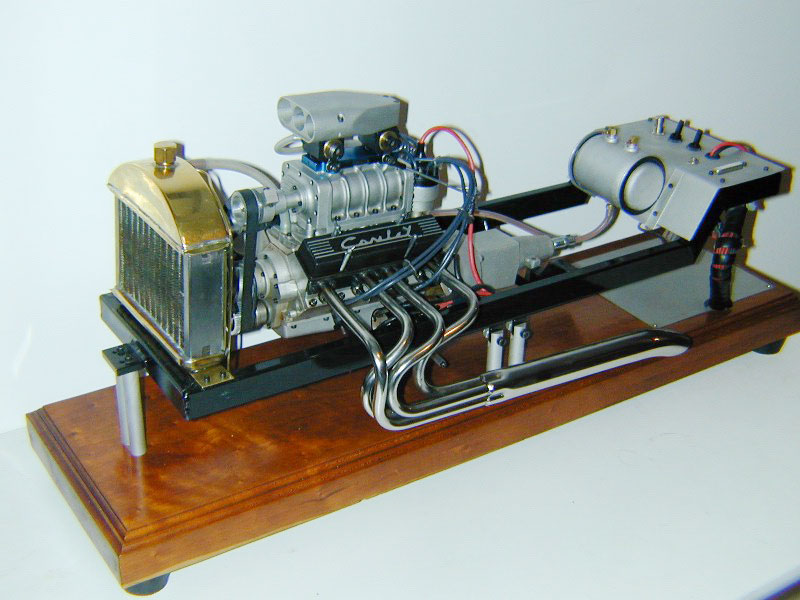
A Conley V-8 engine of the original “427” style sits atop an engine test stand, complete with radiator and fuel tank. This particular version is fitted with an optional supercharger, and custom stainless steel exhaust. The newer engine differs substantially from this original design.
Going back to the start, Gary’s first V-8 engine was crude in comparison to his newer ones. It was machined completely from billet material. Each component was handmade, without the use of any CNC equipment. That was almost 30 years ago, and Gary proudly notes that a number of the original engines are still running. Regarding that fact, he said, “I must have done something right.” However, during this time the engine went through some major changes. Being on a limited budget, it was difficult to make significant running changes in the production and machining, though.
As more money became available, it was quickly spent on new machines. The most significant of these was an Anilam CNC retrofit to his current Bridgeport. By today’s standards this machine was very slow, but Gary finally had the ability to make interchangeable parts. As a side note, that machine was still in use at the time of this writing. However slow it may be, it’s still extremely accurate. Eventually, Gary also added three other pieces of CNC equipment to his arsenal. Since his was not a “job shop,” there were several machines dedicated to specific purposes.
Going from Billet to Cast Parts
Now, another significant change was having a lot of the parts cast for the engine. Some parts were sand cast, while others were either die or investment cast. Not only did this alter the appearance of the engine, but it allowed for considerable internal changes as well. The most notable of these was the investment cast crankshaft and connecting rods. These allowed Gary to increase the bore from .750 to .952. Over the years there have been too many changes to list.
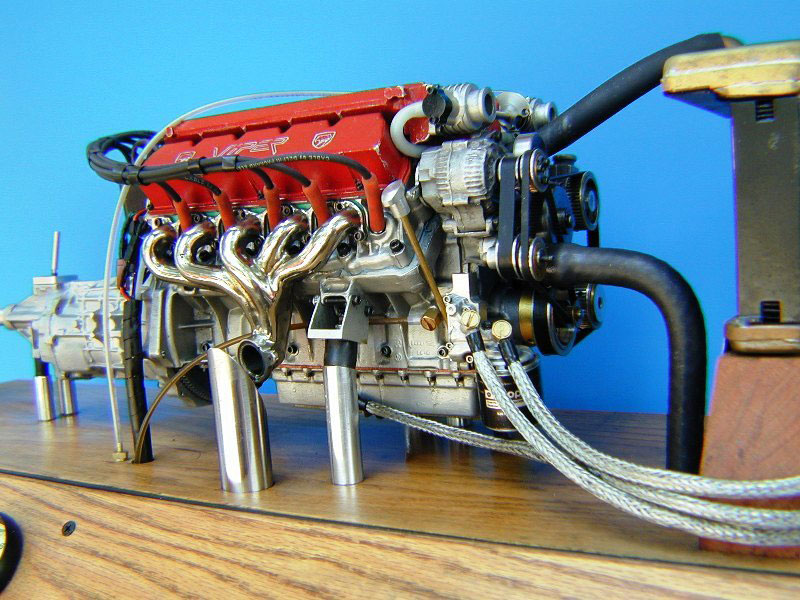
The 1/4 scale Viper V-10 Engine.
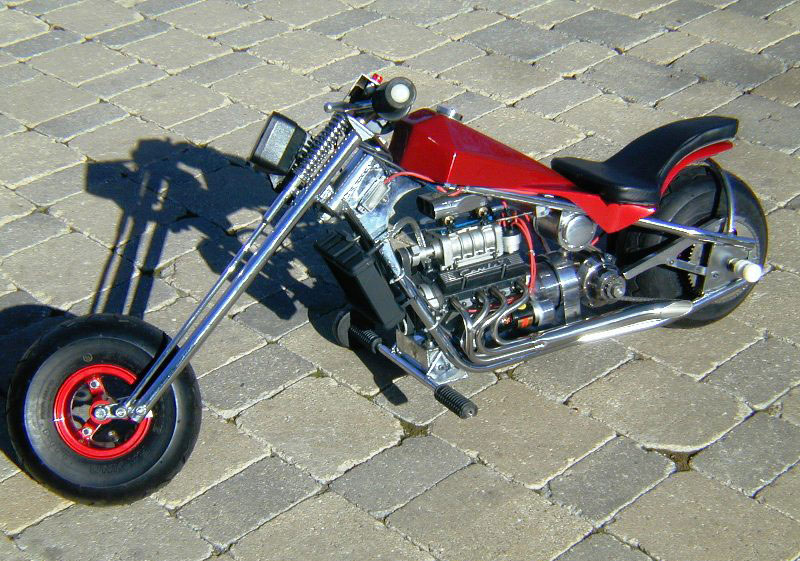
A Pocket Chopper with a Conley “427” engine.
Chrysler Asks for a Model Viper V-10
This stage of business building was full of ups and downs, but in 1996 two representatives from Chrysler approached Gary. Since he was already making a V-8 engine, they asked if he would consider building a 1/4 scale Viper V-10 engine. At that time Gary was contemplating building a 1/4 scale V-12, and after some serious thought the V-10 seemed to be a logical choice.
After receiving a licensing agreement from Chrysler, the next step was to get a full-size engine for the purpose of reverse engineering. Gary got a knock on the door one day, and suddenly a truck was unloading a complete Viper V-10 engine in his driveway!
At that point, Gary began to wonder, “what have I gotten myself into?” Since this engine was mainly a facade, with limited internals, it had to be dismantled for examination. Each piece was analyzed and evaluated to see if the engine could actually be reduced to 1/4 scale. Little did Gary know that this was only the beginning of a very long uphill battle.
Some of the molds he made himself. However, his good friend Ken Bennett, from Topaz Engineering, made one of the most complicated molds. Bennett made the mold for the head, and runners for the intake and exhaust ports.
Overcoming Two Major Problems
Before moving forward, it should be noted that the amount of different problems encountered in this build were too numerous to list altogether. However, two of the major problem areas that had not been considered were the ignition and oiling system. Keep in mind that voltage cannot be scaled down. To solve this, the alternator housing became the distributor. It had ten electronic sensors, and one rotating magnet. The signal it created was then sent to another circuit that told each coil when it needed to fire.
After several failures, it was discovered that the RF interference was burning out some of the sensitive components. The solution: “magnetic suppression wire.” At the time, this didn’t exist in smaller size. But Gary contacted Delphi Packard, and two months later he had 10,000 feet of small diameter magnetic suppression wire. This solved the first problem.
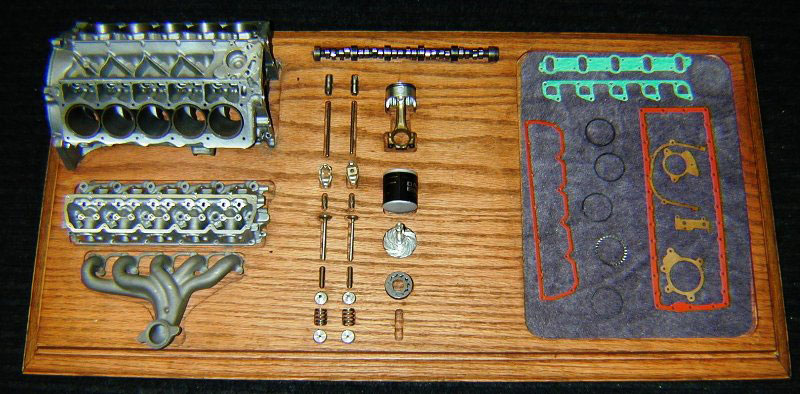
A V-10 block, head, exhaust, valve train, camshaft, and gaskets are laid out before assembly.
The other problem was oil control. There was always plenty of oil, but it was almost impossible to scrape the oil from the walls of the cylinders. This holdup alone took Gary over nine months of twelve-hour days to solve. Remember, oil control rings for this size engine are not commercially available. The entire project should have only taken about a year and a half to complete. In actuality, it took almost five years.
With Production Nearing, Tragedy Strikes
After five years of hard work and toil, it was all about to pay off. Then, suddenly, Gary received possibly the most devastating phone call of his life. The foundry that was doing all of his castings had been consumed by a catastrophic fire, which destroyed everything. All of the V-10 molds had melted down to large puddles of aluminum. Even the molds for the V-8 were destroyed. All told, over $350,000.00 in molds and five years of hard labor were gone—and there was no insurance to cover any of his loses! Only one V-10 engine was ever completed, and it’s now in the possession of an avid engine collector.
Gary recalled that for the next three days following the news of the disaster he just sat in his office and cried. As if that weren’t bad enough, all of the deposits for every engine had to be returned. It would have been very easy to declare bankruptcy, but for Gary this wasn’t an option. He had built a company on honesty and integrity, and could not do that to his customers. However, at the time no other alternatives seemed to present themselves.
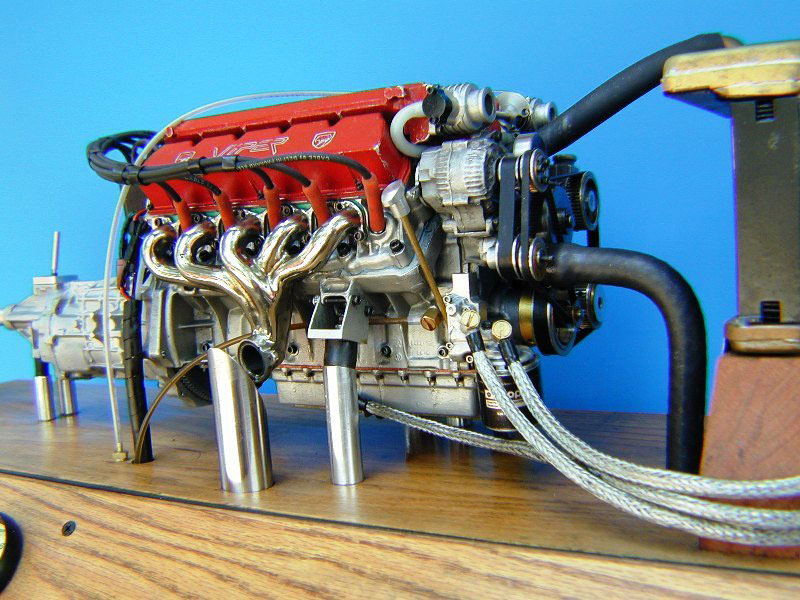
The Viper V-10—a project cut down after years of work by an unfortunate fire at the foundry where all the patterns were stored. Here is the prototype ready to run.
Taking Business in a New Direction Keeps the Dream Alive
Coincidentally, the company that produced the model carburetors which Gary was using on his engines was being sold at this same time. With some very strong soul searching, and lengthy deliberation with his wife, Gary decided to purchase the entire line of Perry products from Varsane Manufacturing. This included not only the model carburetor line, but also the model engine pumps and fuel control valves.
This purchase proved to be Gary’s saving grace. Slowly, all of the deposits were returned, and Gary began to see a little light at the end of the tunnel. Things continued to improve, and after exhausting his entire V-8 inventory, Gary decided to build another V-8 engine in the fall of 2005.
Surviving V-10 Molds Give Life to a New V-8
Despite the destruction of the foundry fire, Gary had retained all of the masters from the V-10 engine. Rather than trying to revive the V-10, a decision was made to modify and shorten it, creating a brand new V-8 engine. The concept of transferable knowledge became very evident when Gary decided to build the new engine.
Keep in mind that he’d already spent almost five years on the original design and construction. Thankfully, some of the internal components didn’t change. Since Gary had a lot of parts in stock, he put them to good use on the new “Stinger 609” engine.
Surprisingly, the only molds that survived the fire were those for the head, and the intake and exhaust runners. With a lot of measuring and careful machining, the mold for the V-10 head was shortened to make a great V-8 head. The runners didn’t change.
Somehow, some way, all of the masters were modified for the new Stinger 609 engine. The rest is history, and the new engine has been in production for some time now. Gary wishes to thank the many customers who stood by him through good times and bad.
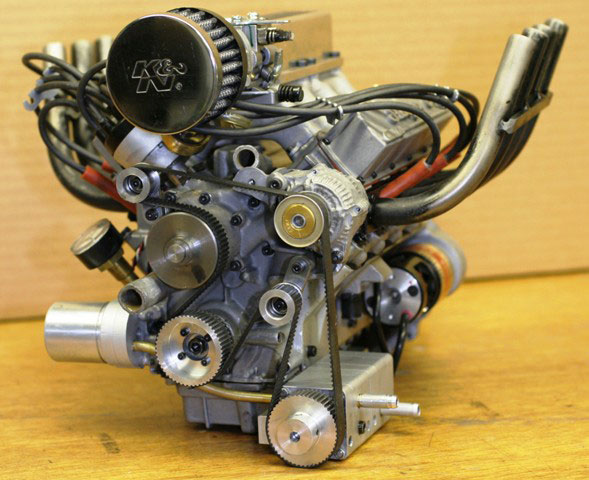
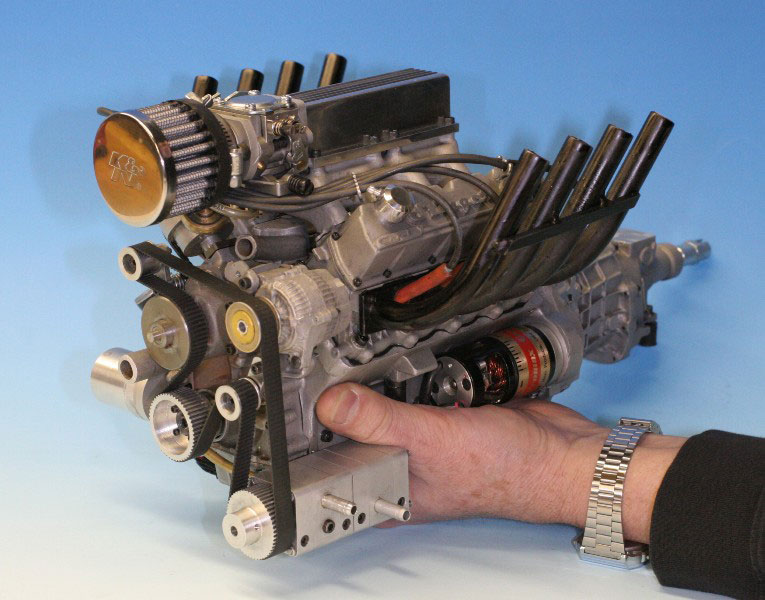
The Stinger 609 was based on modified and reclaimed molds for the scaled down Viper V-10. It shares a high performance lineage with one of the world’s most famous sports car engines. Shown here is the prototype version with front-facing air cleaner.
About the New Stinger 609
When it comes to the Stinger 609, the name is derived from the displacement: 6.09 cubic inches—or almost 100cc. This engine represents the culmination of almost 30 years of knowledge gained through the design and construction of model engines. The new Stinger doesn’t possess any of the parts used in prior V-8 engines.
The bore is 1” with a .970” stroke. The engine weighs about 11.25 pounds, and measures approximately 14” long (from the front timing belt to the end of the transmission), 6” wide, and 8-1/4” tall. The supercharged version would be about 10″ tall. This engine has many innovative features, like the large oval shaped intake ports, “D” shaped exhaust ports, and investment cast parts. However, two bold attributes stand tall: the dry sump pressurized oiling system, and a full ignition system.
The Viper 609 even has a user replaceable oil filter. For those unfamiliar with dry sump oiling, it simply means that oil resides in a holding tank, rather than a conventional oil pan. It circulates throughout the engine from that holding tank. Any oil that does collect in the pan is simply pumped back to the holding tank. There are two separate “Gerotor” style pumps to move all the oil.
As an important side note, the test engine held about 40 pounds of oil pressure at idle, and 80 pounds at 9,000 rpm. The dry sump oiling system not only adds more oil volume, but it also aids in engine cooling. The system ensures that there is plenty of oil during hard acceleration or sharp corners.
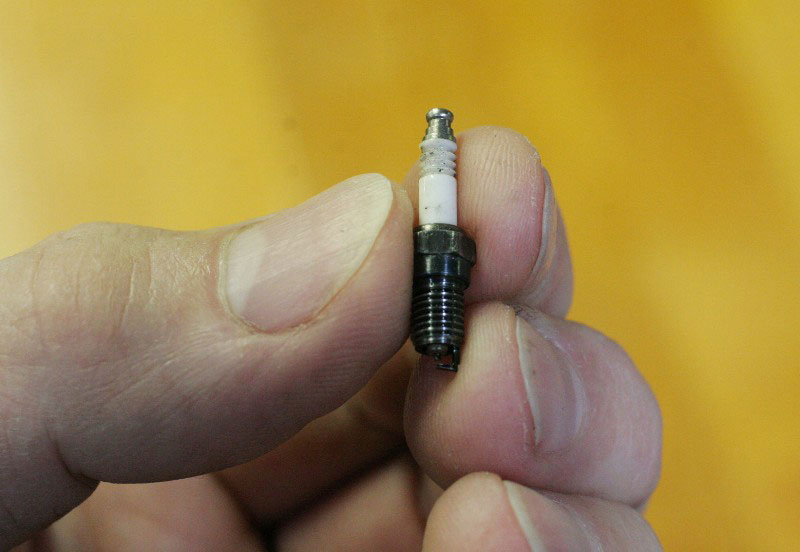
The miniature spark plugs were made by Paul Knapp, under the brand name of “Rimfire.” These have a 10-40 thread.

One of the Stinger heads with valves in place.
With regard to the spark plugs, they have a 10-40 thread. As always, the new Stinger 609 V-8 will have an electric starter as standard equipment. It doesn’t have handheld electric motors, or something that fits in a box below the engine. Instead it has a 12 volt electric motor that is a fundamental part of the engine. It can be activated manually or via the transmitter on a remote control. The centrifugal clutch is also included.
The standard engine includes “Zoomie” style exhaust pipes. Options include: cast stainless steel exhaust manifolds (plain or polished), painted valve covers and intake manifold, supercharger, and high duration camshaft. A transmission with forward-neutral-reverse was expected in the near future, but updates are unknown. Additionally, a self-contained engine test stand was also available. It included a custom hardwood base that concealed the battery and electrical components. The stand was finished and wired, including a radiator, fuel tank, and powder painted steel frame.
The process takes time, and Gary was proceeding as fast as he could without compromising quality. He started an “update” page on his old website where he kept future customers informed on the weekly progress. Most people don’t understand the complexity of an engine, or the many processes that must go into its various parts. One thing that Gary mentioned several times in our interview with him was that he refuses to cut corners. As he says, “I’d rather explain a delay, than have to apologize for a mistake.”
Performance Data: Each Stinger engine was thoroughly tested, and expected to put out over 6 HP at 9,500 rpm in naturally aspirated form.
Designing a ’23 T-Bucket Roadster to Showcase the Engine
In order to showcase the engine, it was put into a “T-Bucket” roadster. The roadster’s many features include: stainless steel rear end housing with differential, a powder coated steel frame, oil-filled shocks, stainless steel exhaust, front wire wheels, “Halibrand” style rear wheels with knock-offs, operating headlights, carpet, leather seats, burled walnut dash with full (simulated) instrumentation, windshield, aluminum firewall, and stainless steel dropped front axle with multi-leaf springs.
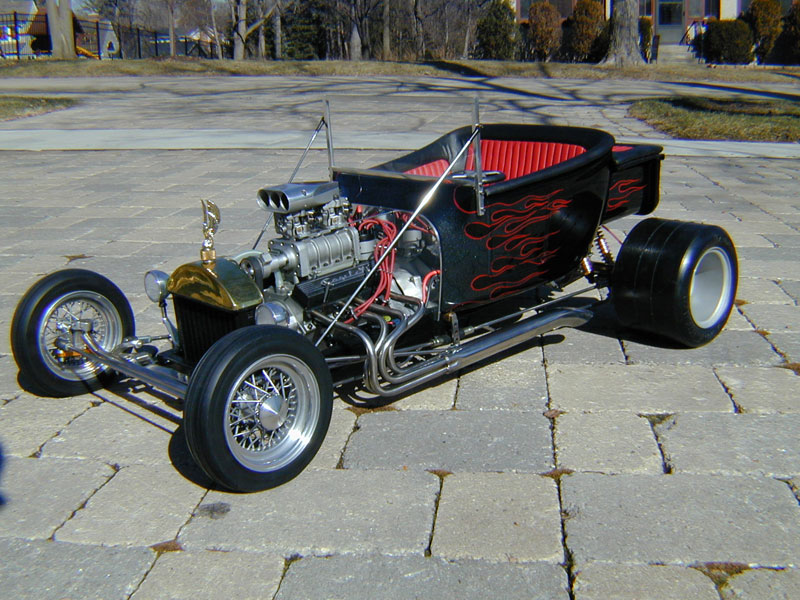
Are the paving stones really big, or is this V-8 powered ’23 T-Bucket roadster just that small? The car is modeled so well that it’s hard to tell from the photo!
Gary’s Shop
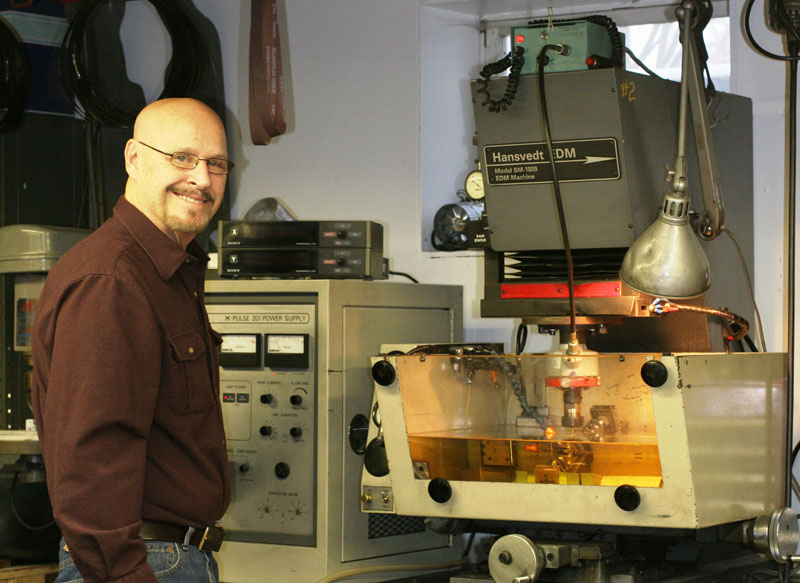
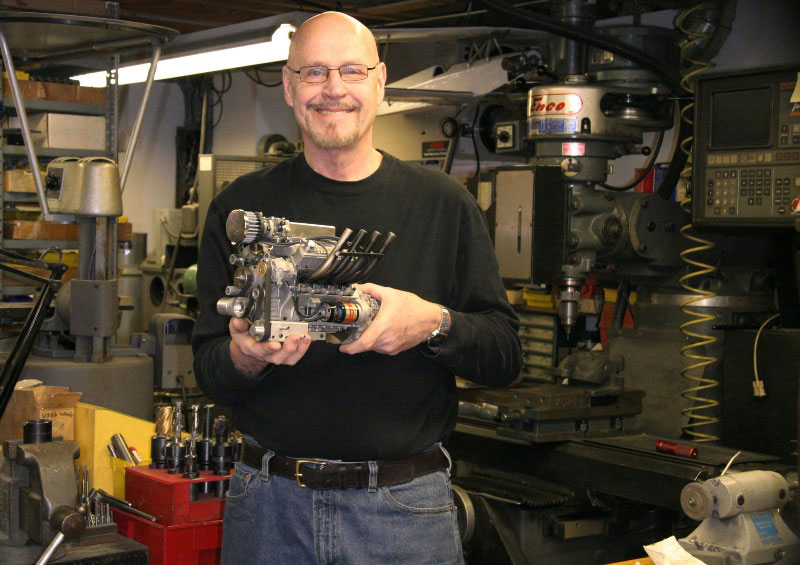
Gary in his shop. In the first photo, he stands in front of his EDM. In the second photo, Gary is holding the new Stinger V-8 while standing in front of his CNC milling machine. More of his machines can be seen below.
Watch this video to take a 25-minute virtual tour of Gary’s shop, and to get some miniature V-8 maintenance tips. Gary’s shop is not as large as you might think, especially considering the number of operations required to produce a line of engines. He has a Hansvedt EDM, and an Emco mill which was converted to CNC. Gary also installed a complete Sun engine analysis station for future testing and evaluation of engine performance. Interestingly, Gary still uses a traditional drafting table for a lot of his designs and layout. He understands that the computer would be faster and probably more accurate, but it takes a long time to learn “CAD”—and right now he doesn’t have that luxury. Maybe sometime in the future. He also lists the following tools:
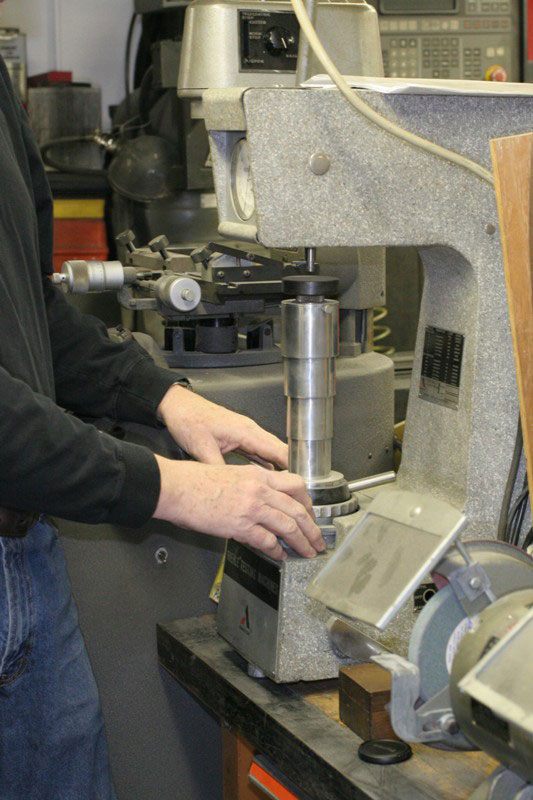
Rockwell Hardness Tester—Although this is not used often, it comes in handy when you need to know how hard a material is before cutting or grinding.
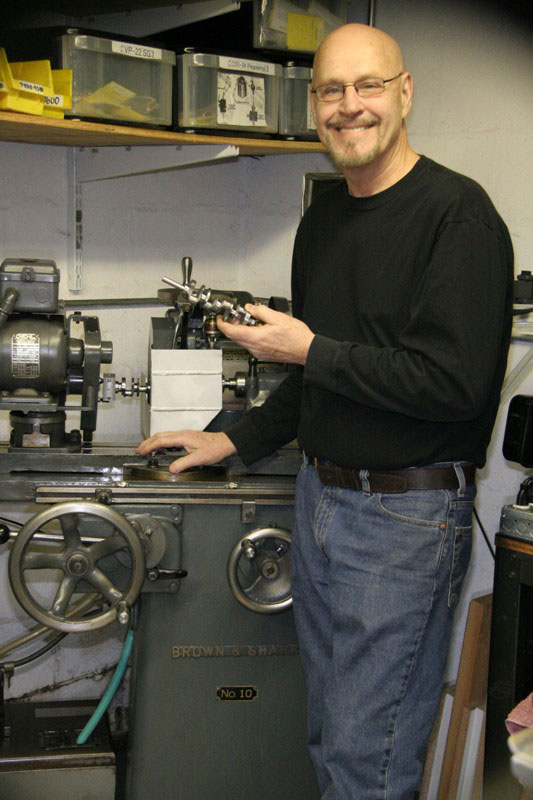
Brown & Sharp Tool and Cutter Grinder—This is a “dedicated” machine which is only used for finish grinding camshafts and crankshafts. Like almost all of Gary’s machines, it’s equipped with a digital readout.
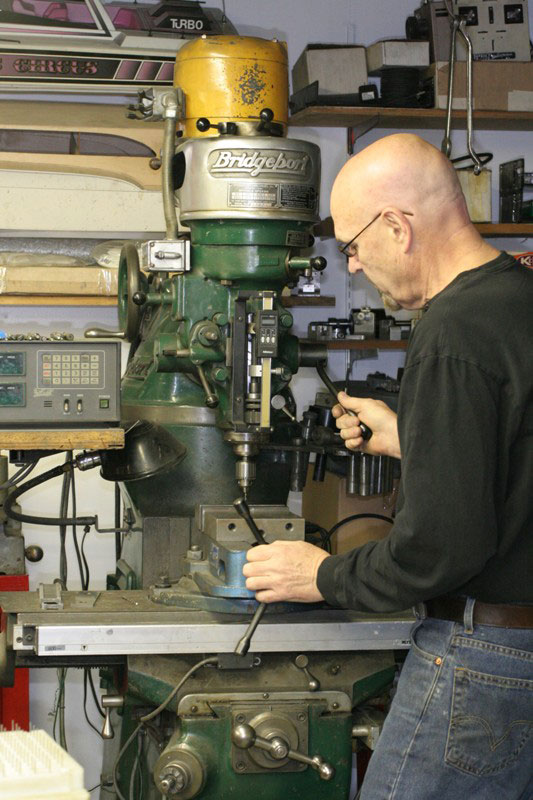
Bridgeport Vertical Milling Machine—The value of this machine is akin to that of the manual lathe, particularly when jigs and fixtures need to be made, or a mold needs to be fabricated. The list of unique uses is endless for some of the manual machines.
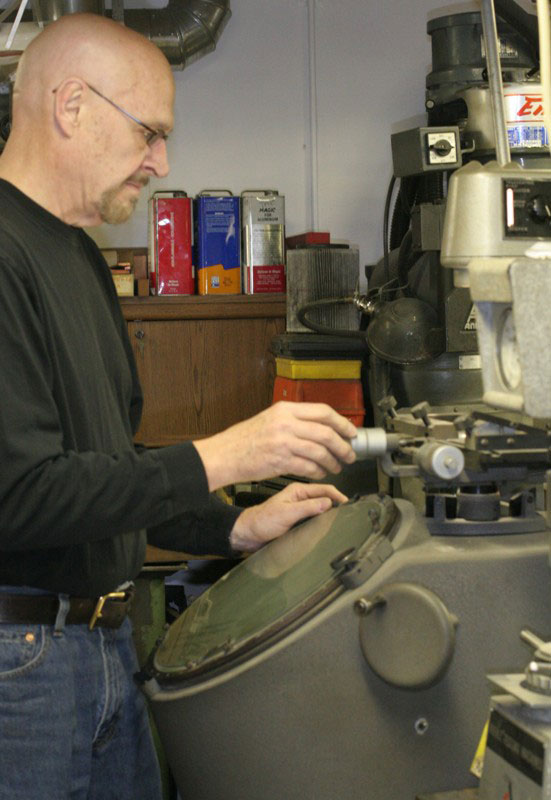
Optical Comparator—This machine has a lot of applications, but was used recently to determine the exact angle and position of the oil holes in a crankshaft.
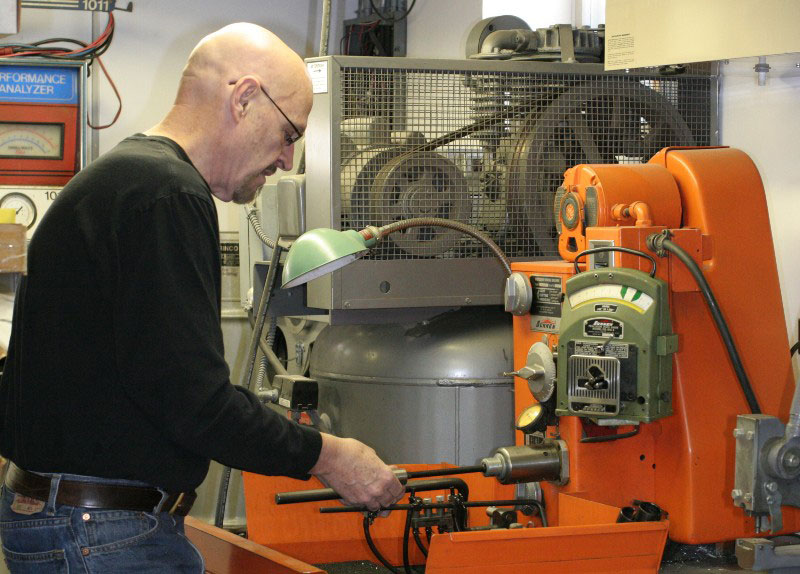
Sunnen Honing Machine—This machine is used to hone the cylinders, and to “line hone” the blocks for the mains and camshaft hole. It’s absolutely critical that these surfaces be dimensionally accurate, straight, and have the proper finish. Since the block is about 5.250 inches long, it takes a lot of experience, knowledge, and effort to achieve the desired results. Once again, if there is any mistake made during the honing process, you will end up with a very expensive paper weight!
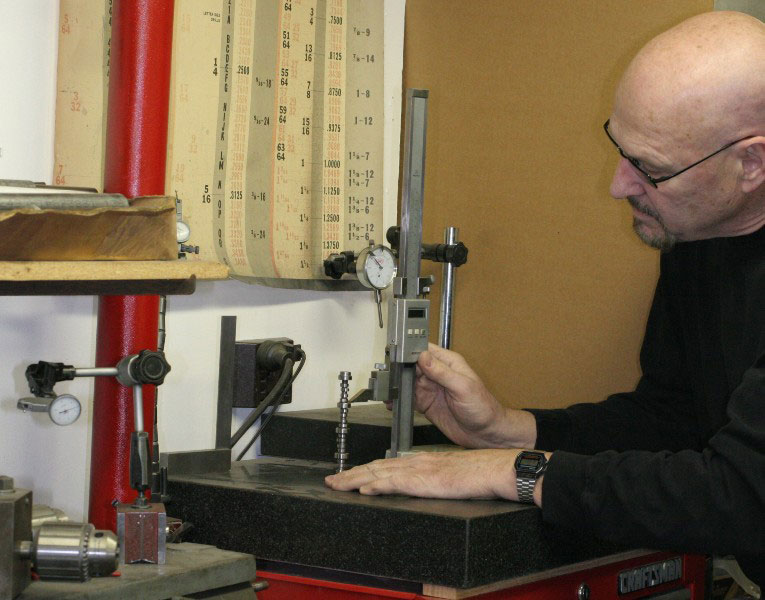
Granite Surface Plate with Digital Height Gauge—The cabinet beneath this granite plate is full of every conceivable measuring instrument, gauge, and layout item.
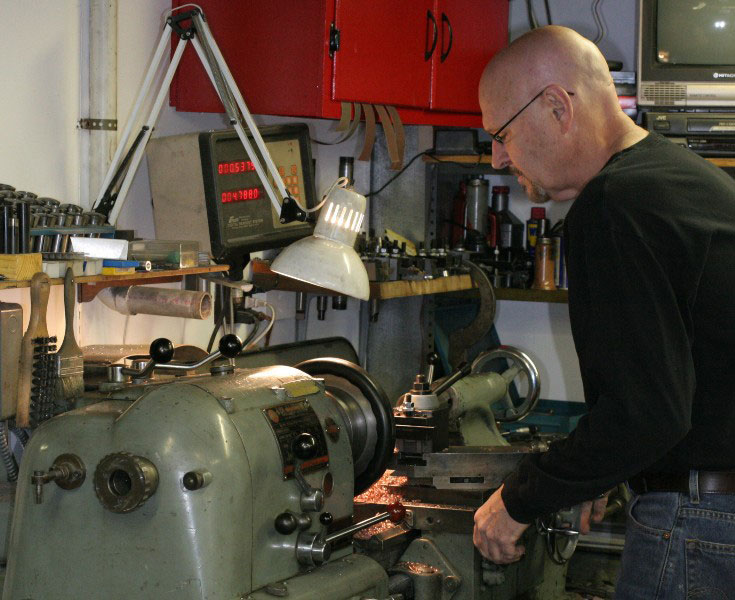
Manual Lathe—Regardless of automatic capabilities, many of Gary’s operations still need to be done on a manual machine. It could be as simple as drilling a hole, or it might be a task that requires several days of machining. One good example is the camshaft blank that needed to be made for Gary’s new mold. When making the blank, an exact amount of “shrinkage” had to be calculated. Every dimension needed to be made larger by .024. In the case of the cam lobe width, the finished dimension was .128, when casting the lobe needed to be .131. This might not sound like a lot, but multiply .003 times 16 lobes and you get .048. Add this to all the other dimensions, and you can immediately see why the digital readout on the lathe is so critical.
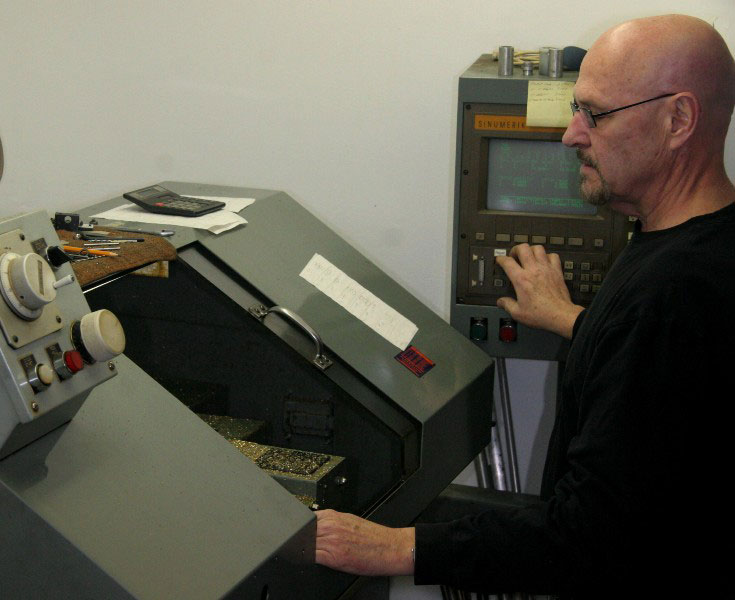
CNC Lathe—The CNC lathe is used to make a lot of small parts—like pistons, wrist pins, valve collets, idler wheels, shafts, distributor housings, etc. This machine has what is known as “gang tooling.” This means that there are a number of tools attached to the top of an X-Y table, which is connected to the bed of the lathe. Although not as fast as the CNC mill, the lathe is still extremely accurate. The lathe is equipped with a bar feed that continually pushes material into the machine. Once the bar stock is used up, the machine stops and new material is added. Both CNC machines are close to each other, making it very easy for Gary to run them simultaneously while also doing other manual operations.
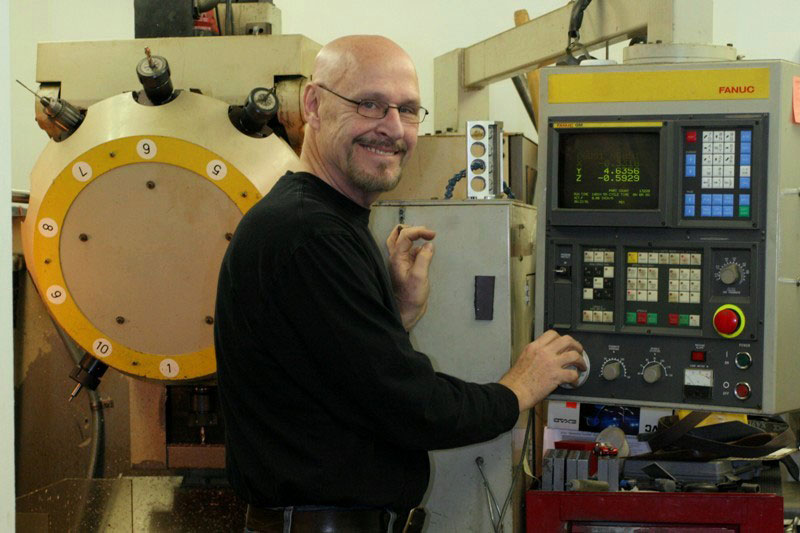
CNC Machining Center—This machine will repeat to .0001, and has a “chip to chip” time of about 5 seconds. Chip to chip refers to the amount of time needed from when the tool stops machining, retracts, changes tools, then rapids (moves) to the next operation. It also has a “rapid” movement of about 975 inches per minute. This is extremely fast, and if you aren’t careful, or there is a mistake in the program, it can get ugly very fast. Once the machine is programmed, Gary can literally walk away and do other work while the machine does almost everything. He says he cannot overemphasize the importance and the need for a machine with this kind of accuracy. It simply means that each part is “identical.” The interchangeability of parts is absolutely critical.
This machine also has what is called “ridged tapping,” which means the tap is fed into a pre-drilled hole at a pre-determined rate and depth. Once the depth has been achieved, the spindle stops instantly, then reverses and retracts at the same feed rate. Gary taps a lot of 2-56 holes with very little breakage. The machine can tap at up to 3,000 rpm. This is really moving. More and more of his tapping operations are using what is call “thread forming”. Simply stated, this is when the metal is not cut with a tap, but rather the metal is displaced and “formed” into the shape of a thread. This not only gives a stronger thread, but also allows him to tap some very difficult metal. A good example of this is when he had to tap some 2-56 holes in the 303 cast stainless steel that was used for the differential housing. No matter how he changed the feed and speed rate, he kept breaking a lot of taps. Once he started using the “thread forming” tap, he was able to tap 234 holes with just one tap. This machine does about everything in the way of machining. Gary jokingly said he was working on a way to program it to make his breakfast.
Along with these machines, Gary’s shop also contains many others not pictures here, as well as a bevy of measuring equipment. These include, but are not limited to: micrometers measuring up to 12”, a digital clinometer for measuring exact angles, setting gauges, dial indicators of every description and size, digital calipers, gauge blocks, pin gauges to 1″, bore gauges, and more. A second rolling tool box contains: drills of every size and various lengths, reamers, end mills from .016” to 1.25″, carbide cutters to 5″, taps and dies from 0-80 to over 1”, and more. Gary also has a vast array of hand and power tools, plus things like wrenches, sockets, files clamps, pliers, cutters, screw drivers, etc. When it comes to saws, he’s never even attempted to keep track of the number and kinds in his shop. As you can see, there are a lot of items needed to make a small manufacturing facility operational. Gary has been designing and building model engines for about 30 years, and during that time he’s acquired many tools and machines. On the topic, Gary said, “I guess that I am really a ‘tool horse’. Tools are good, more tools are better.”
Showbiz Plugs
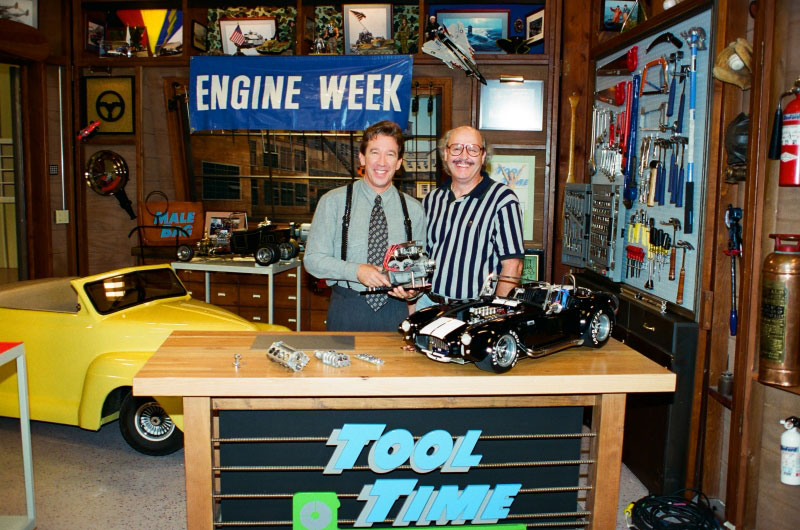
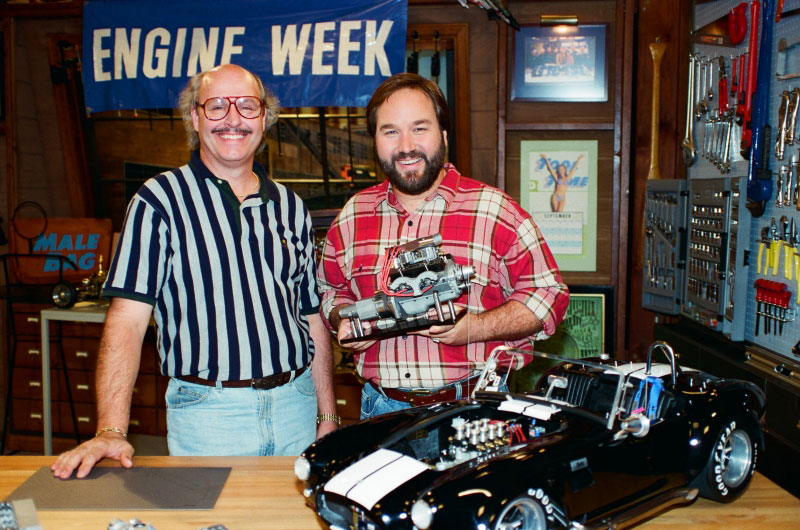
Gary is seen here with Tim Allen, who plays Tim “The Toolman” Taylor on the show Home Improvement. These photos were taken during a season-opening episode called “A Tribute to Engines.” The second photo shows Gary with Richard Karn, who plays Tim’s shy but able assistant, Al Borland. Gary’s engines were featured on the show, and Tim also mentioned running the engine in an interview on the Letterman Show. Gary spent almost a week watching the filming, and recalled that it was an interesting experience.
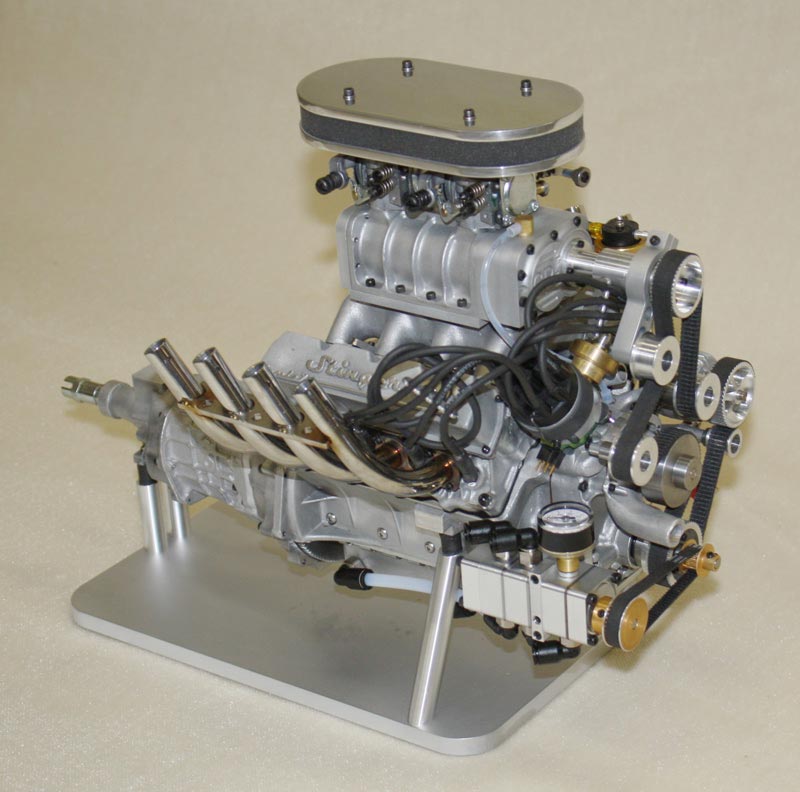
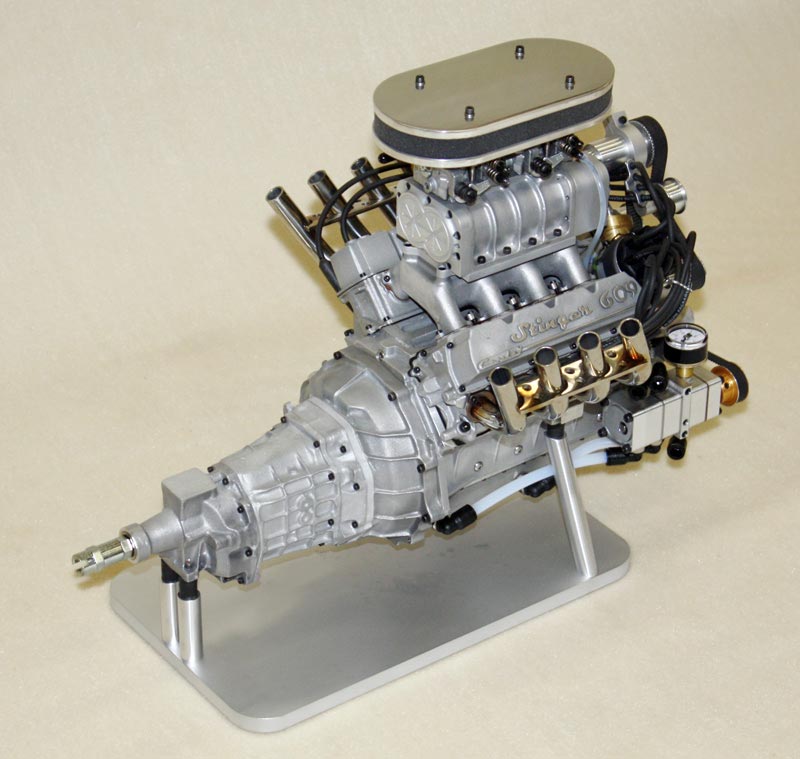
In 2011, Paul Knapp was one of the first people to receive a production version of the supercharged Stinger 609 engine. This engine is currently on display in the Miniature Engineering Craftsmanship Museum. Paul’s own Rimfire Spark Plug Company supplied the tiny spark plugs for the 1/4 scale V-8. This engine includes the new style air cleaner on the top instead of a forward facing K&N version as seen in the prototypes.
Magazine Articles Featuring Gary’s Work
Click on links for a full PDF of the article.
-
Hot Rod Magazine, March, 1984—This 3-page article shows photos of the early V-8 engine in production.
-
Hot Rod Magazine, May, 1990—Another article which shows details of a Conley V-8 powered model of Butch Leal’s Pro Stock dragster in 1/4 scale.
-
R/C Model Cars, June, 1990—This article also features Butch Leal’s Pro Stock Dragster in 1/4 scale. But this article shows more photos of the engines in production, and during the machining process.
-
Popular Mechanics, February, 1994—An article called “Peewee Power” covers 3 full pages of color in this popular consumer magazine. This was a bit of a shot in the arm for Gary, as paid advertising in Popular Mechanics is beyond most small companies’ budgets.
-
Liquid Quarter Mile, December, 1994—The article “Top Fuel Christmas” features an amazingly detailed top fuel drag boat called “Show Time.” The boat is a 1/5 scale running model powered by a supercharged Conley V-8. It’s detailed down to the trailer!
-
Car and Driver, April, 2013—A full-page article entitled “Engine Downsizing” by Casaba Csere covers the development of the Stinger 609 engine.
-
Sand Sport, Novemeber/December, 2013—The “Engineering Masterpiece” article covers the development and history of the Stinger 609 engine—with particular emphasis on Gary’s use of Sunnen honing tools to solve a problem involving too much oil smoke in the exhaust.
Early Engines Included Other Configurations—From V-2 to V-12
Now, if you’ve been reading the story above, you know that the current Stinger 609 didn’t just appear out of thin air. Gary had a ton of experience building other engines by the time circumstances dictated the development of this latest engine. Going back a few years, then, while Gary was still working as a teacher he would use engine projects to get students involved. The shop equipment he had available at the school helped with the process of educating as well.
Gary’s first V-8 engine, made in 1975, did more than just encourage the students. It also gave Gary himself the idea that engines like these could possibly be a commercial success. So he left the education field in 1980, and worked in industry for a couple of years. All the while, Gary’s evenings were spent working on tooling and procedures to make a series of small V-type engines. He started with a V-8, but also made a V-2, V-4, V-6, and a V-12.
Despite these options, only the V-4, and to a larger extent the V-8, seemed to click with the public. The V-2, which displaced .383 cubic inches, saw very little demand. Gary only sold 4 or 5 of these before dropping that engine from the line. All told, approximately 25 V-4 engines were made. All of the engines used the same timing belt cover, pulleys, valves, rocker arms, etc.
With the engines using some of the same components, all that was required for a longer engine was more material. Each engine was more or less built to order from solid billet stock. The V-6 displaced 1.15 cubic inches, but lack of demand meant that only 2 or 3 of those were ever built. Of the V-12’s, 10 were made, and three of them featured belt driven overhead cams. That engine displaced 2.300 cubic inches.
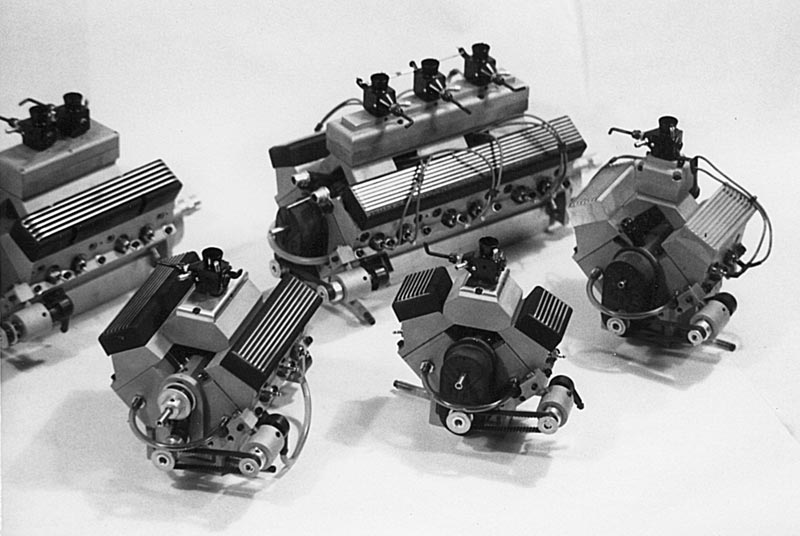
A sample of each of the engines from V-2 (lower center) to V-12 (behind it). The V-8 is at the far left, partially cut off in the photo. The V-6 is on the lower left, and the V-4 is at far right.
Eventually, it became obvious that the V-8 was garnering the most interest—so Gary concentrated on ways to improve that model. In the late 1980’s, he had taken on a major rework that resulted in the Conley “427” (because it displaced 4.27 cubic inches). Going from individually machined bar stock components to castings involved a huge investment in patterns and molds. It was a serious commitment to go from what were basically custom engines to more of a production engine.
The 427 had a .952” bore and a .750” stroke. The crankcase and intake manifold were sand cast, while the heads, valve covers, timing covers, air cleaner top, and pan were all die cast. Pistons and rods were still made from bar stock. The engines can easily be identified by the “Conley” script cast into the valve covers. The crankshaft started as an investment casting, but a supercharger and several different exhaust systems were offered as options. They were offered as both finished engines, or just kits with plans.
In 1985, further refinements were added to the engine. There were more die castings, and an investment casting for the supercharger housing, front and back plate, air scoop, and connecting rods. The rods were actually made using “Controlled Fracture Technology.” Simply stated, this is a process where the connecting rods are cast and machined as one piece.
After heat treatment, the cap of the connecting rod is then carefully broken off the body of the rod. It’s then replaced and held with the screws, after which the rod is honed to exact size. The main and rod bearings used full compliment needles, which did not need pressurized lubrication. Production of this engine continued until 2000.
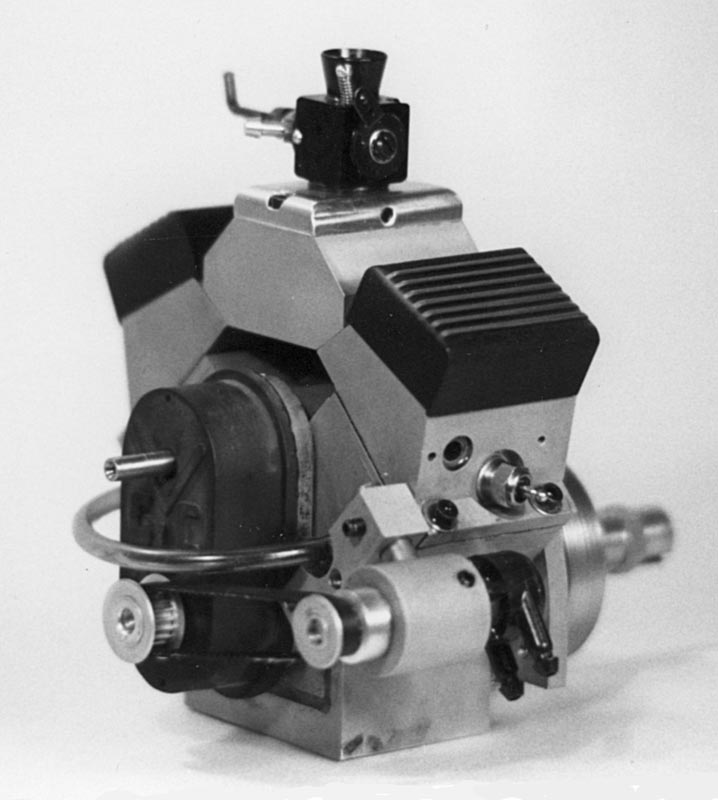
Gary’s V-2 engine is shown without the exhaust headers in place. Only 4 or 5 of these were built. Displacement: .383 cubic inches.
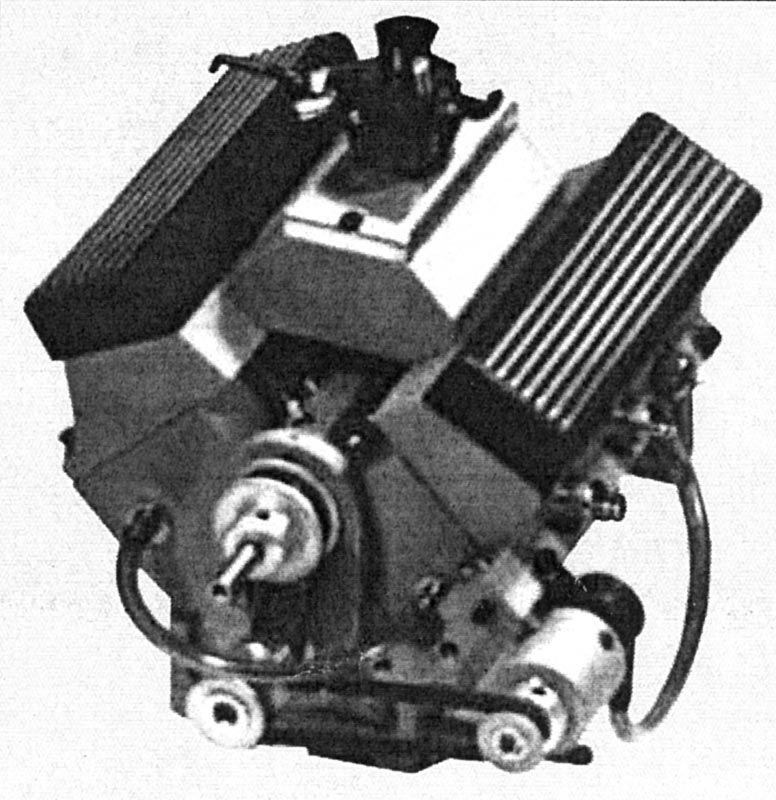
The V-6 engine had a single carburetor, but proved unpopular. Only 2 or 3 were made. Displacement: 1.15 cubic inches.
Now, one little known fact is that Gary also made two multi-cylinder “boxer” type model aircraft engines. There were only two of these engines made—one four-cylinder opposed, and one six-cylinder opposed. Both were air-cooled, four-cylinder engines. It’s also not well known that Gary developed a 4-stroke, 1.20 cubic inch glow engine prototype as a projected engine for K&B. When K&B decided not to go ahead with the engine, Gary built them under his own name. To his knowledge, only two were marked with the K&B name. Later in 1991, Gary was instrumental in arranging for a company in Minnesota to purchase the molds from K&B, make numerous changes, and come out with their own Abitar 4-stroke.
Later on, the year 1996 marked the beginning of the Viper engine project described above. Development time for this engine cut into Gary’s time to build the 427 V-8’s. Additionally, the foundry fire eventually ended all hopes of producing either engine in the future. However, it did lead to the design and production of the current Stinger 609. Gary also learned that offering something as complicated as a V-8 engine as a kit necessitated more technical support than he could afford to offer. As a result, the new engines were only sold as complete running engines, which came tested and guaranteed to run—no kits.
View more photos and descriptions of Gary’s projects.