The
Internet Craftsmanship Museum Presents:
N. Roger Cole
Added to museum: 1/20/10
Highly detailed wooden ship models based on extensive
research

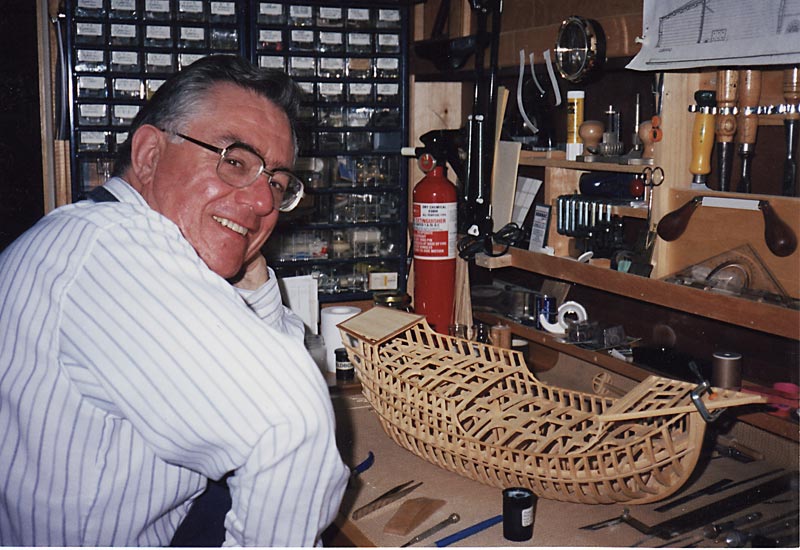
Roger Cole takes a break during the framing of a model of the Santa Maria.
(Click on above photo for larger picture.) More photos of Mr. Cole's work can be
found at the conclusion of his story and articles.
Introduction
Roger Cole first came to our
attention through a conversation with Craftsman of the Year Award winner for
1999, Wilhelm Huxhold of Canada. Mr. Huxhold, while
best known for his beautiful steam engine models is also a very accomplished
ship modeler. I asked him who was the best ship modeler he had run across, and
his first recommendation was Roger Cole. After taking a look at his work, we
immediately agreed that Roger should be represented here. In addition to the
excellence of his models, Roger is also an outstanding historian and writer
who has written many articles on the ships he has researched and built in
miniature. The foundation values this sharing of information by craftsmen as
an extra level of achievement above and beyond the skills of making the
project itself. Roger is a popular speaker at maritime conferences, symposiums
and meetings.

About N. Roger Cole
Roger Cole was
born in Plymouth, Devon, England in 1936. Unfortunately, his father was killed
shortly after his birth, so he grew up never knowing his father. Growing up in
Plymouth, one is never far from the sea, ships, and boats, which is where he
learned to appreciate all manner of vessels from warships to fishing boats, with
the latter interesting him most. As he developed, he also took a serious
interest in the ship models in the Plymouth Museum and Art Gallery including
their collection of Napoleonic and War of 1812 Prisoner of War models, a
life-long study of his, along with a good variety of other models, including
what are known as Navy Board models. These were framed boxwood models of major
sailing warships.
Attending
Devonport Technical College, which was just around the corner from the museum,
the curator soon noticed Roger’s frequent lunch-time visits and his interest in
the models. Time permitting, he would often meet with Roger, and they would eat
their brown bag lunches together while he explained the histories of the actual
vessels and the techniques involved in the construction of the models, although
at that time they were subjects to sketch, not model.
At sixteen
Roger was apprenticed as a machinist in Plymouth, specializing in all aspects of
engine reconditioning machining, except crankshaft grinding. He emigrated to
Canada in 1955 with his tools and exactly $13.00 to his name, $10.00 of which
had to go to cover his first week's room and board. Fortunately, he was
immediately hired in his field and continued to work as an automotive machinist.
Roger and his
wife Jean were married in 1958 and moved into a bachelor apartment, and then
into a one- bedroom, which provided room to build kitchen-table models starting
with a Sterling kit of the Cutty Sark. This was never completed, as one
day Jean felt that it needed dusting, after which, badly damaged, Roger
consigned it to the garbage chute. It was the only kit model he ever tried.
In 1960, he was
hired by IBM, starting in field service in the electric typewriter division in
downtown Toronto. In 1968, with a family that now included three youngsters, he
moved into his current home where his youngest son was born. He also finally had
room for a dedicated workshop, albeit only ten by six feet, but it was
sufficient. There are now two shops; the other one is outside the house and is
seven by fourteen feet and can be heated for winter use. (In Canada that's
important!) For seventeen years his work at IBM and family considerations kept
him too busy for model building and associated interests.
In the
mid-seventies Roger decided to pursue his ship model interests again and started
researching prospective models. In order to do so he amassed a considerable
library; which has often been used by other researchers looking for information.
He never ever had a mentor and is entirely self-taught. So, harking back to the
time spent with the curator of the Plymouth museum, where he suspects a seed was
planted, he gave up on kits and decided to scratch build, and in polished
Boxwood.
One vessel that
had interested him was Benjamin W. Latham, a 1902 mackerel seining
schooner built in Essex, Massachusetts in 1902. Latham was available as
a kit with plans developed by Erik Ronnberg Jr., with
a solid, machine-carved hull for Model Shipways. Wanting to scratch
build the model, framing the hull and planking it in
Columbian Boxwood, he simply ordered the plans and the Guide in Modeling. Erik
Ronnberg Jr. arranged for him to research fishing schooner framing at the
Francis Russell Hart Museum at M.I.T. where he spent four hours with its
curator, the late William Avery Baker and his assistant, who was also his wife,
Ruth, reviewing an enormous amount of pertinent material. Following this
research trip, the framing plans were drawn and construction began. When the
hull was completed, Roger was invited to enter Latham as an unrigged
model in a show at Mystic Seaport in Connecticut called “Model Building Today.”
This was at the bidding of Portia Takakjian, who at that time,
he recalls, was a director of the Nautical Research
Guild. After the show ended, the model was
completed. While studying the other models in the Mystic show, he decided to
enter the completed Latham into the Mariners' Museum Ship Model
Competition in Newport News in 1980 where she won the Bronze Medal in the
Scratch Built Division. Not a bad start to scratch
building, but it came with some valuable help from a
number of great people. It may well have been their help that started him on his
life of mentoring.
Lizzie J.
Cox, a Chesapeake Bay Bugeye, followed Latham and garnered an
honorable mention, despite the fact that it was a more complex model. Many of
Roger’s projects developed into a series of articles on the various models;
including the Santa Maria, Benjamin W. Latham, Lizzie J. Cox,
and the Beetle Whaleboat. Many other articles discussed specific
techniques related to model building.
After 31 years
in a very varied and interesting career with the bulk of his time in either
management or staff positions, ending up as the Emergency Response Coordinator
for the 58 acre manufacturing and laboratory site, Roger retired from IBM in
1991 to pursue a career in model building, writing, lecturing, teaching small
classes at his home and mentoring, the latter being an ongoing and most
rewarding experience, and one that continues today.
While he never
thought of mentoring as “giving back” that's what it's called today. As a member
of the Nautical Research Guild's Technical Assistance Network he answered many
questions for the Guild, but these have been far outweighed by individual
requests he has received for information on various vessels, models and on his
techniques. While many queries have been limited to a single answer, many have
gone well beyond that, including one that has been ongoing for years. Many of
the individual requests for information stemmed from the approximately
eighty-five articles he has had published or from lectures at either Nautical
Research Guild Conference presentations or Symposiums, and from the time he
spent at the Ontario Science Centre.
Later models
included Santa Maria, a commission, which was based on the plans by
Martinez Hidalgo which were ordered from the maritime museum in Barcelona. As is
often the case, those plans left a bit to be desired; nonetheless the client was
totally delighted with the model. He and his wife were the guests of the client
for the unveiling of the model in Puerto Rico.
Alert
was another commission and was based in large part on the work by Peter Goodwin.
Once again a considerable amount of additional research was required before he
could complete the plans for the model. Alert has taken three
international awards along the way; a literary award for the article on her
clenched-lap or lapstrake planking and a hypothesis on coppering a lapstrake
hull. She also took a Silver Medal in the Mariners' Museum Ship Model
Competition in 2000 as an unrigged model and, when completed, a Gold award in
the advanced scratch built category at the Manitowoc Maritime Museum Competition
in 2005.
In addition to
his own model building, Roger also worked part time for several years in the
Ship Model Shop of the Ontario Science Centre. Unfortunately serious illness
brought model building activities to a halt several years ago. However, with his
health now as good as it will ever get, he is getting back into model building
and writing, starting with a model of Smith K. Martin, a Chesapeake Bay
centerboard schooner built in 1899 in Pokomoke City, Maryland by E. James Tull.
While building the model he will be photographing and writing about the
processes involved. This will cover the model from the research stages, which
were put on hold for several years due to illness, right through to the final
installation in a display case.
Notes regarding the Construction of the British Naval
Cutter Alert
By N.R. Cole

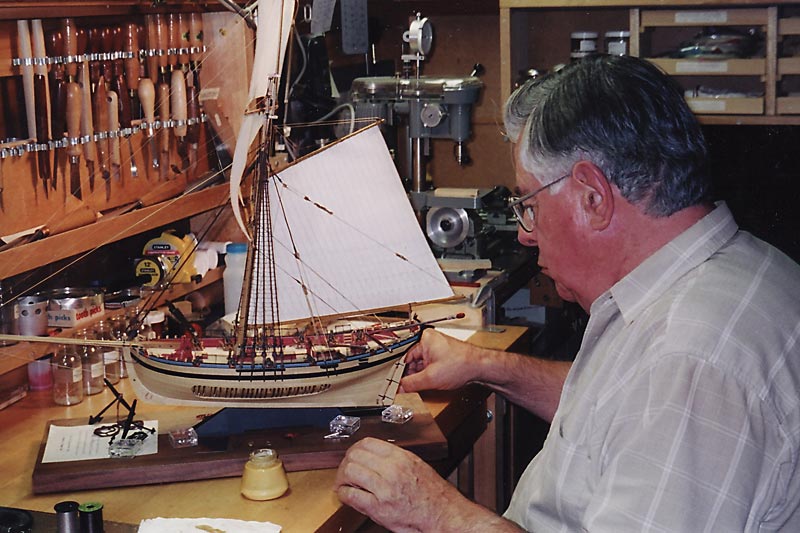
Roger Cole is seen at work in his shop working on the almost completed
Alert. (Click on photo to view a larger image.)
Alert
was entirely scratch built by me to a scale where 3/16ths of an inch represents
one foot. While generally following Peter Goodwin’s book, The Naval Cutter
Alert - 1777, considerable additional research was incorporated during
construction, including belaying, hammock nettings, and shroud trucks, none of
which was discussed in Goodwin’s book. Some deck layout and rigging details were
changed because they were either not covered or, in my opinion, were more likely
and workable as modeled. Alert is shown as she was after her 1778 refit
at Plymouth as she moved out to Cawsand Bay, where she was to remain at anchor
for a week, awaiting orders. Her sixteen-foot longboat, carved and hollowed from
two pieces of Columbian boxwood, blind dowelled to the keel assembly, and then
fitted out, is shown under tow, with equipment stowed and secured.
Alert is rigged “Cutter-style”, meaning that her topgallant mast is
mounted aft of the lower mast, normal on Cutters of the period. She also carried
a running bowsprit, not the fixed bowsprit of a sloop. The bowsprit is mounted
to port of the stem head and can be used in any of three positions, fore or aft.
Because of this, the forestay and preventer stay were mounted to the stem head,
not the bowsprit tip. The two stays were not laced because the foresail hoops
ran on the forestay which is rigged Cutter-style, meaning that the stay is
turned back on itself around its deadeye, not as a shroud which is fitted with
the bitter end seized to the shroud above the deadeye. Cutter-style allowed the
foresail hoops to run to the bottom of the forestay. While totally adequate, the
work done by yard riggers never ever satisfied a Bos’n; it was generally untidy,
with no fancywork such as nettling of the forestay mouse. Once underway, the
crew would be put to work eliminating “Irish Pennants”, loose ends on splices,
seizings, line, etc., with many being redone to suit the Bos’n. As displayed,
the rigging cleanup is done; once at anchor in Cawsand Bay, under the protection
of Rame Head, the forestay would be eased off to permit nettling the mouse.
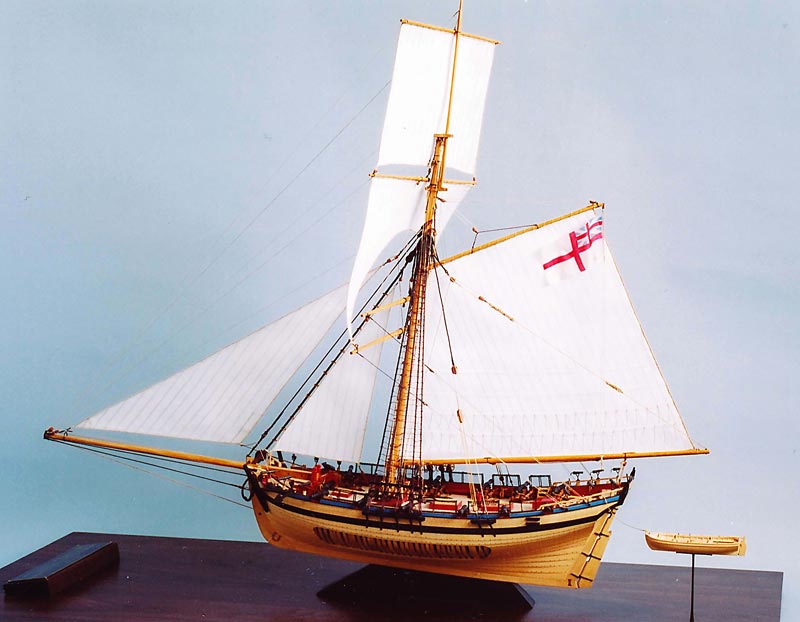
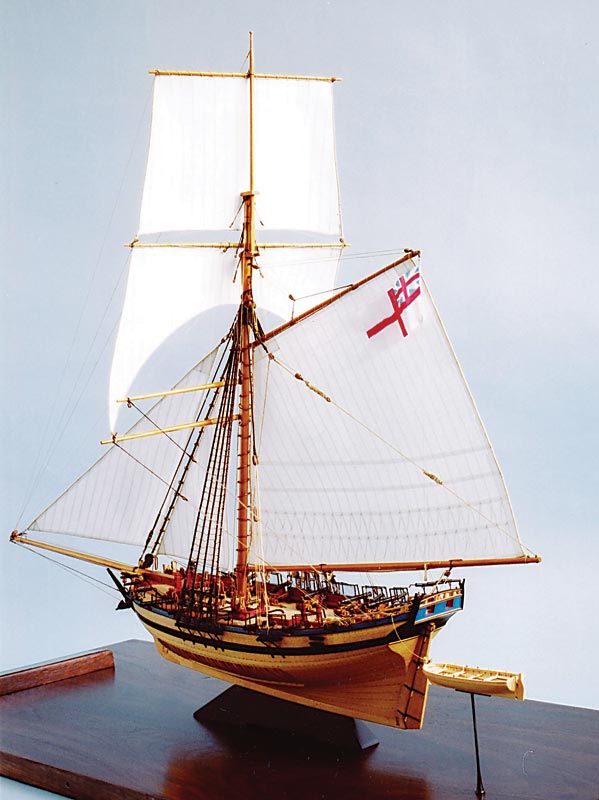
The completed model of Alert including the longboat, which is
in its towing position on the quarter, off the stern. In actual use she would
have been on a longer painter to keep the boat further aft and rudder lashed to
keep the boat tracking. (Click on photo to view larger image.)
Cutters built before 1800 were anachronistic in
that they were clench-lapped and copper fastened over a full-sawn and trunneled
frame, as is Alert. My approach to the planking was published in the
Nautical Research Journal, with a hypothesis on the coppering of a
clenched-lapped vessel. The woods used in the model were as follows: Hull
framing and planking - Columbian boxwood; Decks – Virginia holly, including the
dowelling to create a subtle and more natural deck; Spars – degame,
(lancewood/lemonwood). The windlass barrel, wales, stern fashion pieces, half
the cap rails (they are two-part boxwood/ebony) are Gaboon ebony. Deadeyes,
block sheaves, thimbles, shroud trucks, etc., are lignum vitae. Mast and
foresail hoops – Apple.
Metal fittings, except those that were turned,
were hand cut from flat brass sheet, silver-soldered where necessary, filed,
polished, and then oxidized as appropriate. The cannon and swivel guns were
turned on a Unimat lathe using a pattern-turning device I designed/built to
create repetitive turnings using flat templates to guide the tool.
All the line is linen; almost all hawser-laid and
all the cable-laid line were made on my ropewalk, as were the wire-cored sheets
that hold the sails out in a filled position. The sails were made from
50-year-old tracing linen, moulded over formers. Boltropes were hand stitched by
me, with 26 to 28 stitches per inch. Cutter sails of the period were
loose-footed, meaning that they were not laced to spars at the foot. Her number
2, or General Service Ensign, indicating that she has no specific assignment
yet, was made from raw Chinese silk, dyed with French dyes.
Where used, Floquil paints were blended to
represent the effect seen when viewing a vessel from a distance, where the
colours are muted by atmospheric haze. Clear Floquil finishes blended to give a
soft satin finish were used on the natural areas, then polished with Renaissance
Wax. I etched the nameplate from plate brass, polished it, and then oxidized it
antique bronze.
To read a more complete 12-page illustrated article on the research and
processes involved in the building of Alert,
CLICK HERE. (6.72 MB PDF file. Allow time
to load.)
Awards related to the building of Alert
While the original
vessel took two prizes during her short career: the American Brig Lexington
on September 19, 1777 and the French Lugger Coureur on June 17, 1778, the
model has taken three awards. They are:
1. The
Nautical Research Journal
Editors Essay Contest Award for 1998.
This was for the essay entitled "Clenched-Lap, as Applied to a Framed Hull—A
Hypothesis Regarding How Clench Lap Hulls were Coppered." The essay was
published in the Nautical Research Journal in two parts: "Clench-Lap
Planking Over a Framed Hull: Building the Naval Cutter Alert" (Volume 44,
No. 3, December 1999, pages 204-212) and "Coppering a Clench-Lapped Hull:
Building the Naval Cutter Alert" (Volume 45, No. 1, March 2000, pages
33-34)
2.
The Mariners' Museum Scale Ship Model Competition and Exhibition, 2000.
Silver Medal, Division 1, Class A—Scratch built
models of ships propelled exclusively or primarily by sails or oars. At this
time the model was unrigged and simply fitted with a stub mast, bowsprit and
boom.
3. Wisconsin Maritime Museum at Manitowoc
Gold Award—Advanced Scratch Category, Midwestern
Model Ships and Boats Contest, 2005.
-----
To read a brief history of the real Cutter Alert
as described in Roger Cole's research, CLICK HERE.
To see a list of articles on ship modeling by Roger
Cole, CLICK HERE.

Here
are photos of some of Roger Cole's projects:
(Click
photo for larger image.)
The
Cutter Alert
|
 |
An overall view of the finished model of
Alert |
 |
The Plinth-Mounted
Nameplate
The etched, raised
letter plate was made in my shop from brass plate using Letraset® as a
barrier to the etchant. Once etched, the etching process was stopped, the
plate was polished and then was oxidized to an antique bronze finish to
complement the period of the vessel modeled. The plate is then protected
with two coats of satin Krylon® paint. Regrettably, with the advent of
computers, Letraset is now virtually unobtainable, so this approach is no
longer feasible. |
 |
The Stem, Keel and Sternpost
Assembly
This view shows the stem, keel
and sternpost assembly, along with the aft deadwood, and the apron inside
the stem, mounted in the assembly jig. The assembly seen here was
constructed with Columbian boxwood and includes detail such as the holes
for the forestay lanyard. All aspects of the assembly are glued and
doweled using bamboo dowels. The jig holds the model absolutely true
during construction. |
 |
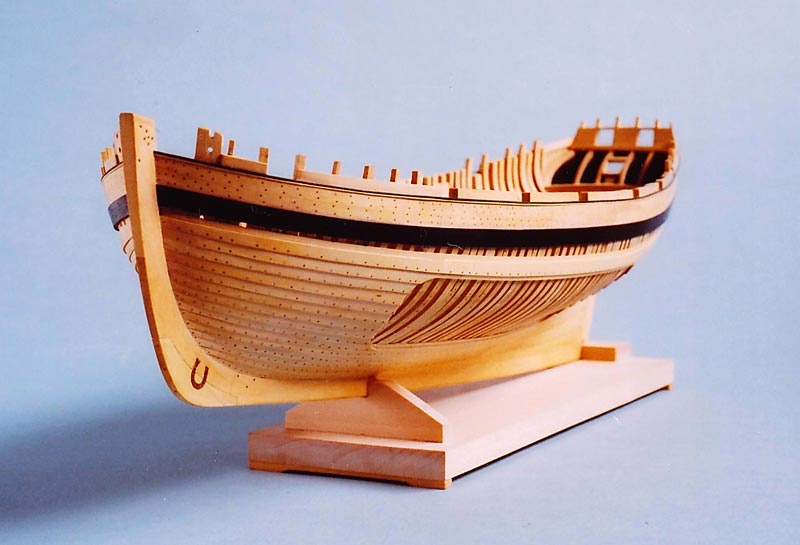
Hull Framing and Ebony Wales
The hull framing is almost
complete. It, like the keel assembly, was made from Columbian boxwood. The
ebony wales were fitted with hook and butt joints matching what was
probably used on the original vessel. The wales were doweled using ebony
dowels. The angle at which the hull is displayed matches the drag seen on
the original vessel. |
 |
Port Side from Ahead—Planking Nearing
Completion
Planking is completed up to the
fifteenth strake. The sixteenth and final strake will be left off until
the hanging knees for the deck structure have been installed. Once
finished, the hull planking was polished and protected with a clear
finish, followed with two coats of Renaissance™ Wax. |
 |
Positions for the Carlins
Marked and Cut
Initial work on the deck
structure started by locating and fitting the deck beams. In this view the
positions for the carlins have been marked and cut, and a few carlins and
ledges have been installed. Once the deck framing has been complete, the
deck will be laid using individual quarter-sawn Virginia holly planks.
These will be doweled to the deck beam structure using holly dowels. This
creates a deck that closely matches the appearances of a holystoned deck
where the caulking seams are to scale and the bungs in the deck are
unobtrusive, in fact, almost invisible. |
 |
The Plinth and Marble Insert
The mounting plinth and the
sacrificial marble insert are installed to absorb the acids originating
from the wood used in the baseboard, plinths and model. The plinth was
made from black cherry, painted flat black. It presents the model so as to
show the waterline level. The slice of Boccaccino marble absorbs and
neutralizes acid that would otherwise damage the materials used in the
model. This is based on research done by Mr. Dana Wegner, Curator of
the United States Navy Ship Model Collection. This view also shows the
starboard planking to advantage. |
 |
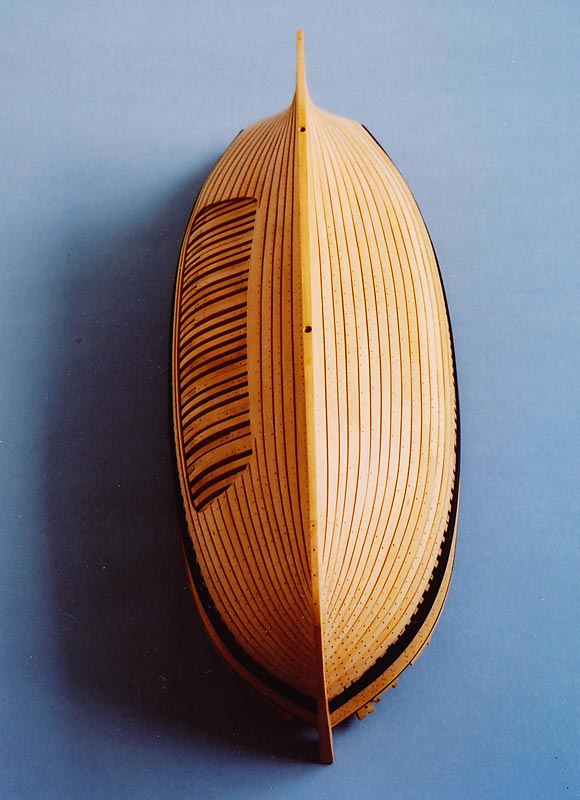
A Look at the Hull Planking
This view, with the model
inverted, shows the symmetry of the hull and planking runs. The cutout on
the port side reveals the framing with the double or mold frames visible
among the single or filler frames. The client requested that part of the
hull planking be left off to reveal the framing. |
 |
Armament
During her refit in Plymouth in
February, 1778, Alert's armament was upgraded from ten four-pounders
to twelve six-pounders and twelve half-pounder swivels. The six-pounder
gun shown here with one of the swivels was simply a trial horse, built to
prove out the tooling and jigs used in the manufacture of the various
components required. This included developing the pattern-turning system
to allow accurate replication of the gun barrels. While the gun barrel
shown here is close, the six-pounders used on the model were patterned
precisely on the John Robertson pattern of 1776, reflecting what was
probably used for her upgrade. |
 |
A Look at the Deck Detail
Forward
Here we see the windlass
details with the working ratchets and check pawls, the detail in the
hammock nettings, guns and tackles and the hatch and companionway
gratings. Also seen here are the somewhat muted colors used on the model,
reflecting the atmospheric effect that would have been evident had the
original vessel been viewed from a distance. |
 |
Headwork and Rigging from
Forward
Seen here is a wealth of detail
including the masthoops securing the mainsail to the mast; the wooden
hanks securing the foresail to the forestay, which is cable-laid; and the
lacing securing the topsail to its yard. Also visible high up on the
shrouds, level with the lower edge of the gaff-jaws, are the shroud trucks
used to lead lines from above down the inside of the shrouds and ratlines
to belay on the shroud-mounted pin racks. Oddly, once a shroud truck has a
line through it, it becomes a fairlead. |
 |
Masting, Rigging and Sails
from the Port Quarter
This view shows a wealth of
detail aloft. The tablings, gussets, reef bands and reef points can be
seen on the mainsail. The mainmast hoops, foresail hanks, ratlines and
cable-laid shrouds can also be seen. There were no footropes on Alert—her
spars would have been far too light to support the weight of a man. The
spars, shown here finished with shellac, would have been lowered to the
deck to replace or unrig sails, and to make repairs to equipment. |
 |
Masting, Rigging and Sails
from the Starboard Bow
This view shows the mast, with
the luff of the mainsail seized to the mast hoops; the backstay tackles;
and, just underneath the gaff jaws, the shroud trucks (fairleads) leading
the various lines down behind the shrouds and ratlines so as to avoid
interference with crew going aloft. This also provided a lead for the
lines to the appropriate belaying pin in the shroud-mounted racks. The
cable-laid forestay is clearly seen in this photo along with the mouse and
collar. |
 |
An Overview of the Model
This view shows the anchor
cables leading in through the hawse; as the cables were too heavy to pass
around the windlass drum, they pass underneath it enroute to the hatch. A
messenger would have been rigged to haul the cable. Lines can be seen
belayed to cleats on the mast, and to pins on the shroud-mounted racks and
windlass pin racks. Everything seen on the model was constructed in my
shop: blocks, deadeyes, gratings and shroud trucks were made of various
woods; anchors, guns and all the metal fittings were made of brass,
oxidized to represent ferrous metals. Cable-aid line, most larger line,
and wire-cored line were laid-up on my ropewalk; eye splices were made in
all line over .021" in diameter. Where required, line is served. Boltropes
on the sails were hand stitched with 26 to 28 stitches to the inch. The
nameplate and casework were also produced in my shops. |
 |
A Look at the Molding in the
Sails
This view shows the molding
achieved in the sails while still leaving them on the soft side. The
headsails are held out with wire-cored sheets. The mainsail boom and gaff
are pinned in place due to the heavier sail and spars. The reef-points on
the mainsail are tacked in place with a touch of glue. This view also
shows the high gore cut into the topsail to allow it to clear the forestay
and preventer. Also seen are the mast hoops securing the mainsail to the
mast and the wood hanks securing the foresail to the forestay. The use of
hanks prevented the usual snaking where the forestay and its preventer
were lashed together in a zigzag pattern. |
 |
Flag Details
The ensign on the model was
made from raw Chinese silk, dyed with French dyes. This process, while
long and at times tedious, produces a flag through which light can be
seen. Alert would have carried a complement of five different size ensigns
or flags ranging from her number one, down through number four, plus a
Jack. In size, the fly of the number one was generally about equivalent to
the molded beam of the vessel, the hoist was 5/9ths of the fly at this
time. The other ensigns were proportional and stepped down where the hoist
of one became the length of the fly on the next smaller ensign. The Jack
was equal to the canton of the largest ensign. |
 |
A Look Inside the Longboat
The longboat is fitted for
sailing with the second thwart pierced for a mast; eyebolts used to
support the standing rigging used when sailing are fitted to the caprails.
The third thwart is not fitted with supporting knees to allow it to be
removed when necessary, such as when transporting water casks, supplies,
guns or ammunition out to the cutter. The oars have been secured to
prevent their loss should the boat be swamped while being towed. |
 |
A Close Look at the Longboat
from Port
The longboat was carved from
two blocks of Columbian boxwood with a false keel sandwiched between the
blocks. Once the outer profile was finalized, the three pieces were
separated, holes for blind dowelling were drilled and the two sides were
hollowed out using rotary burrs and rifflers. With the inside carved out,
the final keel and the two halves were assembled and the inside of the
boat was fitted out. The boat is in its towing position on the quarter,
off the stern. In actual use she would have been on a longer painter to
keep the boat further aft. The rudder has been lashed to keep the boat
tracking rather than wandering with the risk of having her broach in a
cross-sea. |
 |
Represented as Sailing in a
Fickle Breeze
Seen here with her sixteen-foot
longboat rigged for towing, the longboat serves to provide a balance to
the very long bowsprit. In all probability Alert would have been
forced to tow her boat while under way; it is also highly unlikely that
she could have lifted the longboat aboard as the weight of the boat would
have been too much for the light spars to handle. Even if the boat could
be brought aboard, it would have seriously hampered Alert's
abilities in an unexpected engagement. |
 |
The Cased Model
Displayed in her walnut and
Acrylic case, the model is complete. The upper part of the case was
designed to present a lower profile than the base assembly, thus avoiding
a top-heavy appearance to the display case. The upper assembly contains a
lighting system. |
Other
Models and Details
|
1
2
3
4
5
6
7
8 |
Lizzie J.
Cox
Photo 1—Overall view: Lizzie J. Cox, a
Chesapeake Bay Bugeye, was built at Fishing Island, Maryland by John
Branford in 1905. The model was built to a scale where ¼ inch represents
one foot. From the tip of the anachronistic longhead to the stern is
about 19 inches. The model was awarded a Certificate of Commendation at
the Mariners' Museum Ship Model Competition in 1985 and was the subject of
a fourteen-part series of articles in Ships in Scale magazine.
Photo 2—Bow and longhead: The longhead
supporting the bowsprit was a continuation of the days of figureheads. In
fact, Cox did carry a small figurehead, that of an eagle head at the tip
of the longhead. The anchor windlass seen here was manufactured locally
and, while extremely durable, was not a finely-finished piece of
machinery. The hawse holes and chain controllers are located ahead of the
windlass and its heaver.
Photo 3—Anchor
windlass: This photo was exposed to highlight the
detail in the windlass and anchor handling gear with no regard to the
exposure of the background. The whelps and rims seen on the barrels were
protected with a resist while the barrels were etched to remove unwanted
metal. Once cleaned and polished, the whelps and rims were left standing
proud of the barrels. The heaver is located on the front of the Samson
post while the handles are laid alongside the bowsprit heel.
Photo 4—Amidships view: This shows the oyster
dredge gear aboard the Cox. The Hettinger winder, used to haul the
dredges which are shown either side of the fore-hatch, is located in the
centre of the photo. There is also rough sheathing laid to protect the
deck from the abrasive oyster shells. On either side there are heavy
steel rollers over which the dredges were hauled aboard. The angled
roller and bracket at the aft end of the horizontal rollers was there to
protect the hull from the steel cable connecting the dredges to the
winder.
Photo 5—Hettinger Winder: While
extremely rugged and durable, the Hettinger winder was not highly
finished. The machinery end of the model, without the end supports going
to the left, is only slightly larger than the tip of a man's thumb, from
the quick to the tip and about as wide. The finish is an oxide sold as
Win-Ox, used in very weak concentration to be durable. Once oxidized it
was protected with a satin lacquer finish.
Photo 6—Bilge Pump: A
version of an Edson diaphragm pump consisting of about twelve individual
parts. While many of the parts were machined, others were sawn and filed
to achieve the desired shape, e.g. the bowl with its lip. Virtually all
my fittings are made from free-turning brass which, in this case, was
given a bronze oxidized finish, although I am sure these pumps were
primarily cast iron.
Photo 7—12-inch Block: Among the faults seen on many
models are incorrectly sized hooks. This block was scaled from a 12-inch
block in my collection and is correctly proportioned. The assembly
consists of twelve parts and is internally stropped. The finish on the
metal parts are also oxidized and lacquered for protection. All my blocks
above 1/8" long are built up; those below that
are cut from solid wood.
Photo 8—The stern and the push boat: While
Bugeyes were built as double-enders, the lack of space aft was a serious
handicap. A local man then developed the squared platform seen here and
patented it, which solved the space problem aft. The push boat was used
to get to and from the oyster beds as the law demanded that oyster
dredging be done under sail to protect the beds and the resource. The
steering wheel is a Lake wheel, machined and etched in my shop.
|
1
2
3
4 |
Santa Maria
Photo 1—Overall view of the model from the Starboard
Quarter: Santa Maria, Christopher
Columbus' flagship on his voyage of discovery in 1492. The model was
commissioned and now resides in a Corporate Boardroom in Puerto Rico. It
was built from plans prepared by Martinez Hidalgo ordered from the
Maritime Museum in Barcelona. This model was the subject of a
six-part series of articles in Seaways Journal of Maritime History.
The hull framing and planking are Columbian Boxwood,
the deck is Virginia Holly and the spars are Degame. The darker wood used
extensively for trim items is Mountain Mahogany. Very hard and slightly
brittle to work with, nonetheless it does an excellent job. The sails are
50-year-old tracing linen and all the rigging is linen line, laid up on my
ropewalk and appropriately coloured.
Photo 2—Quarter Deck view of the model:
This view shows the quarter deck with four Lombards,
early versions of cannon. These interestingly were breech loaders. The
external futtock riders seen here as vertical frames on the outside of the
hull were reinforcing timbers. The mainsail carries a bonnet laced to the
lower edge of the mainsail. This would be laced on when more sail area was
required, or removed to reduce sail. The aft sail was a lateen and was
changed when tacking by casting off the lines, placing the lateen spar in
a vertical position and swinging it around the mast and re-securing
the sail handling lines.
Photo 3—Sails, Rigging and Flags:
As mentioned earlier the sails were tracing linen with
the starch soaked out in lukewarm water and many rinses. The sails were
formed over carved wooden formers and then airbrushed with a wet blend of
Floquil clear finishes. When dry, the sails were taken off the formers and
the back surfaces airbrushed The crosses on the sails were cut out of
Frisket, which was applied as a mask and then airbrushed. The flags were
made from raw Chinese silk with the colouring done with French dyes. .
Photo 4—On-deck view of the model:
A look on deck revealing the capstan under the front
edge of the quarter deck and the ramshead block immediately aft of the
mast, which is heavily reinforced where it enters the deck. The Mountain
Mahogany used for accent purposes can be seen to good advantage in this
view. The main shrouds and their elongated deadeyes, and additional small
bulwark details can also be seen. |
 |
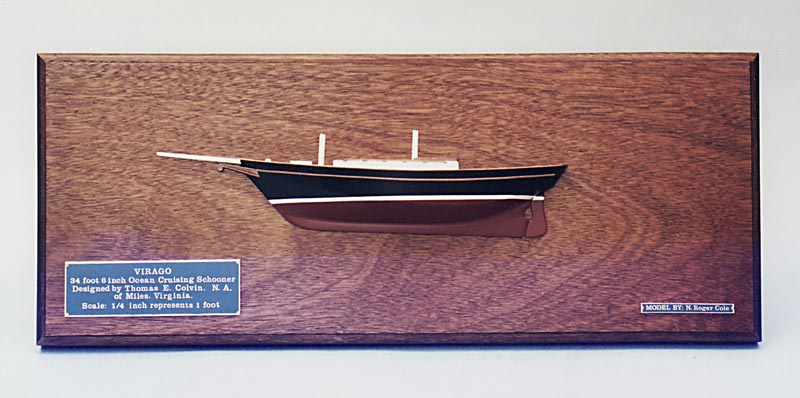
Virago (half model)—A
very small model with a hull length of 8 inches, modeled on a ferro-cement
boat built in Nova Scotia. To represent the teak deck and furnishings I
used Red Gum, a wood commonly found in older buildings in the Toronto area
for trim work such as door frames, moldings, etc. It finishes to a very
good representation of a miniature-grained Teak.
The paint finish was air brushed using Floquil finishes to create the
desired effect, masking off the various parts of the hull while doing so. |
 |
Nova Scotia Pinky,
circa 1875 (half model)—The term "Pinky" comes from the distinctive
up-sweep to the stern bulwarks; this was known as a pink (pinque—denoting
its European origins) stern. It also provided a protected seat-of-ease for
the crew. Pinkies were used extensively on the Canadian and Northeast
coasts, normally for inshore fishing. They were extremely seaworthy boats.
This model is 13 inches long overall, excluding the bowsprit. It was laid
up with 1/4 inch Basswood lifts with each cut to its eventual shape. Once
glued up it was carved using templates to verify the true shape. The
bulwarks were added later. The finish consists of four coats of white
shellac which was rubbed down and waxed with Renaissance wax—a
conservators' wax. The tiller was heat bent to the desired shape. As with
all my name plates, this one was etched in my shop. |
 |
Sirius 28 (half model)—This model was
built to represent a production fiberglass boat and is 14 inches long. The
model was laid up and carved in the traditional manner from Hard Yellow
Poplar, a beautiful carving wood, which cannot be used for
naturally-finished work as it has an objectionable yellowish hue. However,
it is superb for work that will be painted. The finish consists of 14
hand-rubbed coats of lacquer, with the different colours blended so as to
avoid having the traditional raised edge where one colour begins or
ends. When a hand is run across the finish on this model, there is a
continuous smooth finish. |

 |
Edith Cavell, a tern
schooner (half
model)—Edith Cavell was named after the WWI nurse. This was a large
schooner and, as I recall, the hull length of the model was 26 inches. She
was also laid up from Basswood lifts ¼ inch thick with each lift or layer
cut to its shape on the hull. Once glued up, the hull was carved and
checked with templates to ensure accuracy. Cavell is fitted out beyond
the normal half-hull with turned stanchions (individually fitted), a
half-wheel, etc. and three stub masts. The tern schooners were all
Canadian and had all three masts exactly the same height, hence the term
tern, meaning three.
This hull was finished with a blend of three
coats of clear Floquil finishes and was then waxed with Renaissance wax
and polished to create a soft sheen and to provide protection. |
1
2
3 |
Beetle Whaleboat
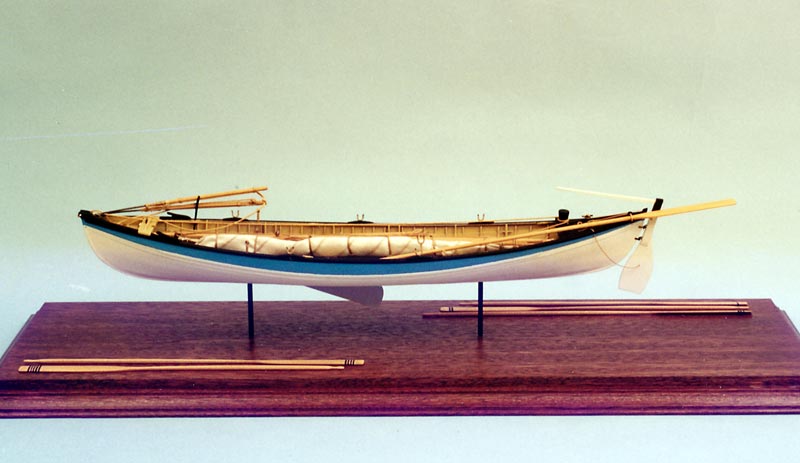
Photo 1—Port side view: This was a Beetle whaleboat, so-called as they were built
by Charles Beetle, a whaleboat builder from New Bedford, Massachusetts; in
fact, the name “Beetle” was burned into two places on the completed
boats. This model was built to a scale where 1/2-inch represents one foot
and was the subject of a two-part series of articles published in Seaways
Journal of Maritime History. The model was based on the last boat Beetle
built. On completion, it was shipped to the Mariners' Museum where it can
still be seen today.
Photo 2—Midships and a look
at the gear: The gear aboard a whaleboat was
highly specialized and included not just harpoons used to fasten to a
whale and the lances that were used to kill the creature, but also the
line tubs. In this case the tubs were built with individual staves, as
were the baling scoop and the fresh water keg. The harpoons and lance
tips, the boat knife and hatchet head were made from nickel silver,
oxidized to a soft patina representing age, and the edges were then
polished to simulate having been recently sharpened.
Photo 3—Interior detail: Whaleboats were ceiled inside, meaning that they were planked inside and
outside the frames. This model is also an example of a painted model as
opposed to being polished Boxwood. At the right-hand end of the last
photo of the interior of the boat the compass can be seen, required for
situations where a boat lost sight of its parent ship. The compass in this model boat was gimbaled as were
the real ones. There are paddles in the bottom of the boat used when
quietly approaching a whale on the surface. All of the equipment has been
aged to represent usage. |
 |
While this model was built to be displayed on a regular base and mounted
on posts, Roger decided to see what it would look like set up on a simulated
beach. This was done in his basement, on a piece of cardboard with a layer
of sand scattered on it and two different coloured backdrops.
The model is
fourteen inches long. |
|
1
2
3
4 |
Benjamin W. Latham
Photo
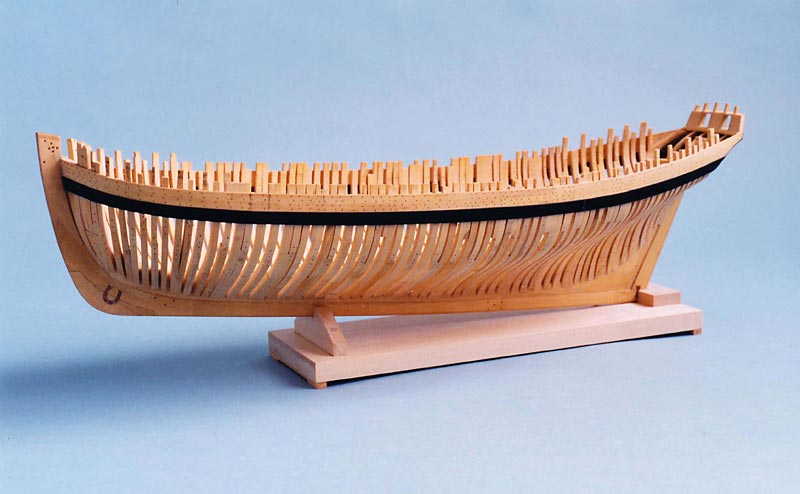
1—Hull framing: The hull was
framed in sugar maple with the keel, stem and sternpost of Columbian
Boxwood. The planking rabbett has been cut into the keel and sternpost,
along with the cutouts for the gudgeons, and the top of the sternpost has
been hollowed out to accommodate the rudder plugstock. The framing and
deck have been faired and are now ready for planking.
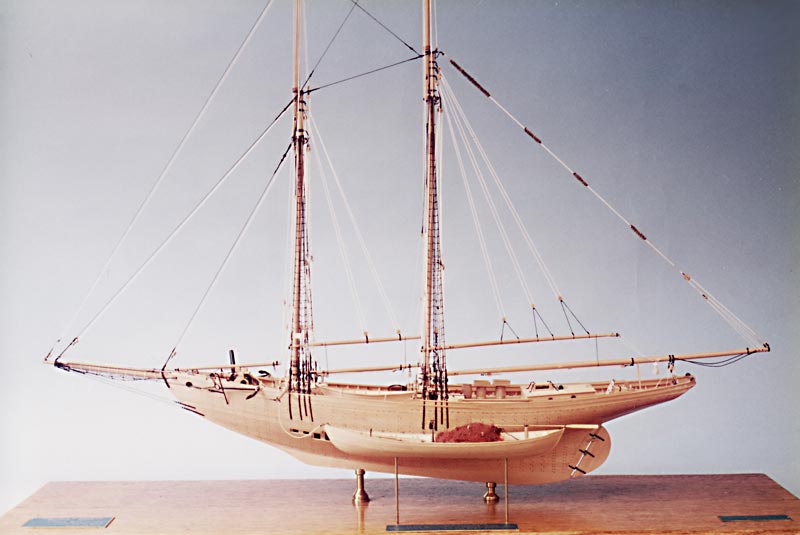
Photo 2—Overall view from the port side: Built to a
scale where ¼ inch represents one foot, this model was Roger's first scratch built model after an absence of seventeen years. All fittings were
also scratch built, including stud-link anchor chain. The hull is planked
in Columbian Boxwood, the deck is individually planked with Virginia
Holly, the spars are Degame, also known as Lancewood and False Boxwood.
Planking has been left off to reveal the hull framing; part of this cutout
can be seen behind the seine boat in photo 3. Latham was the
subject of an eight-part series of articles in Seaways Journal of
Maritime History.
Benjamin W.
Latham was awarded the Bronze Medal in the Scratch built Category in the
1980 International Ship Model Competition held at The Mariners' Museum in
Newport News, Virginia.
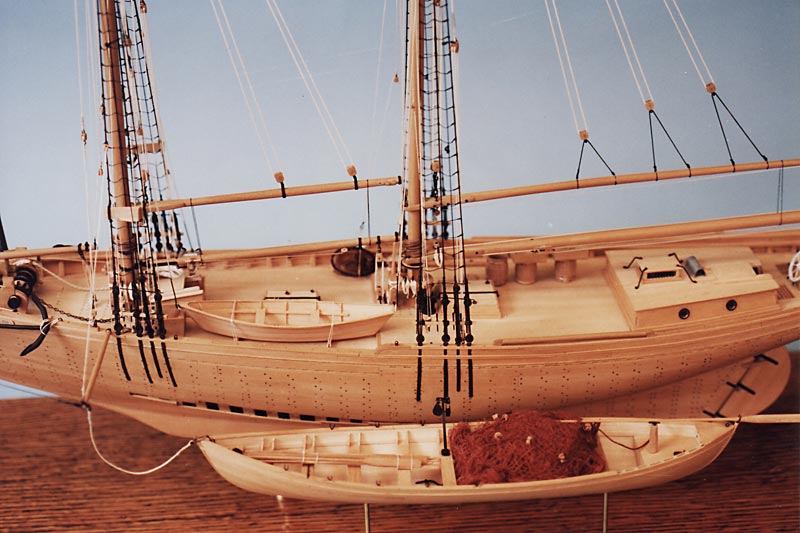
Photo 3—Showing the deck and Seine boat detail: The planking
thickness and framing can be seen in this view. The dory is stowed on
deck, while the seine boat is shown secured to the boat boom. The deck is
laid in individual holly planks which, in this case, were not dowelled.
On-deck detail includes the dip net used to lift mackerel from the seine
boat to the deck of the schooner, and the barrels set up ready to clean
the fish before they were packed ready for market. Including such detail
in a Boxwood model is not traditional but is an important part of telling
the story of the vessel.
Photo 4—Seen from the starboard side: Benjamin W.
Latham was a small mackerel seining schooner built in 1902. Designed for
Captain Henry Langworthy of Noank, Connecticut by Thomas McManus of
Boston; she was built in the yard of Tarr and James in Essex,
Massachusetts. Small, she measured 72 tons gross. This view reveals her
lines to advantage along with the fact that her hull planking is trunnel
or dowel fastened. |

New
Submissions Welcomed
If you have additional
information on a project or builder
shown on this site that your would like
to contribute, please e-mail craig@CraftsmanshipMuseum.com.
We also welcome new contributions.
Please see our page at www.CraftsmanshipMuseum.com/newsubmit.htm
for a submission form and guidelines for
submitting descriptive copy and photos
for a new project.

This
section is not yet sponsored
To
learn how your company or organization
can sponsor a section in the
Craftsmanship Museum, please contact craig@CraftsmanshipMuseum.com.
RETURN
TO MUSEUM HOME PAGE
Copyright 2010, The Joe Martin Foundation for Exceptional Craftsmanship. All
rights reserved.
No part of this web site, including the text, photos or illustrations, may be
reproduced or transmitted in any other form or by any means (electronic,
photocopying, recording or otherwise) for commercial use without the prior
written permission of The Joe Martin Foundation. Reproduction or reuse for
educational and non-commercial use is permitted.