
Early Engine Developer is Best Known as “The Father of the Glow Plug.”
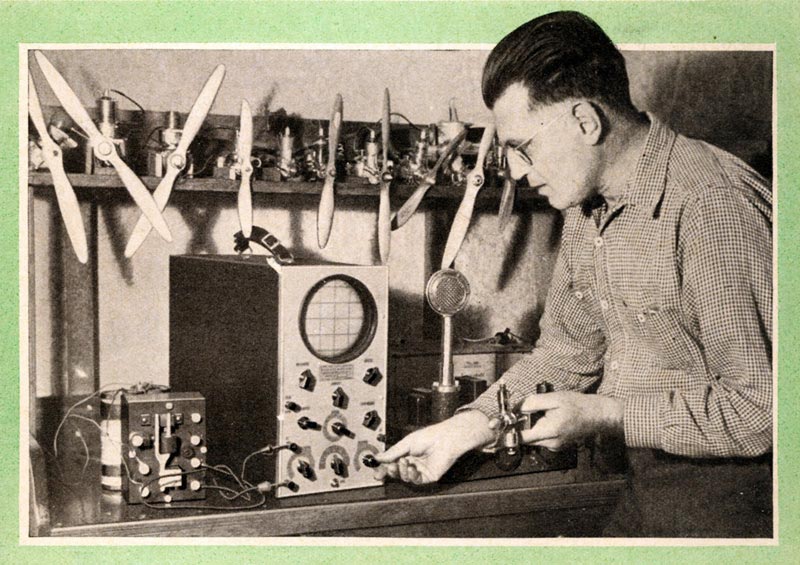
Few photos of Ray Arden can be found. This one is from a 1939 issue of Popular Science. The caption reads: “Here Arden is using a cathode-ray oscillograph to measure the efficiency of one of his power plants. Such tests have shown that his latest product, which weighs only an eighth of an ounce, is more efficient, for cubic inch of cylinder space, than the best modern two-cycle motor-boat engines!”
Introduction:
The following information about Ray Arden was mostly gathered from a few secondary sources. A significant amount of this biographical info was drawn from the Model Aviation Hall of Fame application submitted by Charlie Reich in 2004. Much of the rest of Ray’s background and history was pulled from other submissions by Academy of Model Aeronautics (AMA) members as noted. For more details on Ray Arden, see this short biography that was written and posted by the AMA. Ray’s impactful contribution to the model engine world is his significant work in the development of the glow ignition.
Few photographs of Ray Arden were available at the time of this writing. If anyone viewing this site has a photo of Ray or his engines, we welcome your submissions, and would be glad to add them with appropriate credits.
Biography:
Thomas Ray Arden was born in New York on February 24, 1890. He was a prolific inventor and innovator throughout his life, but is perhaps best remembered in the field of model aeronautics. Ray would become well-known in that field not only for his engine designs, but most importantly for his development of the glow plug ignition.
It seems that Ray was good with his hands right from the start. It’s reported that he started making his own models of vehicles and boats at the early age of five. By age eleven he had built his first rubber powered model airplane from magazine plans. However, his prowess with tools did not necessarily translate to good academic performance, as he had to repeat some grades several times at Public School 63 in the Bronx.
Viewing an Early Model Engine Changes Arden’s Life Focus
In 1907, at the age of 17, Ray attended a sportsman show in Madison Square Garden that would change his life. At the show he observed an early model aircraft engine developed by A.N. Herring. Herring, like the Wright Brothers at the time, was competing to be the first person to achieve powered manned flight. Ray studied Herring’s 2-pound gas engine, which was mounted in a miniature biplane. He stared at it all day long, and would return many times (often skipping school to do so). Ray would buy tickets or simply sneak in to stare at the motor with the dream of building his own. Eventually, he got the opportunity to talk to Mr. Herring and boldly informed him, “Someday I will make the smallest engine ever built.”
That same year Ray managed to make his first gas engine, and it weighed about half that of Herring’s engine. Working in his family kitchen and home shop, Ray also designed a revolutionary vibrating spark coil and condenser. It weighed less than two ounces. In order to combat the characteristic high-speed miss of the jump-spark ignition, he used an early version of glow ignition. This supplemented but did not replace the spark plug. In 1908, Ray designed and successfully flew a biplane powered by this engine.
A few years later, in 1910, Ray designed a two-cylinder model engine weighing only fourteen ounces. Eventually, after 25 years of experimentation, he would be able to get the engine weight down to a mere two ounces!
In his biography of Ray Arden on the Academy of Model Aeronautics web site, Charlie Reich notes the following:
After graduation Ray’s career blossomed as an inventor with somewhere between 300 and 400 inventions sold through the 1920s. In the 1930s Ray formed a company called Ultrad Products to design and develop new products, primarily new toys in which Ray held a particular fascination. When a toy train manufacturer became interested in the possibilities of developing a miniature gas engine Ray was steered back to his natural field. A revolutionary valve-in-piston engine resulted and the Arden-designed Mighty Atom .097 ignition engine was introduced in 1939. After introduction of the first Mighty Atom he continued to improve on the design and offered three additional progressively improved versions then called Super Atoms.
Getting Into the Model Engine Business at the Right Time
From the time that the United States entered World War II in 1941 until the final surrender of Japan in 1945, the model business was essentially put on hold. However, after the war ended thousands of soldiers returned from the German and Pacific theaters, and they were hungry for any recreation related to flying. Along with the return of soldiers, the post-war era meant that the government could halt restrictions on resources like Methanol (which could be used as model fuel). The market was ripe for model aircraft products, so Ray was in the right place at the right time as an inventor. He immediately went to work producing his revolutionary Arden .099 and .199 IC engines, which were introduced in 1946. Their lightweight compact size made them instantly popular with modelers.

Ray Arden with a home-made propeller from one of his engines. Photo: Popular Science.
An Accident Leads to the Discovery of the Glow Plug Ignition
At the same time that Ray was beginning to build these engines, the development of more potent fuels was under way. While Ray was sampling over 500 blends of methanol-based fuels, his friend Ed Chamberlin and Ben Shereshaw had developed a hot new fuel that they were calling “Liquid Dynamite.” By chance, while Ben and Ed were testing some of the new fuel on one of his Bantam .19 engines, they decided to shut off the ignition. Instead of stopping, the engine just kept running. So they manually shut down the engine and quickly removed the spark plug. They found that the plug’s ground strap had broken, and the center electrode was still glowing red hot—keeping the engine firing.
Ed immediately informed Ray of this exciting discovery, and both Ben and Ray started trying different glow plug designs. Ben’s first choice of wire for the electrode was Nichrome, which worked well but burned out quickly. After experimenting with many different materials, Ray finally settled on a two-piece glow plug with a replaceable element made from platinum and iridium. When used with a methanol-based fuel this element would not burn out.
At this point, Charlie Reich notes:
Ray quickly introduced his second series of Arden engines, ceasing production on the clear plastic fuel tanks, which melted when using the hot new glow fuel. The 1947 engines offered the new, fuel impervious, black fuel tanks and the Arden engines were thereafter only offered in the ball-bearing version to take the additional stress and rpm’s created by the hot new glow fuel. At the 1947 control line Junior Air Races in Cleveland, Ohio rumors started circulating that a man was selling a new gadget out of the trunk of his car. Word was that he had this “Gold Plug”—a replacement for our Champion Spark Plug, and that we could throw away our coils, condensers, points and batteries! Of course, it was Ray Arden with his new “Arden Glow Plug”, and modeling was forever changed! Ray Arden formally introduced the plug a month later at the Nationals in Minneapolis.
Between 1947 and 1948, Ray transferred the rights for his glow plug to Ben Shereshaw. Ben then sold the Bantam engine manufacturing rights, spare parts, and tooling to the OK-Herkimer Company. His agreement included a provision whereby he would manufacture the newly designed glow plug for them in his Miniature Motors plant. The plugs would then be sold under the OK-Herkimer brand name. The Miniature Motors plant quickly started producing a line of new glow plugs known as OK brand XL Glow Plugs.
Ray Arden retired from the engine and glow plug manufacturing business in 1948, but in all likelihood continued to invent and design until his death in 1965.
View an article about Ray Arden from 1939:
An article appeared in a 1939 issue of Popular Science magazine that tells more about Ray and his engines. Our thanks to MECA (Model Engine Collectors Assn.) member Eugene Ethier for the donation of the magazine to our library museum.
The following note on the unfortunate fate of Ray’s engine tooling comes from Victor G. Didelot, courtesy of Tandy Walker:
Ray Arden passed away in 1965, while still living in Danbury, CT. After Ray’s death, his wife retained all of the Atom and Arden tooling for several years. However there was an unusual Connecticut law enforced at that time that required her to provide semi-annual financial statements to the state. Even though the engines were no longer in production, this was still a requirement because she owned the tooling that could produce these engines. To put a stop to this difficult task of providing these financial statements each year, she had all of the Atom and Arden tooling destroyed. Shortly thereafter, the state of Connecticut did away with that law!
See a few of Ray’s engines which are on display at the museum.